Ellen Schultz - Retirement Heist
Здесь есть возможность читать онлайн «Ellen Schultz - Retirement Heist» весь текст электронной книги совершенно бесплатно (целиком полную версию без сокращений). В некоторых случаях можно слушать аудио, скачать через торрент в формате fb2 и присутствует краткое содержание. Город: New York, Год выпуска: 2011, ISBN: 2011, Издательство: Penguin Group, Жанр: economics, org_behavior, на английском языке. Описание произведения, (предисловие) а так же отзывы посетителей доступны на портале библиотеки ЛибКат.
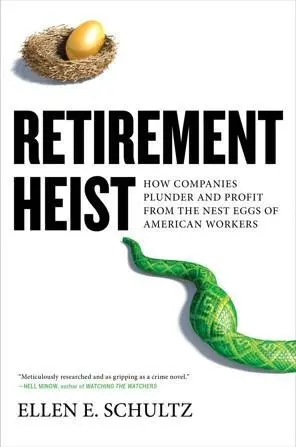
- Название:Retirement Heist
- Автор:
- Издательство:Penguin Group
- Жанр:
- Год:2011
- Город:New York
- ISBN:978-1-101-44607-2
- Рейтинг книги:3 / 5. Голосов: 1
-
Избранное:Добавить в избранное
- Отзывы:
-
Ваша оценка:
Retirement Heist: краткое содержание, описание и аннотация
Предлагаем к чтению аннотацию, описание, краткое содержание или предисловие (зависит от того, что написал сам автор книги «Retirement Heist»). Если вы не нашли необходимую информацию о книге — напишите в комментариях, мы постараемся отыскать её.
It’s no secret that hundreds of companies have been slashing pensions and health coverage earned by millions of retirees. Employers blame an aging workforce, stock market losses, and spiraling costs- what they call “a perfect storm” of external forces that has forced them to take drastic measures.
But this so-called retirement crisis is no accident. Ellen E. Schultz, award-winning investigative reporter for the
, reveals how large companies and the retirement industry-benefits consultants, insurance companies, and banks-have all played a huge and hidden role in the death spiral of American pensions and benefits.
A little over a decade ago, most companies had more than enough set aside to pay the benefits earned by two generations of workers, no matter how long they lived. But by exploiting loopholes, ambiguous regulations, and new accounting rules, companies essentially turned their pension plans into piggy banks, tax shelters, and profit centers.
Drawing on original analysis of company data, government filings, internal corporate documents, and confidential memos, Schultz uncovers decades of widespread deception during which employers have exaggerated their retiree burdens while lobbying for government handouts, secretly cutting pensions, tricking employees, and misleading shareholders. She reveals how companies:
Siphon billions of dollars from their pension plans to finance downsizings and sell the assets in merger deals
• Overstate the burden of rank-and-file retiree obligations to justify benefits cuts while simultaneously using the savings to inflate executive pay and pensions
• Hide their growing executive pension liabilities, which at some companies now exceed the liabilities for the regular pension plans
• Purchase billions of dollars of life insurance on workers and use the policies as informal executive pension funds. When the insured workers and retirees die, the company collects tax-free death benefits
• Preemptively sue retirees after cutting retiree health benefits and use other legal strategies to erode their legal protections.
Though the focus is on large companies—which drive the legislative agenda-the same games are being played at smaller companies, non-profits, public pensions plans and retirement systems overseas. Nor is this a partisan issue: employees of all political persuasions and income levels-from managers to miners, pro-football players to pilots-have been slammed.
Retirement Heist
Retirement Heist — читать онлайн бесплатно полную книгу (весь текст) целиком
Ниже представлен текст книги, разбитый по страницам. Система сохранения места последней прочитанной страницы, позволяет с удобством читать онлайн бесплатно книгу «Retirement Heist», без необходимости каждый раз заново искать на чём Вы остановились. Поставьте закладку, и сможете в любой момент перейти на страницу, на которой закончили чтение.
Интервал:
Закладка:
Retirees were told to complete a form so that payments could be deducted from their pension checks; if they failed to return the form within two weeks, the company would terminate their benefits. Chapman worried that some of the less literate retirees “in the hollows” might not understand the letter or respond to it, and spent hours on the phone making sure they turned it in.
The Steelworkers union countersued in federal court in Huntington, West Virginia, to dismiss ACF’s complaint, contending that ACF had gone through “the charade of telephoning retiree Chapman about the cuts, just so it could provoke a predictable negative reaction and then use the reaction to immediately sue.”
The retirees’ suit also complained that ACF was suing not because it had been harassed but as a preemptive strike “to beat its own retirees to the courthouse,” and chose St. Louis because “ACF apparently believes that the Eighth Circuit is more favorable to employers in retiree medical benefits cases, and apparently feels that its chances are improved if it makes the retirees litigate hundreds of miles from their homes.”
In 2004, the court in St. Louis said that ACF’s move had “resulted in a proverbial race to the courthouse in order to deprive defendants of their choice of forum” and moved the case to federal court in Huntington, West Virginia. ACF may have lost its chosen venue, but it won the case anyway. The retirees appealed, and the case settled, with retirees paying more for their coverage than before.
Chapter 11
IN DENIAL
Incentives to Withhold Benefits
AFTER FORTY-TWO YEARSworking in a coal mine, Elmer Daugherty could barely breathe. Doctors told him he had pneumoconiosis, commonly called black lung disease, a disabling, incurable ailment that has killed ten thousand miners over the past decade. His employer, Constellation Energy, provides disability and workers’ compensation for those injured or sickened on the job. It also provides black lung disease coverage, a benefit mandated by Congress.
Daugherty applied for black lung benefits in 2001, but the company denied his claim. Over the next three years, Daugherty was examined by nine different pulmonologists, underwent a battery of painful tests, and had more than thirty X-rays. Even though most of the doctors agreed he had black lung caused by his years in a coal mine, the company continued to deny his claim. He died in 2005.
Daugherty’s struggle to be awarded black lung benefits wasn’t unusual. Industry-wide, only fifteen claims in one hundred are paid. Providing benefits wouldn’t have put a dent in Constellation’s finances: Black lung is such a common outcome of working in coal mines that the federal government requires coal companies to pay into a central fund, run by the Labor Department, to finance the benefits.
But black lung coverage has something else is common with pensions: it’s a “postretirement obligation,” and under accounting rules is treated like other retiree liabilities, including retiree health care, long term disability, executive supplemental pensions, and deferred compensation. Coal producers must estimate the amounts they will likely pay over their afflicted miner’s lives, as short as they may be, and record that obligation on their financial statements.
These accounting rules, which reward employers for cutting retiree benefits, also provide them with an incentive to prevent workers and retirees from collecting benefits in the first place. Denying claims doesn’t just save coal companies money, it also helps the bottom line.
Consider the black lung obligations at Console Energy, one of the largest coal producers in the country. The $185 million “coal workers’ pneumoconiosis” obligation is calculated using assumptions including the incidence of disability, medical costs, mortality, death benefits, and interest rates.
But because the company has been so successful in denying claims, it has a pool of actuarial gains to draw on each year to offset the expense of its black lung obligation. As the company puts it in its financial disclosures: The gains are the result of “lower approval rates for filed claims than our assumptions originally reflected.” In 2010, Console recognized $21.6 million in gains; as far as accounting rules go, gains from denying benefits to dying miners are no different from profits from selling coal and methane gas.
In an effort to get the coal industry to shoulder more of the costs for its afflicted workers, the Patient Protection and Affordable Care Act of 2010 created new rules to make it harder for coal companies to deny claims. For one thing, the new law established the legal presumption that miners suffering from totally disabling black lung disease who have worked at least fifteen years in coal mines, have, in fact, contracted the disease on the job, not from smoking, living with a smoker, or some other means. And rather than a miner’s having to prove he contracted the disease by breathing coal dust, under the new law, a coal company that wants to deny benefits has to prove that a miner doesn’t have black lung disease or didn’t contract it from breathing coal dust. Coal companies are also required to continue paying benefits to dependent survivors, even if the miners with black lung disease die from something else, such as lung cancer.
Console Energy estimated that the impact of the new law increased its black lung liability by $45.7 million. But thanks to the flexibility built into benefits accounting, this didn’t hurt earnings. As the company explains, somewhat obliquely, in its financial disclosures, “In conjunction with the law change, Console Energy conducted an extensive experience study regarding the rate of claim incidence. Based on historical company data and industry data, with emphasis on recent history, certain assumptions were revised,” it says. “Most notably, the expected number of claims, prior to the law change, was reduced to more appropriately reflect Console Energy’s historical experience… This resulted in a decrease in the liability of $47.7 million.”
In other words, the company retrofitted its assumptions, which not only kept its black lung obligation from increasing but actually reduced it by $2 million. Combined with gains it took from denying benefits to dying miners in the past, the company reported income of $3.5 million for its black lung benefits program in 2010.
Only in the alternative universe of postretirement benefits accounting can a company profit from its black lung benefits plan. And Console Energy will likely continue to do so. The company disclosure is basically telling the world that while the company may be required to pay benefits to more old-timers, it will find ways to more aggressively deny them to everyone else.
Massey Energy, another giant coal producer, didn’t go through the same actuarial acrobatics. It reported a $98 million obligation for “traumatic workers’ compensation” benefits, which is what the company estimates it will pay for black lung, crushed limbs, and other traumatic injuries one might expect to find in mines that have racked up thousands of safety violations.
As for its black lung benefits, it estimated that the new law would increase its obligation by only $11.3 million, pushing its total black lung obligation to $77 million. “We do not believe the impact of these changes will significantly impact our financial position,” its filings said. The total amount Massey Energy paid out to miners for their black lung benefits in 2010 was just $2.4 million.
To put this into perspective, compare it with what the company spent for a single Massey retiree, chief executive Don Blankenship, who stepped down in December 2010. During his eighteen years as CEO, Blankenship aggressively promoted “mountaintop removal,” the practice of blowing off the tops of mountains to uncover seams of coal, and was at the helm when one of the company’s slurry ponds spilled 300 million gallons of toxic sludge into nearby streams, an event the EPA calls the worst man-made environmental catastrophe in the Southeast.
Читать дальшеИнтервал:
Закладка:
Похожие книги на «Retirement Heist»
Представляем Вашему вниманию похожие книги на «Retirement Heist» списком для выбора. Мы отобрали схожую по названию и смыслу литературу в надежде предоставить читателям больше вариантов отыскать новые, интересные, ещё непрочитанные произведения.









Обсуждение, отзывы о книге «Retirement Heist» и просто собственные мнения читателей. Оставьте ваши комментарии, напишите, что Вы думаете о произведении, его смысле или главных героях. Укажите что конкретно понравилось, а что нет, и почему Вы так считаете.