Ellen Schultz - Retirement Heist
Здесь есть возможность читать онлайн «Ellen Schultz - Retirement Heist» весь текст электронной книги совершенно бесплатно (целиком полную версию без сокращений). В некоторых случаях можно слушать аудио, скачать через торрент в формате fb2 и присутствует краткое содержание. Город: New York, Год выпуска: 2011, ISBN: 2011, Издательство: Penguin Group, Жанр: economics, org_behavior, на английском языке. Описание произведения, (предисловие) а так же отзывы посетителей доступны на портале библиотеки ЛибКат.
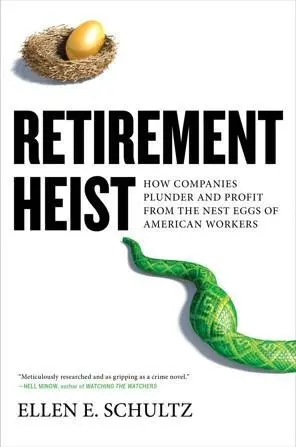
- Название:Retirement Heist
- Автор:
- Издательство:Penguin Group
- Жанр:
- Год:2011
- Город:New York
- ISBN:978-1-101-44607-2
- Рейтинг книги:3 / 5. Голосов: 1
-
Избранное:Добавить в избранное
- Отзывы:
-
Ваша оценка:
Retirement Heist: краткое содержание, описание и аннотация
Предлагаем к чтению аннотацию, описание, краткое содержание или предисловие (зависит от того, что написал сам автор книги «Retirement Heist»). Если вы не нашли необходимую информацию о книге — напишите в комментариях, мы постараемся отыскать её.
It’s no secret that hundreds of companies have been slashing pensions and health coverage earned by millions of retirees. Employers blame an aging workforce, stock market losses, and spiraling costs- what they call “a perfect storm” of external forces that has forced them to take drastic measures.
But this so-called retirement crisis is no accident. Ellen E. Schultz, award-winning investigative reporter for the
, reveals how large companies and the retirement industry-benefits consultants, insurance companies, and banks-have all played a huge and hidden role in the death spiral of American pensions and benefits.
A little over a decade ago, most companies had more than enough set aside to pay the benefits earned by two generations of workers, no matter how long they lived. But by exploiting loopholes, ambiguous regulations, and new accounting rules, companies essentially turned their pension plans into piggy banks, tax shelters, and profit centers.
Drawing on original analysis of company data, government filings, internal corporate documents, and confidential memos, Schultz uncovers decades of widespread deception during which employers have exaggerated their retiree burdens while lobbying for government handouts, secretly cutting pensions, tricking employees, and misleading shareholders. She reveals how companies:
Siphon billions of dollars from their pension plans to finance downsizings and sell the assets in merger deals
• Overstate the burden of rank-and-file retiree obligations to justify benefits cuts while simultaneously using the savings to inflate executive pay and pensions
• Hide their growing executive pension liabilities, which at some companies now exceed the liabilities for the regular pension plans
• Purchase billions of dollars of life insurance on workers and use the policies as informal executive pension funds. When the insured workers and retirees die, the company collects tax-free death benefits
• Preemptively sue retirees after cutting retiree health benefits and use other legal strategies to erode their legal protections.
Though the focus is on large companies—which drive the legislative agenda-the same games are being played at smaller companies, non-profits, public pensions plans and retirement systems overseas. Nor is this a partisan issue: employees of all political persuasions and income levels-from managers to miners, pro-football players to pilots-have been slammed.
Retirement Heist
Retirement Heist — читать онлайн бесплатно полную книгу (весь текст) целиком
Ниже представлен текст книги, разбитый по страницам. Система сохранения места последней прочитанной страницы, позволяет с удобством читать онлайн бесплатно книгу «Retirement Heist», без необходимости каждый раз заново искать на чём Вы остановились. Поставьте закладку, и сможете в любой момент перейти на страницу, на которой закончили чтение.
Интервал:
Закладка:
Though healthy for shareholders, the company’s practices haven’t been healthy for miners—or their families and neighbors, who have complained that poisoned groundwater has caused a litany of illnesses. Fatal mine accidents have been common, including the worst mining accident in forty years: the explosion at the Upper Big Branch mine in 2010, which killed twenty-nine miners. After the tragedy, shareholders sued Blankenship and the board of directors for mismanagement, and the Justice Department launched a criminal investigation into the Big Branch disaster.
In the wake of all this, Blankenship decided to retire, a decision for which the board awarded him $12 million in cash. He’ll also collect a pension worth at least $5.6 million, and $27.2 million in deferred compensation, which was on top of $10.4 million in pay. He can remain, rent-free, in a company-owned home in Sprigg, West Virginia, a property well protected by steel fences and security cameras. He’ll retain his company office, plus a full-time secretary. And he gets to keep a 1965 blue Chevrolet truck.
Blankenship will likely be healthier than most of his neighbors. Rolling Stone reported that Massey Energy constructed a pipeline to bring potable water from Matewan to Blankenship’s home. Corporate filings show that should he get sick, the company will pay 100 percent of the health coverage for him and his family.
The total payout for all this in 2010? More than $55 million.
The total the company paid its retired coal miners in 2010 for black lung, traumatic workers’ compensation, and other retiree benefits: $37 million.
HOLDING THE LINE
Profits may motivate many employers to hold the line on awarding pensions, retiree health care, or disability. Pension law helps them tackle retirees who push back.
Victor Washington, a former San Francisco 49ers running back, spent most of his life fighting the NFL for disability benefits. His battle illustrates how federal benefits law, ERISA, though intended to protect workers, has become a legal shield for employers, enabling them to deny benefits with no penalty—and even finance their legal defense using pension assets.
Football was Washington’s ticket out of the rougher towns of northern New Jersey, where he’d spent part of his teen years in an orphanage in Elizabeth. A college scholarship eventually led to the 49ers, who picked him in the 1970 NFL draft. He was the team’s rookie of the year in 1971–72 and went to the Pro Bowl at the end of the season. The fivefoot-eleven, 195-pound Washington later played for the Houston Oilers and Buffalo Bills. Playing as a running back, defensive back, and wide receiver, he took the field against the likes of Joe Namath, Terry Bradshaw, and O.J. Simpson. At his peak, he was earning about $50,000 a year. When he racked up injuries to a shoulder (in 1973), back (1974), and elbow (1976), he says teams gave him painkillers and Valium so he could keep playing. “I took every play like it was my last play—that’s the only way to play,” Washington says.
Washington left the game the same way most players do: He was too injured to play. Knee trouble sidelined him for good in 1976. He’d lasted longer than most: Players on average leave after 3.2 years, often after multiple injuries. Players from the 1960s to the 1980s are a particularly busted-up bunch, having played on artificial turf that was little more than a carpet over poured concrete, in flimsy helmets and protective gear that provided little protection to someone who was rammed in the head by opposing players using the kinds of maneuvers that have since been banned. Concussions were regarded as badges of honor and, to keep players in the game, doctors doped them up with amphetamines and painkillers and looked the other way when players bulked up on steroids, oblivious to the long-term effects.
When Washington left pro football, he was thirty years old and had no other marketable skills. His marriage unraveled, and he moved in with his grandmother in New Jersey. He enrolled in business courses at a community college, but, in pain and depressed, he couldn’t concentrate or sit still. It would take more than two decades for the league to acknowledge that concussions cause brain damage. Seven years after leaving the game, Washington, who didn’t have health coverage and couldn’t afford physical therapy, applied for football disability benefits and went through the gauntlet of doctors the league hires to evaluate players’ claims. Orthopedists hired by the NFL plan enumerated his ailments, which included arthritis, degenerative joint disease, and an inability to fully extend one knee. A Rutgers University professor of psychiatry hired by the NFL concluded that depression and difficulty with concentration, “combined with his physical injury and significant pain (both knee and back) indeed render him disabled by his football related injuries.”
One would think that awarding the benefits would be a simple call. But league officials, though agreeing that Washington had a disability, deemed that it wasn’t football-related, so his benefit would be $750 a month instead of $4,000. [18] The football disability benefit increased to $5,585 in December 1994, $6,835 in April 1997, and $7,667 in April 2000.
Washington appealed, and after more medical reviews, league doctors again concluded that Washington was disabled totally by football injuries. The determination went to the trustees for a vote, and they deadlocked: Three trustees representing players agreed his disability was caused by football; team-owner trustees said that Washington’s problems were the result of a crummy childhood, a failed marriage, and money troubles. It was all in his head—but not the result of a concussion. In 1986, three years after Washington first applied for benefits, the decision went to an arbitrator, who noted that the plan defined a football-related disability as being the result of “a football injury.” Focusing on the word “a,” the arbitrator said this meant a former player had to have a single injury to be eligible for football-related disability benefits. Because Washington had several injuries, he was out of luck.
TIME OUT
Based on this creative interpretation, the NFL plan denied the claims of many other former players that were pending at the time. If Washington’s claim had been brought before a state court, it would have come under state insurance laws regarding unfair claims denials, where a judge may have concluded that the arbitrator’s decision was “arbitrary and capricious,” a legal standard referring to a decision that has no reasonable basis.
But employees benefits cases fall under ERISA, which “preempts,” or overrides, state laws, including insurance laws about fairness. Where does that leave plaintiffs? In a black hole.
When Congress created ERISA in 1974, it assumed that the law would apply to pension plans, so it granted trustees of a pension plan broad “discretion” to make decisions, such as how to invest money and how to determine who is eligible for benefits. When it comes to pensions, this can be a straightforward decision: If the rules say that a person who works five years is eligible for a pension, then he’s eligible.
But in 1987, the Supreme Court ruled that ERISA covers not only pensions but other benefits, such as medical and disability plans. Suddenly, trustees were deciding what constitutes a disability. But few players have disabilities as clear-cut as those of wide receiver Darryl Stingley, who was paralyzed during a preseason game in 1978. The more common injuries cited in disability claims—cervical-spine injuries, osteoarthritis, and knee, hip, and other joint injuries—can’t be as easily measured. Debilitating problems may not show up for years and can be exacerbated by the use of painkillers and steroids, along with substance abuse.
Читать дальшеИнтервал:
Закладка:
Похожие книги на «Retirement Heist»
Представляем Вашему вниманию похожие книги на «Retirement Heist» списком для выбора. Мы отобрали схожую по названию и смыслу литературу в надежде предоставить читателям больше вариантов отыскать новые, интересные, ещё непрочитанные произведения.




Обсуждение, отзывы о книге «Retirement Heist» и просто собственные мнения читателей. Оставьте ваши комментарии, напишите, что Вы думаете о произведении, его смысле или главных героях. Укажите что конкретно понравилось, а что нет, и почему Вы так считаете.