Ellen Schultz - Retirement Heist
Здесь есть возможность читать онлайн «Ellen Schultz - Retirement Heist» весь текст электронной книги совершенно бесплатно (целиком полную версию без сокращений). В некоторых случаях можно слушать аудио, скачать через торрент в формате fb2 и присутствует краткое содержание. Город: New York, Год выпуска: 2011, ISBN: 2011, Издательство: Penguin Group, Жанр: economics, org_behavior, на английском языке. Описание произведения, (предисловие) а так же отзывы посетителей доступны на портале библиотеки ЛибКат.
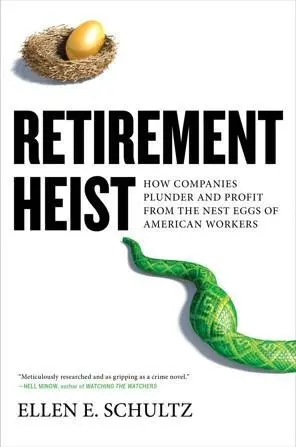
- Название:Retirement Heist
- Автор:
- Издательство:Penguin Group
- Жанр:
- Год:2011
- Город:New York
- ISBN:978-1-101-44607-2
- Рейтинг книги:3 / 5. Голосов: 1
-
Избранное:Добавить в избранное
- Отзывы:
-
Ваша оценка:
Retirement Heist: краткое содержание, описание и аннотация
Предлагаем к чтению аннотацию, описание, краткое содержание или предисловие (зависит от того, что написал сам автор книги «Retirement Heist»). Если вы не нашли необходимую информацию о книге — напишите в комментариях, мы постараемся отыскать её.
It’s no secret that hundreds of companies have been slashing pensions and health coverage earned by millions of retirees. Employers blame an aging workforce, stock market losses, and spiraling costs- what they call “a perfect storm” of external forces that has forced them to take drastic measures.
But this so-called retirement crisis is no accident. Ellen E. Schultz, award-winning investigative reporter for the
, reveals how large companies and the retirement industry-benefits consultants, insurance companies, and banks-have all played a huge and hidden role in the death spiral of American pensions and benefits.
A little over a decade ago, most companies had more than enough set aside to pay the benefits earned by two generations of workers, no matter how long they lived. But by exploiting loopholes, ambiguous regulations, and new accounting rules, companies essentially turned their pension plans into piggy banks, tax shelters, and profit centers.
Drawing on original analysis of company data, government filings, internal corporate documents, and confidential memos, Schultz uncovers decades of widespread deception during which employers have exaggerated their retiree burdens while lobbying for government handouts, secretly cutting pensions, tricking employees, and misleading shareholders. She reveals how companies:
Siphon billions of dollars from their pension plans to finance downsizings and sell the assets in merger deals
• Overstate the burden of rank-and-file retiree obligations to justify benefits cuts while simultaneously using the savings to inflate executive pay and pensions
• Hide their growing executive pension liabilities, which at some companies now exceed the liabilities for the regular pension plans
• Purchase billions of dollars of life insurance on workers and use the policies as informal executive pension funds. When the insured workers and retirees die, the company collects tax-free death benefits
• Preemptively sue retirees after cutting retiree health benefits and use other legal strategies to erode their legal protections.
Though the focus is on large companies—which drive the legislative agenda-the same games are being played at smaller companies, non-profits, public pensions plans and retirement systems overseas. Nor is this a partisan issue: employees of all political persuasions and income levels-from managers to miners, pro-football players to pilots-have been slammed.
Retirement Heist
Retirement Heist — читать онлайн бесплатно полную книгу (весь текст) целиком
Ниже представлен текст книги, разбитый по страницам. Система сохранения места последней прочитанной страницы, позволяет с удобством читать онлайн бесплатно книгу «Retirement Heist», без необходимости каждый раз заново искать на чём Вы остановились. Поставьте закладку, и сможете в любой момент перейти на страницу, на которой закончили чтение.
Интервал:
Закладка:
When Washington later learned of the earlier case, he felt like he’d been duped into taking the settlement, and sued the league, asking a court to set aside his settlement on the ground that the NFL had breached a fiduciary duty by not telling him of the other decision five years earlier.
A STRONG DEFENSE
Washington was up against a tough team. To tackle players who file disability claims, the NFL has long relied on Groom Law Group, a Washington, D.C., law firm whose ranks include former officials from the Labor Department, the Treasury, and other agencies.
Groom’s star player in these football disputes is Douglas Ell, who has handled—and won—most of the NFL’s disability suits since 1994. Like other lawyers who defend plans, he said the trustees are only doing what the plan required to protect resources for everyone. “A lot of people say, ‘The evil NFL denies disability benefits,’ but that’s not the issue,” said Ell. “It’s whether the person met the terms of the plan.” There’s a reason the law gives the trustees the power to overrule the league’s own doctors. Without the legal protections ERISA provides employers, he said, they’d have to lower the benefits they pay, because they’d be paying ineligible claims. “The people running the plans shouldn’t be secondguessed by judges. We want to pay the player, not the lawyers.”
With Ell heading the NFL’s defense, the league has enjoyed an impressive winning streak in the courtroom. Of more than twenty lawsuits filed by retired players in the decade before Washington filed his suit, all but four were initially decided in favor of the NFL plan, and of those four, two were reversed on appeal.
Taking on the NFL, Washington faced a well-funded foe, as do most employees or retirees who challenge a pension decision: ERISA allows plan administrators to use pension assets to pay for fees associated with running the plans; these include fees to record keepers, investment managers, consultants, and… lawyers. Thus, the defense pockets are very deep. The NFL paid Groom Law Group $2.9 million from its pension assets in 2008, and roughly $25 million over the prior decade, though not all of that was for defense work. Former players, who may have little or no income other than Social Security disability benefits, usually crash into a wall when they try to find an attorney to represent them.
Like most people who initially flail about looking for legal help with their pensions, the players contact lawyers they pull from the Yellow Pages or Internet ads, oftentimes personal injury lawyers unfamiliar with the boggling quirks of the federal law—as evidenced by the fact that they often file the claims in state court, where they have a brief life.
Most people can’t afford hourly fees for an attorney, so they seek out lawyers who take cases on a contingency-fee basis. But few attorneys represent employees and retirees in ERISA cases because the most a plaintiff can recover is the benefit, not other damages that can finance the case. Yet another quirk of ERISA: The attorneys, if successful, are awarded fees only at the court’s discretion. Plaintiffs face a financial risk as well: If they lose, they could be required to pay the other side’s costs. Delvin Williams, a former 49ers and Miami Dolphins running back, successfully sued the NFL for seven years’ worth of back benefits, but the NFL appealed, and the Ninth Circuit not only reversed his victory but also ordered him to reimburse the NFL plan $75,000 for legal fees. The league’s plan deducts $625 a month from his disability checks. His debt will be paid off in 2012.
Washington had been fortunate enough to find an attorney willing to take his case on a contingency basis, and initially, it seemed as though he would prevail. In March 2005, a federal judge in Phoenix ruled that the NFL plan had breached a duty to Washington by not disclosing relevant facts. The judge ordered the NFL plan to reconsider Washington’s claim for football-related disability payments.
The league stalled, at one point saying they were suspending processing his claim until Washington sent twenty years’ worth of income tax returns. The league then appealed, and in 2007 the U.S. Ninth Circuit Court of Appeals reversed the lower court’s ruling and handed a victory to the NFL. Victor Washington’s long game in the courts was finally over.
Washington refused to believe it. He continued to mail copies of his records and appeals to lawmakers, the media, and anyone he thought would listen. He died of heart and renal failure in a Pennsylvania hospice on New Year’s Eve 2008. He was sixty-two. Elapsed time: twenty-eight years.
PENSION PARTISAN
Another quirk in ERISA ensures that most employees and retirees who dispute a benefits decision are knocked off the field before the game even starts. Before they can take a case to court, they must follow a lengthy claims-and-appeals procedure that can take months or years, trying to obtain critical documents and attempting to meet tricky deadlines.
And they must deal with the benefits clerks. Anyone who has waited on hold to talk to a benefits plan administrator at a call center in Bangalore knows what a Kafkaesque process this can be.
If anyone was up for the challenge, it was Fred Loewy. He had worked in a lab at Motorola Inc. near Phoenix, Arizona, for more than thirty-five years, analyzing systems failures in guided missiles and nuclear power plants. As a teenager in France, he had joined the partisans and fought the Nazis. So Loewy was not daunted by complex calculations or uneven battles.
But he had never tried to fight a benefits administrator. His battle began the day after he retired in 1998. Loewy (pronounced Low-ey ) noticed that his pension had been calculated incorrectly. It wasn’t a big deal—under $100 a month, reducing his pension to $1,100.
Loewy wrote a polite letter to the pension administrator, asking the staff to review their math and recalculate his pension. Instead of an answer, the next month the administrator sent him a check for $111, with no explanation. Loewy wrote again. A month later he received a check for $222, again with no explanation. This was just the beginning of a long, unhappy relationship. But before Loewy could pursue the matter further, his wife died unexpectedly, and he put aside his pension dispute while he dealt with family matters and medical claims.
He resumed his pension pursuit in December 2001, when he mailed a certified letter to the pension administrator asking it to explain how it was calculating his pension and to send copies of the pension documents they used, which are rights under ERISA.
After a month went by with no response, Loewy phoned the administrative offices and was told his letter hadn’t arrived. He sent a certified letter a second time, and again got no answer. In February 2002, he called again, and was again told that his letter hadn’t arrived. In March, not having heard back, he sent his letter a fourth time, and, in April, a fifth time. Finally, an administrator wrote back saying they had received his letter. In May, the administrator sent Loewy a copy of the pension-plan rules from 1998, the year Loewy retired, but didn’t include an explanation of how it calculated his pension.
Loewy already had a copy of the pension rules booklet from 1998. What he really wanted was an explanation of how his benefit was being calculated. So in June he wrote to Motorola’s Appeals Center, complaining that his requests for a review of his pension calculation had been “consistently ignored.” They ignored him.
After five more months of phone calls and letters, Motorola mailed Loewy a copy of the 1998 plan rules, which it had already sent in June. Loewy persisted. In January 2003, he began addressing his monthly letters to Noemi Lopez, an administrator in the Scottsdale office with whom he had been corresponding. His letter was returned, unclaimed, after three delivery attempts.
Читать дальшеИнтервал:
Закладка:
Похожие книги на «Retirement Heist»
Представляем Вашему вниманию похожие книги на «Retirement Heist» списком для выбора. Мы отобрали схожую по названию и смыслу литературу в надежде предоставить читателям больше вариантов отыскать новые, интересные, ещё непрочитанные произведения.












Обсуждение, отзывы о книге «Retirement Heist» и просто собственные мнения читателей. Оставьте ваши комментарии, напишите, что Вы думаете о произведении, его смысле или главных героях. Укажите что конкретно понравилось, а что нет, и почему Вы так считаете.