Ellen Schultz - Retirement Heist
Здесь есть возможность читать онлайн «Ellen Schultz - Retirement Heist» весь текст электронной книги совершенно бесплатно (целиком полную версию без сокращений). В некоторых случаях можно слушать аудио, скачать через торрент в формате fb2 и присутствует краткое содержание. Город: New York, Год выпуска: 2011, ISBN: 2011, Издательство: Penguin Group, Жанр: economics, org_behavior, на английском языке. Описание произведения, (предисловие) а так же отзывы посетителей доступны на портале библиотеки ЛибКат.
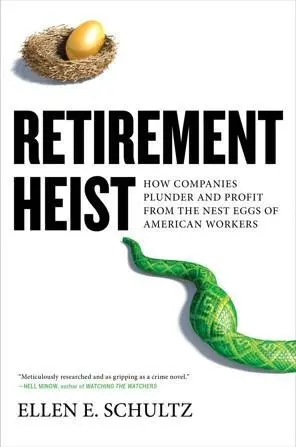
- Название:Retirement Heist
- Автор:
- Издательство:Penguin Group
- Жанр:
- Год:2011
- Город:New York
- ISBN:978-1-101-44607-2
- Рейтинг книги:3 / 5. Голосов: 1
-
Избранное:Добавить в избранное
- Отзывы:
-
Ваша оценка:
Retirement Heist: краткое содержание, описание и аннотация
Предлагаем к чтению аннотацию, описание, краткое содержание или предисловие (зависит от того, что написал сам автор книги «Retirement Heist»). Если вы не нашли необходимую информацию о книге — напишите в комментариях, мы постараемся отыскать её.
It’s no secret that hundreds of companies have been slashing pensions and health coverage earned by millions of retirees. Employers blame an aging workforce, stock market losses, and spiraling costs- what they call “a perfect storm” of external forces that has forced them to take drastic measures.
But this so-called retirement crisis is no accident. Ellen E. Schultz, award-winning investigative reporter for the
, reveals how large companies and the retirement industry-benefits consultants, insurance companies, and banks-have all played a huge and hidden role in the death spiral of American pensions and benefits.
A little over a decade ago, most companies had more than enough set aside to pay the benefits earned by two generations of workers, no matter how long they lived. But by exploiting loopholes, ambiguous regulations, and new accounting rules, companies essentially turned their pension plans into piggy banks, tax shelters, and profit centers.
Drawing on original analysis of company data, government filings, internal corporate documents, and confidential memos, Schultz uncovers decades of widespread deception during which employers have exaggerated their retiree burdens while lobbying for government handouts, secretly cutting pensions, tricking employees, and misleading shareholders. She reveals how companies:
Siphon billions of dollars from their pension plans to finance downsizings and sell the assets in merger deals
• Overstate the burden of rank-and-file retiree obligations to justify benefits cuts while simultaneously using the savings to inflate executive pay and pensions
• Hide their growing executive pension liabilities, which at some companies now exceed the liabilities for the regular pension plans
• Purchase billions of dollars of life insurance on workers and use the policies as informal executive pension funds. When the insured workers and retirees die, the company collects tax-free death benefits
• Preemptively sue retirees after cutting retiree health benefits and use other legal strategies to erode their legal protections.
Though the focus is on large companies—which drive the legislative agenda-the same games are being played at smaller companies, non-profits, public pensions plans and retirement systems overseas. Nor is this a partisan issue: employees of all political persuasions and income levels-from managers to miners, pro-football players to pilots-have been slammed.
Retirement Heist
Retirement Heist — читать онлайн бесплатно полную книгу (весь текст) целиком
Ниже представлен текст книги, разбитый по страницам. Система сохранения места последней прочитанной страницы, позволяет с удобством читать онлайн бесплатно книгу «Retirement Heist», без необходимости каждый раз заново искать на чём Вы остановились. Поставьте закладку, и сможете в любой момент перейти на страницу, на которой закончили чтение.
Интервал:
Закладка:
And when it comes to depression or head injuries, determinations can be especially subjective. For years, the NFL steadfastly maintained that there was little credible research linking football with developing health problems, such as arthritis, heart disease, or cognitive impairment, in later life. This was like the tobacco industry insisting that smoking doesn’t cause lung damage.
Though Congress didn’t intend trustees to have so much power to decide who gets benefits, employers have blocked and tackled every effort to create rules similar to those existing in state courts. The wellpublicized medical-claims denial cases in the 1990s weren’t really about rogue behavior by HMOs; rather, they were merely examples of what employers and insurers could do when unfettered by state insurance laws. Benefits provided in the workplace are all shielded by ERISA, which is why the employer-plan market has been so lucrative for insurers. Disability, long-term care, life insurance—if it’s provided in the workplace, even if the employee pays 100 percent of the cost, it falls under ERISA, and has no state-law protections for unfair denials or for compensatory or punitive damages.
Ironically, the very people who decided that benefits would fall under ERISA are themselves exempt from that federal law: Congress. All government employees are exempt from ERISA, which means that judges, lawmakers, police, and municipal meter readers have access to state courts to ensure their benefits, while their neighbors who are employed by private businesses do not. [19] Employees of religious organizations are also exempt from ERISA.
Vic Washington could have created a league of his own out of all the players the NFL denied paying disability to. Scores of other players from the 1960s to the 1980s faced similar long fights with the league over disability. Although most NFL players suffer injuries of one sort or another during their careers, only ninety of the more than seven thousand former pro players covered by the NFL disability plan were receiving football disability benefits at the time Washington was pursuing his claim in the courts. [20] Only about half of former pro players are eligible for coverage under the plan, because they had fewer than three credited seasons, which is the minimum required.
And the total amount the league was paying in disability benefits was a mere $1.2 million a month, or just $14.5 million for the year. Of that, about $8 million came from the league’s more than $5.2 billion in annual revenue, and the rest was paid from the players’ pension plan, the Bert Bell/Pete Rozelle NFL Player Retirement Plan.
The NFL has maintained that the generosity of the benefits attracts unqualified applicants, which is why it has to aggressively hold the line to protect the plan. “The trustees have to make some tough calls,” said a key league attorney, Douglas Ell. He maintained that many former players are too quick to blame football for causing their problems and that the league wants to avoid awarding benefits to someone “sitting in his den drinking beer and feeling sad and thinking football made him crazy. The trustees are fiduciaries, and can’t just say, ‘This guy was in the Hall of Fame’… and pay him extra money he doesn’t qualify for.”
Certainly, players from the 1970s and 1980s didn’t have the gargantuan pay packages that today’s stars negotiate and have therefore had an incentive to apply for football disability benefits, but that doesn’t mean they’re all mooches. “Injuries may not put you in a wheelchair for the rest of your life, but you still have injuries,” said Randy Beisler, who was a guard and defensive end with the Philadelphia Eagles, San Francisco 49ers, and Kansas City Chiefs until a broken neck put him out of the game in 1978. Although NFL doctors concluded in the 1990s that he was 80 percent disabled, he gave up seeking benefits after his claim dragged on for five years.
NO FOUL, NO PENALTY
Another hurdle for employees and retirees: ERISA doesn’t say anything about punitive damages; there are no damages for wrongful death, financial loss, or pain and suffering. With no penalties for egregious conduct, employers have little disincentive to aggressively deny claims. The worst that can happen is that the plans can later be ordered to provide the benefit.
Basically, under federal benefits law, if you mug an old man and steal his wallet, the worst that can happen is that you’ll have to give the wallet back. If the old guy dies from his injuries, you won’t have to do even that.
Mike Webster had been a center on the offensive line for the Pittsburgh Steelers from 1974 to 1988, then played two more seasons for the Kansas City Chiefs. He played 177 consecutive games—the fifth highest in league history—and the games took a toll. Webster suffered multiple concussions in his career, and when he retired in 1991 he was so cognitively impaired that he was unable to hold a job. According to court papers, he earned $10,000 in 1992, and $1,000 in 1993, from signing football cards and making appearances. In the 1994–95 season, the Chiefs hired him as a “conditioning coach,” mostly because team officials felt sorry for him. Webster had been homeless at various points in the 1990s and slept in his car, train stations, and the Chiefs’ equipment room.
In 1998, Webster applied for disability benefits, and a series of doctors, including a neurologist, a psychiatrist, and a psychologist, concluded that he was totally and permanently disabled; one noted that he suffered from a “traumatic or punch drunk encephalopathy, caused by multiple head blows received while playing in the NFL.” And they all concluded that his disability arose when he was an active player, in 1991.
The NFL plan trustees, however, pointed to a medical report by a neurologist Webster had visited in 1996, who made no mention of a head injury. On this basis, the trustees concluded that there was doubt about the onset of Webster’s disability, and awarded him “degenerative” benefits rather than “active” benefits, making him ineligible for payments retroactive to 1991.
Webster appealed. His case dragged on. He died in 2002, at age fifty, while his appeal was pending. In 2003, the plan denied his appeal. The administrator of Webster’s estate then sued the NFL plan. In March 2005, a federal court said the plan had “abused its discretion,” because even if the trustees had found a “scintilla” of evidence to support their contention that Webster wasn’t disabled until 1996, that wasn’t enough to ignore the mountain of evidence presented by its own doctors. The court awarded Webster’s estate the value of the benefits he should have been paid.
RESUME PLAY
Vic Washington thought he had one more chance to qualify for disability benefits when the NFL and the players’ union adopted a new disability plan with more flexible rules in 1993. But the NFL trustees denied his claim, providing no explanation. When Washington appealed again, the league plan hired private investigators to question his neighbors, friends, minister, and ex-wife, seeking evidence that his injuries were exaggerated and that he’d held a paid job. It scrutinized his income tax returns for evidence he’d held a job. He had not.
Washington had moved to Phoenix, where he’d played once in a college game, against Arizona State University; his mother was in a nearby nursing home. He joined the local Black Republican group and was a volunteer minister in a local Baptist church.
Finally, in 1998, the NFL plan offered Washington $400,000 to settle his longstanding disability dispute, and he accepted it, taking advice from a former player turned attorney, who was unfamiliar with ERISA law and didn’t know that the NFL had just lost a critical Court of Appeals case in the Eighth Circuit in Minneapolis. A judge had ruled in favor of an ex-player who, like Washington, was denied football disability benefits because he had more than a single injury. “To require that a disability result from a single, identifiable football injury when the relevant plan language speaks of ‘a football injury while an active player’ is to place undue and inappropriate emphasis on the word ‘a.’ ” The judge concluded that the NFL’s decision to deny benefits was “arbitrary and capricious.”
Читать дальшеИнтервал:
Закладка:
Похожие книги на «Retirement Heist»
Представляем Вашему вниманию похожие книги на «Retirement Heist» списком для выбора. Мы отобрали схожую по названию и смыслу литературу в надежде предоставить читателям больше вариантов отыскать новые, интересные, ещё непрочитанные произведения.







Обсуждение, отзывы о книге «Retirement Heist» и просто собственные мнения читателей. Оставьте ваши комментарии, напишите, что Вы думаете о произведении, его смысле или главных героях. Укажите что конкретно понравилось, а что нет, и почему Вы так считаете.