Ellen Schultz - Retirement Heist
Здесь есть возможность читать онлайн «Ellen Schultz - Retirement Heist» весь текст электронной книги совершенно бесплатно (целиком полную версию без сокращений). В некоторых случаях можно слушать аудио, скачать через торрент в формате fb2 и присутствует краткое содержание. Город: New York, Год выпуска: 2011, ISBN: 2011, Издательство: Penguin Group, Жанр: economics, org_behavior, на английском языке. Описание произведения, (предисловие) а так же отзывы посетителей доступны на портале библиотеки ЛибКат.
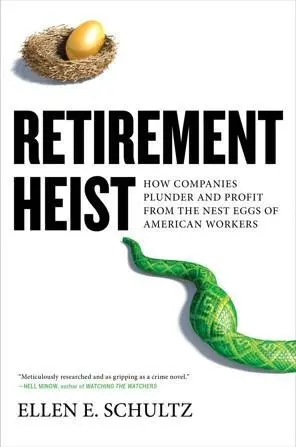
- Название:Retirement Heist
- Автор:
- Издательство:Penguin Group
- Жанр:
- Год:2011
- Город:New York
- ISBN:978-1-101-44607-2
- Рейтинг книги:3 / 5. Голосов: 1
-
Избранное:Добавить в избранное
- Отзывы:
-
Ваша оценка:
Retirement Heist: краткое содержание, описание и аннотация
Предлагаем к чтению аннотацию, описание, краткое содержание или предисловие (зависит от того, что написал сам автор книги «Retirement Heist»). Если вы не нашли необходимую информацию о книге — напишите в комментариях, мы постараемся отыскать её.
It’s no secret that hundreds of companies have been slashing pensions and health coverage earned by millions of retirees. Employers blame an aging workforce, stock market losses, and spiraling costs- what they call “a perfect storm” of external forces that has forced them to take drastic measures.
But this so-called retirement crisis is no accident. Ellen E. Schultz, award-winning investigative reporter for the
, reveals how large companies and the retirement industry-benefits consultants, insurance companies, and banks-have all played a huge and hidden role in the death spiral of American pensions and benefits.
A little over a decade ago, most companies had more than enough set aside to pay the benefits earned by two generations of workers, no matter how long they lived. But by exploiting loopholes, ambiguous regulations, and new accounting rules, companies essentially turned their pension plans into piggy banks, tax shelters, and profit centers.
Drawing on original analysis of company data, government filings, internal corporate documents, and confidential memos, Schultz uncovers decades of widespread deception during which employers have exaggerated their retiree burdens while lobbying for government handouts, secretly cutting pensions, tricking employees, and misleading shareholders. She reveals how companies:
Siphon billions of dollars from their pension plans to finance downsizings and sell the assets in merger deals
• Overstate the burden of rank-and-file retiree obligations to justify benefits cuts while simultaneously using the savings to inflate executive pay and pensions
• Hide their growing executive pension liabilities, which at some companies now exceed the liabilities for the regular pension plans
• Purchase billions of dollars of life insurance on workers and use the policies as informal executive pension funds. When the insured workers and retirees die, the company collects tax-free death benefits
• Preemptively sue retirees after cutting retiree health benefits and use other legal strategies to erode their legal protections.
Though the focus is on large companies—which drive the legislative agenda-the same games are being played at smaller companies, non-profits, public pensions plans and retirement systems overseas. Nor is this a partisan issue: employees of all political persuasions and income levels-from managers to miners, pro-football players to pilots-have been slammed.
Retirement Heist
Retirement Heist — читать онлайн бесплатно полную книгу (весь текст) целиком
Ниже представлен текст книги, разбитый по страницам. Система сохранения места последней прочитанной страницы, позволяет с удобством читать онлайн бесплатно книгу «Retirement Heist», без необходимости каждый раз заново искать на чём Вы остановились. Поставьте закладку, и сможете в любой момент перейти на страницу, на которой закончили чтение.
Интервал:
Закладка:
The company was also planning to make more major cuts in benefits. But rather than wait for the retirees to sue, it sued the retirees. Under legal rules, the first party to file generally gets to have its case heard in the location where it files the suit. So, suing the retirees first enhances a company’s chances to get the case heard in a circuit with pro-business judges.
In “declaratory judgment” suits, such as Rexam’s, the company asks a judge to rule that the company has the right to change the retiree health plans. Rexam pointed to a line in a booklet it gave retirees. It stated that the company “reserves the right to amend, modify or discontinue the plan in the future in conformity with applicable legislation.”
The retirees said the clause meant that if government legislation or regulations changed, then the plan might have to be modified accordingly. It didn’t give the company a right to unilaterally change the agreement. They pointed to another sentence stating that the right to modify the benefits “was subject to any applicable collective bargaining agreement.” In any case, the union wouldn’t go to the trouble of negotiating benefits for retirees if they assumed the employer could subsequently cancel the benefits at will. This was an inference in favor of union retirees.
Rexam filed in Minneapolis, within a conservative circuit. There was little logic to this from a geographic standpoint. Minnesota was home to only 100 of the 3,600 retirees, and the company—known as American National Can before Rexam bought it in 2000—is based in Chicago and has offices in Charlotte, North Carolina. It’s a subsidiary of Britain’s Rexam PLC.
The retirees, supported by the United Steelworkers of America, countersued in Toledo, Ohio, asking that the case be dismissed or transferred there. They said that Rexam had made a preemptive legal strike in order to choose the jurisdiction.
The judge in Minneapolis rejected all the retirees’ arguments. She ruled that the case would remain there, because the company had 110 employees there. She said the retirees threatened to sue and hadn’t sued quickly enough, so couldn’t claim that Rexam was suing as a preemptive strike—there was nothing to preempt. She also made a nonlegal observation: She cited a $79 million liability for the benefits on Rexam’s balance sheet and said the company was harmed “because it cannot lower the liability unless it reduces the retirees’ benefits.”
Still, she found in a later decision that the language was ambiguous, rejecting the company’s motion for judgment on the papers alone, and she allowed the suit to move forward to a trial by jury, a move that may have led to a favorable settlement for the retirees. But the case was then assigned to Judge Patrick Schiltz, a former law clerk for Supreme Court Justice Antonin Scalia. Schiltz didn’t think the language in the contract was ambiguous and, rather than go to trial, where a jury would hear the facts, he invited Rexam to move for reconsideration, meaning it could file another motion asking the judge to decide the case on the papers alone. Rexam was happy to oblige. Schiltz concluded that the language in the documents was unambiguous for approximately 80 percent of the retirees, and clearly gave the company the right to unilaterally change the benefits that it had a contractual agreement to provide.
Occasionally, a judge will refuse to hear a case in the jurisdiction where it is originally filed and send it to another circuit. But this doesn’t occur often. Crown Cork & Seal, a Philadelphia-based packaging company that makes wrappers for such things as Mars bars and bottles of beer, sued its union retirees in U.S. district court in Chicago, but the judge wasn’t convinced that was where the case belonged.
“From day one, it seemed to me that Illinois was an unlikely home for this litigation,” Judge Milton Shadur told Crown’s lawyers, according to a transcript of a meeting he held in his chambers in August 2003 to determine whether the case should remain in Chicago or move to Cincinnati, where the retirees had countersued.
“I am not faulting you for this, but it’s pretty obvious why you chose the Seventh Circuit as your forum,” he said. “Because it’s very unfriendly to the idea of retiree benefits being vested at all.” He added that he was inclined to send the case to Pittsburgh. “You know, they [the retirees’ attorneys] want Ohio, because I think they view the Sixth Circuit on this subject of retirees as more favorable, but I am not going to give them that.”
“They shopped more than we did, Judge,” said James Rydzel, a lawyer with Jones Day, in Cleveland, representing Crown.
“Well, I am not sure about that,” the judge responded. He subsequently sent the case to Pittsburgh, where a number of the company’s retirees lived. The Crown retirees were initially hopeful because the case was assigned to a judge with a proworker reputation. However, the judge recused himself because his mother had worked in a factory at Continental Can, a predecessor company, and was potentially a member of the class. The next judge sent the case to Cincinnati, where it ultimately went to arbitration.
It may be routine for litigants to try to pick a favorable jurisdiction. If two parties sue each other, the courts generally hear the case that’s filed first. But a court can dismiss or transfer a case if it believes a company is “forum shopping” or suing retirees as a preemptive strike to deprive them of their rights, as “natural plaintiffs,” to sue in the court they would choose.
ACF Industries, a railroad-car maker headquartered in St. Charles, Missouri, took the additional step of provoking a retiree and then filing suit, claiming that the company was suing to protect itself. The company didn’t dispute that the contract promised health coverage at “$100 per month for life,” but said this referred only to the major medical coverage, not explicitly to the hospital/surgical portion.
And it maintained that St. Louis was the proper venue for the suit because “a substantial part of the activities and events giving rise to these claims occurred in this district.” Most of its 678 retirees and dependents lived four hundred miles away, in West Virginia, in the Fourth Circuit, which had ruled in favor of retirees in a similar case.
ACF, controlled by CEO Carl Icahn through an investment vehicle in New York, prepared its suit and had its legal guns lined up when its human resources vice president called up a retiree in Barboursville, West Virginia. Basil Chapman, a retired union representative, was sitting on his porch with his dog, Bo, enjoying a mild Friday in December, when he got the call. The executive told him that ACF was going to start charging the union retirees for their benefits. Chapman had been the chair of the union’s bargaining committee and had helped negotiate contracts in which the trade-off for lower salary increases was lifetime health coverage that would cost retirees a flat $100 a month.
“We have a contract. You can’t do that,” Chapman replied. “We will file in federal court against you bastards, I’ll guarantee you that.” That, in any case, was what ACF claimed, in court papers, Chapman had said, when it sued him the following Monday in federal district court in St. Louis. In its complaint, the company said Chapman had threatened them, and it was taking the step to protect itself from a lawsuit it anticipated from the retirees. “Defendant Chapman has already informed ACF that he plans to file a lawsuit concerning the amendments of the plan,” the complaint said.
The day after ACF sued the retirees, it sent them a letter, blaming a slump in the railcar-building-and-leasing industry, “particularly the covered hopper car producers. Because of this we are forced to make changes in our group insurance coverage.” And, by the way, it said, the plan documents gave the company the right to modify or revoke the benefits at any time.
Читать дальшеИнтервал:
Закладка:
Похожие книги на «Retirement Heist»
Представляем Вашему вниманию похожие книги на «Retirement Heist» списком для выбора. Мы отобрали схожую по названию и смыслу литературу в надежде предоставить читателям больше вариантов отыскать новые, интересные, ещё непрочитанные произведения.












Обсуждение, отзывы о книге «Retirement Heist» и просто собственные мнения читателей. Оставьте ваши комментарии, напишите, что Вы думаете о произведении, его смысле или главных героях. Укажите что конкретно понравилось, а что нет, и почему Вы так считаете.