Ellen Schultz - Retirement Heist
Здесь есть возможность читать онлайн «Ellen Schultz - Retirement Heist» весь текст электронной книги совершенно бесплатно (целиком полную версию без сокращений). В некоторых случаях можно слушать аудио, скачать через торрент в формате fb2 и присутствует краткое содержание. Город: New York, Год выпуска: 2011, ISBN: 2011, Издательство: Penguin Group, Жанр: economics, org_behavior, на английском языке. Описание произведения, (предисловие) а так же отзывы посетителей доступны на портале библиотеки ЛибКат.
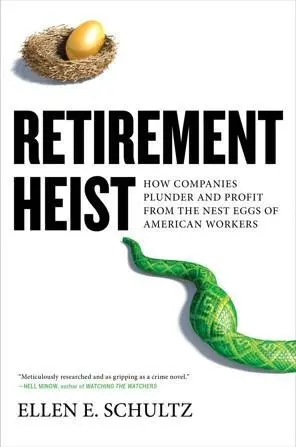
- Название:Retirement Heist
- Автор:
- Издательство:Penguin Group
- Жанр:
- Год:2011
- Город:New York
- ISBN:978-1-101-44607-2
- Рейтинг книги:3 / 5. Голосов: 1
-
Избранное:Добавить в избранное
- Отзывы:
-
Ваша оценка:
Retirement Heist: краткое содержание, описание и аннотация
Предлагаем к чтению аннотацию, описание, краткое содержание или предисловие (зависит от того, что написал сам автор книги «Retirement Heist»). Если вы не нашли необходимую информацию о книге — напишите в комментариях, мы постараемся отыскать её.
It’s no secret that hundreds of companies have been slashing pensions and health coverage earned by millions of retirees. Employers blame an aging workforce, stock market losses, and spiraling costs- what they call “a perfect storm” of external forces that has forced them to take drastic measures.
But this so-called retirement crisis is no accident. Ellen E. Schultz, award-winning investigative reporter for the
, reveals how large companies and the retirement industry-benefits consultants, insurance companies, and banks-have all played a huge and hidden role in the death spiral of American pensions and benefits.
A little over a decade ago, most companies had more than enough set aside to pay the benefits earned by two generations of workers, no matter how long they lived. But by exploiting loopholes, ambiguous regulations, and new accounting rules, companies essentially turned their pension plans into piggy banks, tax shelters, and profit centers.
Drawing on original analysis of company data, government filings, internal corporate documents, and confidential memos, Schultz uncovers decades of widespread deception during which employers have exaggerated their retiree burdens while lobbying for government handouts, secretly cutting pensions, tricking employees, and misleading shareholders. She reveals how companies:
Siphon billions of dollars from their pension plans to finance downsizings and sell the assets in merger deals
• Overstate the burden of rank-and-file retiree obligations to justify benefits cuts while simultaneously using the savings to inflate executive pay and pensions
• Hide their growing executive pension liabilities, which at some companies now exceed the liabilities for the regular pension plans
• Purchase billions of dollars of life insurance on workers and use the policies as informal executive pension funds. When the insured workers and retirees die, the company collects tax-free death benefits
• Preemptively sue retirees after cutting retiree health benefits and use other legal strategies to erode their legal protections.
Though the focus is on large companies—which drive the legislative agenda-the same games are being played at smaller companies, non-profits, public pensions plans and retirement systems overseas. Nor is this a partisan issue: employees of all political persuasions and income levels-from managers to miners, pro-football players to pilots-have been slammed.
Retirement Heist
Retirement Heist — читать онлайн бесплатно полную книгу (весь текст) целиком
Ниже представлен текст книги, разбитый по страницам. Система сохранения места последней прочитанной страницы, позволяет с удобством читать онлайн бесплатно книгу «Retirement Heist», без необходимости каждый раз заново искать на чём Вы остановились. Поставьте закладку, и сможете в любой момент перейти на страницу, на которой закончили чтение.
Интервал:
Закладка:
Peksa, a former marine, hadn’t planned on working at Wal-Mart in retirement, or traveling. But he ended up doing both. He needed the greeter job because he was no longer receiving the $320-a-month pension he’d earned after working a quarter-century in the tennis ball department at GenCorp. His former employer was keeping it all to pay for Peksa’s share of his retiree health coverage. The coverage had been company-paid when he retired, but the company had unilaterally begun charging very steep premiums. Peksa couldn’t drop the coverage, because he needed it to help cover his wife’s prescription drugs, so he began working thirty hours a week at Wal-Mart. He thought the job was pretty decent, since he got an hour for lunch and two fifteen-minute breaks a day.
He also ended up traveling to court, over and over, as the retirees tried to reverse the company’s decision. Though he didn’t know it, he was living out a process that the Varity human resources managers had so candidly discussed behind closed doors years ago: Companies had little to lose by unilaterally cutting benefits they had promised retirees in written contracts. The retirees might pass the hat and try to raise funds to file a suit, but even if they got that far, it would be easy for an employer to drag out a case until the employees died. And whatever the outcome, the company saves money in the meantime.
Such was the legal odyssey of the GenCorp retirees. In January 2000, the company, by then a manufacturer of aerospace products, began charging 2,063 hourly retirees health care premiums, despite a labor contract that promised them free coverage for life. John Van Dyke, a retired millwright, thought fighting back in court was the answer. “I was sure that once the judge saw the contract, it would be over,” he said. “How long could it take?”
Longer than many of them would be around. Frank Palumbo was one of the oldest. Born in 1914, he went to work for the General Tire and Rubber Co. when he was sixteen years old. In 1934, at age nineteen, he participated in the first sit-down strike to organize the rubber workers at the Akron, Ohio, plant. Always active in the union, he worked at the company for forty-four years until he retired in 1975, with a promise of lifetime medical coverage.
By the early 1990s, most of the retirees, like him, were on Medicare, so their company-paid benefits covered only prescription drugs and Medicare premiums and deductibles. Not a huge amount for the company, but critical for the retirees, most of whom had pensions in the low three digits.
In the mid-1990s, the company used a trick the Varity managers hadn’t thought of: It sent the retirees enrollment forms giving them a choice between remaining in their no-cost plan or switching to one with significant cost sharing.
Elderly but not demented, Palumbo and the other retirees of course chose to remain in their current plan. But perhaps with their failing eyesight, they didn’t notice, at the bottom of the form, a sentence in microscopic print. It said that the retiree acknowledged that the “benefits elected… replace benefits under the prior GenCorp/URN retiree medical plans.”
About five years after Palumbo returned the form, his January pension check arrived. It was smaller. A mistake? No. The company said it was beginning to deduct some of their pensions to help pay for their health coverage. The retirees pointed out that the contract said the company would provide lifetime coverage. GenCorp didn’t dispute that, but said “lifetime” didn’t mean “at no cost.”
Their union couldn’t help them because, when it negotiated a contract in 1994, the United Rubber Workers had agreed not to represent retirees in any future lawsuit in exchange for delaying an increase in benefits. Some unions have less noble reasons for not backing retirees. When negotiating compensation for current workers, some are tempted to toss the retirees, who don’t vote, overboard. Without a union to back them in court, the retirees face almost impossible odds. There are few attorneys who handle ERISA cases for plaintiffs. One reason is that an individual employee or retiree can’t afford the fees, and class actions can be hard to bring for a variety of reasons. Courts have interpreted ERISA as disallowing any punitive or pain-and-suffering damages, so there are no potential damages of this sort that attorneys can use to finance cases. All a plaintiff can win is restoration of the disputed benefit, if he’s still alive. The plaintiff’s attorney takes a risk, too: Thanks to the way in which courts have interpreted ERISA’s attorneys’ fee provision, it’s up to a judge to decide whether the plaintiff’s lawyer will be reimbursed for any of his time and expense.
Still, the retirees who had worked at the Jeannette plant passed a hat and chipped in: $100 per couple. Mabel Kramer, a widow, chipped in $50. She’d begun working at the company in 1944, making gas masks for World War II soldiers. She was no longer receiving her pension of $179 a month, based on her husband’s thirty-four years with the company, because GenCorp deducted every cent to use for her health coverage, for which it was charging her $284 a month. She had to pay the company the remaining $105 from her $810 Social Security check.
The $12,000 the retirees collected would cover only a fraction of the cost of mounting a suit, but the retirees found a lawyer who was willing to take the case anyway: William Payne, a Pittsburgh attorney who had represented retirees over the years in more than sixty cases. One of the first cases he worked on, soon after getting out of law school in the late 1970s, was the now infamous Continental Can case, in which company managers had used a secret program with the code name “BELL,” which is a reverse acronym for “Let’s Limit Employee Benefits.” The can company used the system to identify older workers who were about to lock in bigger pensions and targeted those plants for closing. The case was a rare win for workers. It has been mostly downhill since. Payne has spent the rest of his career watching ERISA protections get eroded in the courts.
Payne and his law partner, John Stember, met the retirees at Dick’s Diner, a popular fuel stop just off the highway between Pittsburgh and Jeannette, and over coffee and cheesesteaks he cautioned them that the case could take a long time. The retirees were undaunted. Three, John Van Dyke, Stanley Wotus, and Ed Peksa, all veterans who had served in the Pacific during or after World War II, volunteered to be plaintiffs. Nor were Payne and Stember daunted by the cardboard boxes the retirees hauled with them, filled with decades-old documents they’d dredged out of basements, closets, and garages. They filed suit in October, and the first meeting with the judge was scheduled the following May. In the seventeen months since GenCorp had started charging them for health coverage, the retirees’ costs had doubled.
ROAD TRIP
The first court conference was in Akron, Ohio, 110 miles away. Van Dyke, who had the best eyesight, drove the other guys in the predawn darkness to rendezvous with Payne, who drove them the rest of the way in the minivan he usually used to take his sons to hockey practice. They had to pull over numerous times. Van Dyke had had part of his stomach removed following a bout of cancer in the 1990s and needed small, frequent meals. Others had prostate problems, and Wotus was taking several medications for blood pressure and heart problems. Peksa, who misjudged the insulin shots he was taking for his diabetes, at one point passed out in the backseat, prompting a quick pit stop at a gas station mini-mart for orange juice.
Despite their various pit stops, the retirees made it to the 9 A.M. court session on time. There, the eager retirees cited labor contracts promising lifetime coverage. But GenCorp, in court documents, maintained that “lifetime” didn’t mean “at no cost.” This kind of semantic game had become common. Another popular one was to say that “lifetime” referred not to the life of the retiree but to the life of the contract.
Читать дальшеИнтервал:
Закладка:
Похожие книги на «Retirement Heist»
Представляем Вашему вниманию похожие книги на «Retirement Heist» списком для выбора. Мы отобрали схожую по названию и смыслу литературу в надежде предоставить читателям больше вариантов отыскать новые, интересные, ещё непрочитанные произведения.










Обсуждение, отзывы о книге «Retirement Heist» и просто собственные мнения читателей. Оставьте ваши комментарии, напишите, что Вы думаете о произведении, его смысле или главных героях. Укажите что конкретно понравилось, а что нет, и почему Вы так считаете.