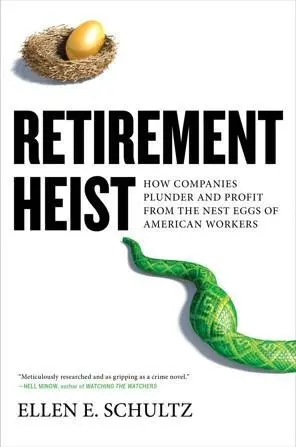
Ellen Schultz - Retirement Heist
Здесь есть возможность читать онлайн «Ellen Schultz - Retirement Heist» весь текст электронной книги совершенно бесплатно (целиком полную версию без сокращений). В некоторых случаях можно слушать аудио, скачать через торрент в формате fb2 и присутствует краткое содержание. Город: New York, Год выпуска: 2011, ISBN: 2011, Издательство: Penguin Group, Жанр: economics, org_behavior, на английском языке. Описание произведения, (предисловие) а так же отзывы посетителей доступны на портале библиотеки ЛибКат.
- Название:Retirement Heist
- Автор:
- Издательство:Penguin Group
- Жанр:
- Год:2011
- Город:New York
- ISBN:978-1-101-44607-2
- Рейтинг книги:3 / 5. Голосов: 1
-
Избранное:Добавить в избранное
- Отзывы:
-
Ваша оценка:
Retirement Heist: краткое содержание, описание и аннотация
Предлагаем к чтению аннотацию, описание, краткое содержание или предисловие (зависит от того, что написал сам автор книги «Retirement Heist»). Если вы не нашли необходимую информацию о книге — напишите в комментариях, мы постараемся отыскать её.
It’s no secret that hundreds of companies have been slashing pensions and health coverage earned by millions of retirees. Employers blame an aging workforce, stock market losses, and spiraling costs- what they call “a perfect storm” of external forces that has forced them to take drastic measures.
But this so-called retirement crisis is no accident. Ellen E. Schultz, award-winning investigative reporter for the
, reveals how large companies and the retirement industry-benefits consultants, insurance companies, and banks-have all played a huge and hidden role in the death spiral of American pensions and benefits.
A little over a decade ago, most companies had more than enough set aside to pay the benefits earned by two generations of workers, no matter how long they lived. But by exploiting loopholes, ambiguous regulations, and new accounting rules, companies essentially turned their pension plans into piggy banks, tax shelters, and profit centers.
Drawing on original analysis of company data, government filings, internal corporate documents, and confidential memos, Schultz uncovers decades of widespread deception during which employers have exaggerated their retiree burdens while lobbying for government handouts, secretly cutting pensions, tricking employees, and misleading shareholders. She reveals how companies:
Siphon billions of dollars from their pension plans to finance downsizings and sell the assets in merger deals
• Overstate the burden of rank-and-file retiree obligations to justify benefits cuts while simultaneously using the savings to inflate executive pay and pensions
• Hide their growing executive pension liabilities, which at some companies now exceed the liabilities for the regular pension plans
• Purchase billions of dollars of life insurance on workers and use the policies as informal executive pension funds. When the insured workers and retirees die, the company collects tax-free death benefits
• Preemptively sue retirees after cutting retiree health benefits and use other legal strategies to erode their legal protections.
Though the focus is on large companies—which drive the legislative agenda-the same games are being played at smaller companies, non-profits, public pensions plans and retirement systems overseas. Nor is this a partisan issue: employees of all political persuasions and income levels-from managers to miners, pro-football players to pilots-have been slammed.
Retirement Heist
Retirement Heist — читать онлайн бесплатно полную книгу (весь текст) целиком
Ниже представлен текст книги, разбитый по страницам. Система сохранения места последней прочитанной страницы, позволяет с удобством читать онлайн бесплатно книгу «Retirement Heist», без необходимости каждый раз заново искать на чём Вы остановились. Поставьте закладку, и сможете в любой момент перейти на страницу, на которой закончили чтение.
Интервал:
Закладка:
The “pleading” strategy had also met with some success. A union bargaining unit at a facility in Racine, Wisconsin, had agreed to accept reduced benefits.
But Rice wanted more. A big motive now was FAS 106, the new accounting rule that required employers to put the liability for its retiree health benefits on its books. Varity wanted to reduce its liability by 40 percent and turned to Towers Perrin for advice. The consulting firm said it would hook them up with one of their experts who had “successfully negotiated rather dramatic decreases in postretirement welfare benefits.” The consultant projected he could cut 63 percent from the company’s estimated $344 million retiree liability by using his benefits-reduction model, which he called “Strawman.”
Accounting smoke and mirrors could take care of some of the cost reductions. The company could change some of the key assumptions it used to estimate its obligations. For one, it could assume that fewer employees and retirees were married, so the liability for spousal and survivor benefits would be lower. Towers Perrin also suggested the company could use “liberalized” turnover assumptions. For example, they could assume that job turnover would be higher, so employees wouldn’t build up significant benefits.
At the same time, it could lower mortality assumptions and assume that the people who remained would work until age seventy, which would make it look as if the company had fewer years of retirement to pay for. The consultant must have known that this latter point, for one, wasn’t true. His research showed that virtually no one at Varity worked past sixty-five.
Though these moves would lower the liabilities the company would publicly disclose, “the real reduction,” Towers Perrin concluded, “can come only if the benefits are reduced.” To facilitate Varity’s decisionmaking process, the consulting firm’s actuaries prepared charts showing which units had the highest potential retiree costs.
Rice wanted quick results, and laid down the law in a memo to managers. “The reported FAS 106 liability will be closely reviewed by analysts and it will affect the stock price and debt ratings.” Cutting benefits to reduce the costs that “will result from FAS 106 ABSOLUTE TOP PRIORITY.”
In December, Rice gathered the president, the CFO, the vice president for HR, and the company’s benefits chief and reiterated his goals: “We must reduce the liabilities, and take aggressive actions that would be reviewed favorably within the financial community.” His statement of objectives was accompanied by a checklist.
• 40% MAY be all we can get now…
• Continue to aggressively push legal counsel on risk analysis.
• I don’t believe in “show stoppers,” and won’t accept them. Give me a course of action. Keep on schedule.
• I am concerned we will run out of time. If you or the business units need more resources, get them. Let’s not be penny wise and pound-foolish.
Not long after, the company’s legal advisers prepared a “Litigation Risk assessment” listing dozens of manufacturing plants and facilities operated by the company, with estimates for retiree medical liabilities at each. Each was assigned a litigation risk number, with five having the highest risk (“virtually unavoidable commitments” with “almost certain loss” in litigation) and 1 having the lowest. Varity would go after the weakest units first. Varity sent managers a memo summing it up: “We are not averse to assuming acceptable levels of risk [of lawsuits].… No approach is too aggressive to consider.”
A few months later, in April 1993, Varity announced it would make steep cuts to the health benefits, effective January 1, 1994. Under the new accounting rules, the move allowed Varity to report reduced expense—as good as income from selling tractors.
As the company predicted, retirees sued. Hourly and salaried workers brought five suits altogether. A federal judge in one of the cases in Michigan cited “a veritable mountain of evidence” that Varity had promised lifetime medical coverage to the 3,300 retirees of Varity’s Kelsey-Hayes unit and ordered the company to restore the benefits, which it did in 2000. Cases at two other units were settled in 1997 and 1998.
But, as Varity human resources managers had predicted, the process dragged out for years, and though most of the retirees prevailed, it was too late for the many retirees who had died in the interim.
The Massey Combines employees, who had been loaded into the unit that went bankrupt, sued Varity, and the court heard the testimony about how Rice had boasted, over cognac and cigars, that he’d dumped all his losers into the doomed unit. This didn’t go over well with the Des Moines jury. They handed a victory to the Massey Combines employees and awarded them $38 million in punitive damages.
But no punitive damages are allowed under federal benefits law, so the judge threw out the award but ordered Varity to reinstate the retirees into Varity’s health care plan. (The only thing a plaintiff can win in a federal benefits case is the benefit he should have been paid. If he’s dead, there’s nothing to award, even out-of-pocket costs the retirees had incurred.) Varity appealed, and the former employees fought their case all the way to the U.S. Supreme Court. In 1996—a full decade after Pittman and Wellman had begun sketching out Varity’s plan—the Court, in Varity Corp. v. Howe, found that Varity had deceived the employees and thus violated its fiduciary duty. It ordered that the benefits be reinstated. But this victory was Pyrrhic; the employees were still out of a job, and some had died in the meantime.
Victor Rice, meanwhile, turned from breaking up retiree benefits to breaking up the company. In 1996, he sold Massey Ferguson’s farm machinery business assets to AGCO and merged its auto-parts businesses with a British auto-parts maker, renaming it LucasVarity. The combination languished, and Rice started shopping the company almost as soon as he assumed the corner office. TRW bought the firm in 1999, and Rice collected $50 million in severance. TRW, an aerospace and automotive company, enrolled the portfolios of Varity retirees in its existing retiree medical plans. Things were fine—until 2006.
CREEPING REDUX
John Galloway, the retired foundry worker, had so far survived all these benefit shenanigans with his coverage largely intact. That was thanks in large part to the dogged efforts of Roger McClow, a lawyer in Detroit who had represented groups of retirees from different units of the company since 1993. At the same time the Varity employees were taking their case to the Supreme Court, McClow was juggling a handful of cases, representing both salaried and union retirees from the other units, including Massey Ferguson and Kelsey-Hayes.
It was during the tedious discovery phase for two of those suits that McClow unearthed the trove of Varity memos quoted above. When he requested records pertinent to the case, attorneys for the company responded with a “documents dump,” the passive-aggressive move in which an opposing party responds to an adversary’s information request by trying to bury it in paperwork. McClow and an assistant spent days shoveling through decades-old payroll records, benefits booklets, and the other detritus of the human resources departments from various units, some defunct.
Against great odds, the colorful documents had survived the company shredders. When the company had shuttered an operation in Buffalo, a former Massey Combines officer who was transferred to Kelsey-Hayes brought his Massey Ferguson documents with him to Romulus, Michigan, where they gathered dust in the orphaned files of a long-gone human resources manager until they were rounded up to add bulk to the documents dump.
Читать дальшеИнтервал:
Закладка:
Похожие книги на «Retirement Heist»
Представляем Вашему вниманию похожие книги на «Retirement Heist» списком для выбора. Мы отобрали схожую по названию и смыслу литературу в надежде предоставить читателям больше вариантов отыскать новые, интересные, ещё непрочитанные произведения.






Обсуждение, отзывы о книге «Retirement Heist» и просто собственные мнения читателей. Оставьте ваши комментарии, напишите, что Вы думаете о произведении, его смысле или главных героях. Укажите что конкретно понравилось, а что нет, и почему Вы так считаете.