Ellen Schultz - Retirement Heist
Здесь есть возможность читать онлайн «Ellen Schultz - Retirement Heist» весь текст электронной книги совершенно бесплатно (целиком полную версию без сокращений). В некоторых случаях можно слушать аудио, скачать через торрент в формате fb2 и присутствует краткое содержание. Город: New York, Год выпуска: 2011, ISBN: 2011, Издательство: Penguin Group, Жанр: economics, org_behavior, на английском языке. Описание произведения, (предисловие) а так же отзывы посетителей доступны на портале библиотеки ЛибКат.
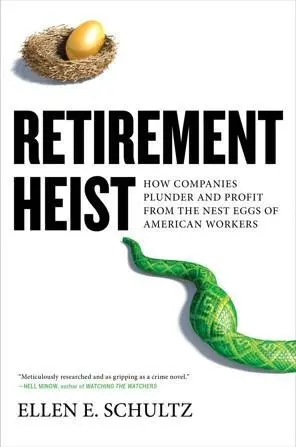
- Название:Retirement Heist
- Автор:
- Издательство:Penguin Group
- Жанр:
- Год:2011
- Город:New York
- ISBN:978-1-101-44607-2
- Рейтинг книги:3 / 5. Голосов: 1
-
Избранное:Добавить в избранное
- Отзывы:
-
Ваша оценка:
Retirement Heist: краткое содержание, описание и аннотация
Предлагаем к чтению аннотацию, описание, краткое содержание или предисловие (зависит от того, что написал сам автор книги «Retirement Heist»). Если вы не нашли необходимую информацию о книге — напишите в комментариях, мы постараемся отыскать её.
It’s no secret that hundreds of companies have been slashing pensions and health coverage earned by millions of retirees. Employers blame an aging workforce, stock market losses, and spiraling costs- what they call “a perfect storm” of external forces that has forced them to take drastic measures.
But this so-called retirement crisis is no accident. Ellen E. Schultz, award-winning investigative reporter for the
, reveals how large companies and the retirement industry-benefits consultants, insurance companies, and banks-have all played a huge and hidden role in the death spiral of American pensions and benefits.
A little over a decade ago, most companies had more than enough set aside to pay the benefits earned by two generations of workers, no matter how long they lived. But by exploiting loopholes, ambiguous regulations, and new accounting rules, companies essentially turned their pension plans into piggy banks, tax shelters, and profit centers.
Drawing on original analysis of company data, government filings, internal corporate documents, and confidential memos, Schultz uncovers decades of widespread deception during which employers have exaggerated their retiree burdens while lobbying for government handouts, secretly cutting pensions, tricking employees, and misleading shareholders. She reveals how companies:
Siphon billions of dollars from their pension plans to finance downsizings and sell the assets in merger deals
• Overstate the burden of rank-and-file retiree obligations to justify benefits cuts while simultaneously using the savings to inflate executive pay and pensions
• Hide their growing executive pension liabilities, which at some companies now exceed the liabilities for the regular pension plans
• Purchase billions of dollars of life insurance on workers and use the policies as informal executive pension funds. When the insured workers and retirees die, the company collects tax-free death benefits
• Preemptively sue retirees after cutting retiree health benefits and use other legal strategies to erode their legal protections.
Though the focus is on large companies—which drive the legislative agenda-the same games are being played at smaller companies, non-profits, public pensions plans and retirement systems overseas. Nor is this a partisan issue: employees of all political persuasions and income levels-from managers to miners, pro-football players to pilots-have been slammed.
Retirement Heist
Retirement Heist — читать онлайн бесплатно полную книгу (весь текст) целиком
Ниже представлен текст книги, разбитый по страницам. Система сохранения места последней прочитанной страницы, позволяет с удобством читать онлайн бесплатно книгу «Retirement Heist», без необходимости каждый раз заново искать на чём Вы остановились. Поставьте закладку, и сможете в любой момент перейти на страницу, на которой закончили чтение.
Интервал:
Закладка:
This works with pensions as well. In 1999, for example, Royal & Sun Alliance Co., with the assistance of PricewaterhouseCoopers, amended its pension to award a small increase to one hundred employees. One employee got a pension increase of an additional $1.92 a month in retirement. This enabled the company to pass the discrimination tests and award eight officers and directors significantly more. The largest payment went to John Winterbauer, the sixty-year-old vice president of human resources, who got an additional $5,300 a month for life, paid out in a lump sum of $792,963.
PricewaterhouseCoopers, which pioneered many of these techniques, has used them on its own workforce. The accounting and benefits consulting giant provides its partners’ contributions to the 401(k) with a 200 percent matching contribution—putting in $2 for every $1 the partners contribute—but only 25 percent for lower-paid workers.
The plan passes the discrimination test in part because new employees joining the plan receive a 200 percent matching contribution in the first month of participation, which is always in December, which is also when the company tests the plan for discrimination. This practice has the effect of making the contributions to the lower-paid, as a group, appear higher, which helps the plan pass the test.
YOUNG AND VESTLESS
Another clever way to pass the discrimination tests is by providing matching contributions. A common scenario is that an employer will chip in fifty cents for every dollar an employee contributes to his 401(k), up to 6 percent of pay. An employee making $50,000 who contributes 6 percent of pay ($3,000) to his 401(k) will get a matching contribution from his employer of $1,500.
Employers say they provide matching contributions to encourage lower-paid and younger employees to participate. That’s true, but a bit disingenuous. If that were the whole story, the contributions would be the employees’ to keep. In reality, lower-paid workers commonly forfeit the employer contribution, because of lengthy vesting requirements, which used to be as long as ten years but now are three years for savings plans and three to five years for pensions.
A company with high turnover can afford to provide a more generous match, since ultimately it won’t pay it all out. Employers use the forfeited matching contributions to make future contributions, which reduces their costs. A 2 percent match will cost only 1 to 1.5 percent, because of forfeitures.
When employees forfeit the employer contributions, they also forfeit the earnings on those amounts. This means that the employer not only gets its contribution back; it also receives tax-free earnings on the money.
The vesting period can be stretched out in other ways. Some plans have required employees to be employed on the fifth anniversary of the day they were hired in order to vest, or on the last day of the fifth year. Wal-Mart employees must work for 1,000 hours in a consecutive twelve-month period to be eligible to participate in the profit-sharing plan. In 2009, 79,339 employees forfeited some of their benefit when they left.
The company then redistributed the money to the remaining employees “based on eligible wages,” meaning that some company contributions originally destined to aid lower-paid employees ended up benefiting longer-service, higher-paid employees.
Employers are perennially seeking to loosen the discrimination rules even further. They scored a big coup with Automatic Enrollment, a provision in the Pension Protection Act that became effective in 2007. This was touted as a way to improve participation. The theory is that poor participation rates are the result of worker apathy and that if they are automatically enrolled, it would solve that problem. It’s hard to see how it will help improve savings rates: Employees can drop out at any time, and they aren’t forced to contribute. At Wal-Mart, 8 percent of the employees who are considered participants in the retirement plan have nothing in their accounts.
What the new rules do, however, is give employers a free pass from the discrimination rules: As long as a plan merely offers automatic enrollment, employers don’t have to worry about passing discrimination tests.
Chapter 9
PROJECT SUNSHINE
A Human Resources Plot to Dissolve Retiree Benefits
AT AGE NINETY-TWO,John Wesley Galloway had beaten the actuarial odds for someone who’d spent a lifetime in hard labor in an iron foundry. For thirty years, he’d churned out parts for Kelsey-Hayes, the Rockford, Illinois, unit of a Midwestern farm equipment maker. Galloway had also beaten even more impressive odds: He’d survived more than two decades with his retiree health coverage largely intact, despite the relentless efforts of his former employer—and the current owner of the retiree portfolio he’s part of—to take it away. The company and its successors had used almost every trick in the book: legal maneuvers, illegal maneuvers, restructuring games, and deceit. Despite myriad attempts to whittle down the coverage for Galloway and his wife, Pansy, it was still intact.
But in 2006, and again in 2008, the plan administrator came up with a new trip wire. It sent Galloway a letter telling him that his health coverage would be canceled unless he could prove he wasn’t dead. If the company didn’t receive a notarized affidavit attesting to his continued presence on earth, the company, TRW, would cancel this coverage. Galloway had heard about IRS audits, but not death audits. This is just one of the many cost-saving maneuvers consultants have dreamed up in recent years to help their clients reduce the cost of their retiree health plans. Over the past twenty years, Galloway had just about seen it all. And there was more to come.
Galloway had never worked for TRW but, like millions of other retirees, including the Western Electric and AT&T employees who ended up with Lucent and the McDonnell Douglas retirees who ended up at Boeing, he was part of a portfolio of retirees that had passed through several owners’ hands. Not surprisingly, none of the owners felt like paying the retirees’ benefits, but they couldn’t cut the pension plans, which are protected by law. Yet the law protecting retiree health benefits wasn’t as ironclad as they thought. So this was where employers directed their legal firepower.
The quest to end Galloway’s retiree health coverage actually began at another company, Massey Ferguson, which bought the company he worked for, Kelsey-Hayes. Massey Ferguson isn’t a household name outside the Farm Belt, but for most of a century it was an almost iconic fixture in the Midwest. Founded in 1847 by a storied Canadian family whose descendants include the actor Raymond Massey, the company thrived until the agricultural recession in the 1970s dried up demand for its combines and tractors. The struggling company subsequently passed through many hands, all eager to extract a profit, at whatever cost. Conrad Black, the controversial Canadian businessman, gained control of the company in the late 1970s and added it to the portfolio of mining, media, and other businesses owned by holding company Argus Corp. The company didn’t thrive, and Black resigned as chairman of Massey Ferguson in 1979 and moved on to become a media baron and a prison inmate after being convicted of mail fraud and obstruction of justice. [16] Convicted in 2007, Black was freed on bail in 2010 while part of his case was on appeal. In June 2011, a federal judge ordered him back to prison for thirteen months.
Black may have been gone, but he was replaced by a new chief executive cut from the same cloth: Victor A. Rice, a pugnacious Brit who claimed to be the son of a chimney sweep. In 1986, Rice changed the name of the company from Massey Ferguson to Varity (after his initials), bought a couple of companies, including Kelsey-Hayes, the one Galloway worked for, and began looking for ways to boost profits. The retirees were an obvious resource.
Читать дальшеИнтервал:
Закладка:
Похожие книги на «Retirement Heist»
Представляем Вашему вниманию похожие книги на «Retirement Heist» списком для выбора. Мы отобрали схожую по названию и смыслу литературу в надежде предоставить читателям больше вариантов отыскать новые, интересные, ещё непрочитанные произведения.








Обсуждение, отзывы о книге «Retirement Heist» и просто собственные мнения читателей. Оставьте ваши комментарии, напишите, что Вы думаете о произведении, его смысле или главных героях. Укажите что конкретно понравилось, а что нет, и почему Вы так считаете.