Ellen Schultz - Retirement Heist
Здесь есть возможность читать онлайн «Ellen Schultz - Retirement Heist» весь текст электронной книги совершенно бесплатно (целиком полную версию без сокращений). В некоторых случаях можно слушать аудио, скачать через торрент в формате fb2 и присутствует краткое содержание. Город: New York, Год выпуска: 2011, ISBN: 2011, Издательство: Penguin Group, Жанр: economics, org_behavior, на английском языке. Описание произведения, (предисловие) а так же отзывы посетителей доступны на портале библиотеки ЛибКат.
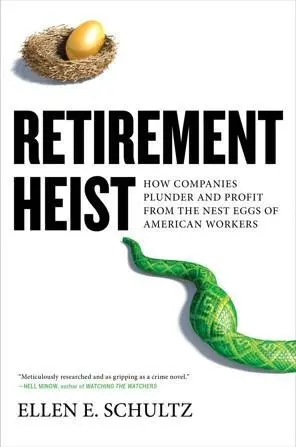
- Название:Retirement Heist
- Автор:
- Издательство:Penguin Group
- Жанр:
- Год:2011
- Город:New York
- ISBN:978-1-101-44607-2
- Рейтинг книги:3 / 5. Голосов: 1
-
Избранное:Добавить в избранное
- Отзывы:
-
Ваша оценка:
Retirement Heist: краткое содержание, описание и аннотация
Предлагаем к чтению аннотацию, описание, краткое содержание или предисловие (зависит от того, что написал сам автор книги «Retirement Heist»). Если вы не нашли необходимую информацию о книге — напишите в комментариях, мы постараемся отыскать её.
It’s no secret that hundreds of companies have been slashing pensions and health coverage earned by millions of retirees. Employers blame an aging workforce, stock market losses, and spiraling costs- what they call “a perfect storm” of external forces that has forced them to take drastic measures.
But this so-called retirement crisis is no accident. Ellen E. Schultz, award-winning investigative reporter for the
, reveals how large companies and the retirement industry-benefits consultants, insurance companies, and banks-have all played a huge and hidden role in the death spiral of American pensions and benefits.
A little over a decade ago, most companies had more than enough set aside to pay the benefits earned by two generations of workers, no matter how long they lived. But by exploiting loopholes, ambiguous regulations, and new accounting rules, companies essentially turned their pension plans into piggy banks, tax shelters, and profit centers.
Drawing on original analysis of company data, government filings, internal corporate documents, and confidential memos, Schultz uncovers decades of widespread deception during which employers have exaggerated their retiree burdens while lobbying for government handouts, secretly cutting pensions, tricking employees, and misleading shareholders. She reveals how companies:
Siphon billions of dollars from their pension plans to finance downsizings and sell the assets in merger deals
• Overstate the burden of rank-and-file retiree obligations to justify benefits cuts while simultaneously using the savings to inflate executive pay and pensions
• Hide their growing executive pension liabilities, which at some companies now exceed the liabilities for the regular pension plans
• Purchase billions of dollars of life insurance on workers and use the policies as informal executive pension funds. When the insured workers and retirees die, the company collects tax-free death benefits
• Preemptively sue retirees after cutting retiree health benefits and use other legal strategies to erode their legal protections.
Though the focus is on large companies—which drive the legislative agenda-the same games are being played at smaller companies, non-profits, public pensions plans and retirement systems overseas. Nor is this a partisan issue: employees of all political persuasions and income levels-from managers to miners, pro-football players to pilots-have been slammed.
Retirement Heist
Retirement Heist — читать онлайн бесплатно полную книгу (весь текст) целиком
Ниже представлен текст книги, разбитый по страницам. Система сохранения места последней прочитанной страницы, позволяет с удобством читать онлайн бесплатно книгу «Retirement Heist», без необходимости каждый раз заново искать на чём Вы остановились. Поставьте закладку, и сможете в любой момент перейти на страницу, на которой закончили чтение.
Интервал:
Закладка:
McClow obtained another batch of strategy memos when he subpoenaed Towers Perrin. On the final day of shoveling through a roomful of printouts of actuarial projections, he found the suggestions for ways to cut the retiree benefits and “Litigation Risk” analyses. These kinds of unflattering strategy memos come to light so rarely that when Massey Ferguson found out that McClow had obtained them, a lawyer for the company accused him of stealing the documents, then filed a motion for a protective order to get them back. The judge denied the request.
Ironically, the documents never played a role in any court case, even the famous Varity Corp. v. Howe case that went before the Supreme Court, nor did McClow need them for the case he was handling, in which he succeeded in getting the company to restore 80 percent to 100 percent of the retirees’ benefits. He thought the matter was settled.
For several years, nothing happened. Then, in 2006, TRW resurrected the game book of its predecessor and began a series of creeping take-aways. It conducted its first “death audit,” sending letters to retirees, telling them they had to prove they were alive or lose their coverage. Death audits seem to serve a legitimate purpose; after all, companies audit health plans to ensure that ineligible family members aren’t included. With retiree health plans, a cynical person might think death audits exist primarily to generate fees for benefits consulting firms. After all, if a retiree dies, he isn’t running up prescription drug costs, and few eighty-year-olds have dependent children.
Panicked retirees called McClow, who contacted TRW and got the company to back off. After all, the settlement provided for lifetime benefits. It didn’t have any provision about requiring the retirees to prove they were still alive.
Months later, the retirees were notified that they had been dropped from Medicare. Why? Because TRW had automatically enrolled them in a Medicare Advantage plan. These are health plans run by private insurers, who receive a government subsidy to provide the equivalent of Medicare. The benefits differ slightly—Medicare Advantage plans might provide low-cost benefits, such as gym memberships and discounts on hearing aids, but as a trade-off the plans limit the retirees’ choice of hospitals and doctors. TRW called it a “better” plan, and it was—for TRW. The plan saved the company $95,000 a month.
McClow, who looks like a cross between Sean Connery and the Archbishop of Canterbury and has the slightly exasperated air of a middle-school teacher dealing with unruly teens, took the company to court. He pointed out that the settlement didn’t allow the company to change the plan. TRW filed a motion to say it hadn’t changed the plan—it had only changed the administrator. The magistrate agreed.
McClow filed an appeal, and in December 2009, a federal judge vacated the magistrate’s decision because, under federal law, people must be given the choice to remain on Medicare. TRW then filed a motion for reconsideration. This lingered on the judge’s docket for eight months, until McClow filed a motion to get the judge to make a decision.
Finally, in November 2010, the retirees’ prior coverage was restored. Still, TRW and its lawyers came out ahead: The several hundred thousand dollars it paid in legal fees was more than offset by the $1.7 million in savings it enjoyed while the retirees were on the Medicare Advantage Plan. [17] Less fortunate were the retirees who ended up at auto-parts maker Hayes Lemmerz. To dump the retirees, the company initially explored the idea of suing them in court and asking a judge to agree that an earlier settlement McClow had negotiated, in which the company had agreed to provide a certain level of lifetime coverage, was ambiguous. The company filed for Chapter 11 in 2009 and shed most of its retiree obligation. When it emerged from bankruptcy, it was obliged to pay only $1,000 a year per post-sixty-five retiree.
A few years earlier, in 2008, TRW had initiated a different cost-savings tack when it eliminated coverage for certain categories of drugs. John Galloway learned that TRW was no longer paying for a prescription drug that his wife, Pansy, takes for acid reflux when, instead of a co-pay of $3, he got a bill for $103. According to TRW, the drug wasn’t medically necessary; Tums would do just as well. Maybe for healthy people, but not for someone confined to a bed in a nursing home. McClow filed a motion for an injunction; the settlement hadn’t agreed to allow TRW to establish its own formulary.
In October 2010, TRW began trying another cost-savings tack: It sent the dwindling number of retirees yet another death audit. The “Life Verification Declaration” required the retirees to provide a notarized affidavit, the first page of their federal income tax returns, and a marriage license if they had coverage for a spouse. To acquire the needed documentation, the verification form advised retirees to contact the county clerks in the locations of the marriages and births and the local Social Security Administration. And for all those Web-savvy octogenarians, it provided “Helpful Web sites,” such as Michigan.gov.
Retirees were instructed to return all the required documents by November 29. “If you do not, TRW will automatically terminate coverage for you and your dependants as of December 31, 2010.” It also warned them about the “Possible Consequences of Insurance Fraud,” which would include having to reimburse TRW for the cost of services the ineligible person receives. “Research has shown that ineligible members left on a healthcare plan can contribute thousands of dollars to raising healthcare costs that impact everyone,” the letter said.
Audits of regular health plans might save company money by turning up ineligible dependents, such as grown children or ex-spouses. But with retiree health coverage, the only way a person can become ineligible is by dying. If that’s the case, his name turns up within two months on the Social Security death register, which benefits administrators parse monthly to make sure they discontinue sending pension checks and drop the deceased retiree from its plan.
McClow considered the death audit to be a cynical trick to strip retirees of their coverage: “The real savings comes from terminating the retirees who do not respond,” which, in fact, one-third of the retirees failed to do. McClow asked TRW for a list of the one hundred or so Kelsey-Hayes retirees it was prepared to drop because it hadn’t received their affidavits. One by one, McClow looked up each retiree’s name in the Social Security death index. All but one was alive. The trick was to locate the rest and get them to turn in their paperwork.
He began by calling those he had numbers for, sometimes letting the phone ring twenty times to give them time to totter to the phone. “By the end of the conversation, some of them couldn’t remember what I was calling about. ‘What was it you wanted?’ they’d say.” Equipped with printouts from MapQuest, McClow went door to door in some of the desolate neighborhoods of Detroit, where some of the retirees were too nervous to come to the door. In one case, he was able to get a neighbor to persuade one elderly woman to let McClow pass the papers through the bars on her door.
Some were in nursing homes or had moved in with their families. Several others died while McClow was on the hunt. As of March 2011, McClow had located all the missing retirees. Their coverage was safe. Until the next audit.
Chapter 10
TWILIGHT ZONE
How Employers Use Pension Law to Thwart Retirees
UNTIL RECENTLY,someone pausing at the Wal-Mart in Delmont, Pennsylvania, might have been greeted by Ed Peksa, who had retired years before from GenCorp, the former General Tire and Rubber Co., whose well-known jingle goes, “Sooner or later, you’ll own General.”
Читать дальшеИнтервал:
Закладка:
Похожие книги на «Retirement Heist»
Представляем Вашему вниманию похожие книги на «Retirement Heist» списком для выбора. Мы отобрали схожую по названию и смыслу литературу в надежде предоставить читателям больше вариантов отыскать новые, интересные, ещё непрочитанные произведения.



Обсуждение, отзывы о книге «Retirement Heist» и просто собственные мнения читателей. Оставьте ваши комментарии, напишите, что Вы думаете о произведении, его смысле или главных героях. Укажите что конкретно понравилось, а что нет, и почему Вы так считаете.