Ellen Schultz - Retirement Heist
Здесь есть возможность читать онлайн «Ellen Schultz - Retirement Heist» весь текст электронной книги совершенно бесплатно (целиком полную версию без сокращений). В некоторых случаях можно слушать аудио, скачать через торрент в формате fb2 и присутствует краткое содержание. Город: New York, Год выпуска: 2011, ISBN: 2011, Издательство: Penguin Group, Жанр: economics, org_behavior, на английском языке. Описание произведения, (предисловие) а так же отзывы посетителей доступны на портале библиотеки ЛибКат.
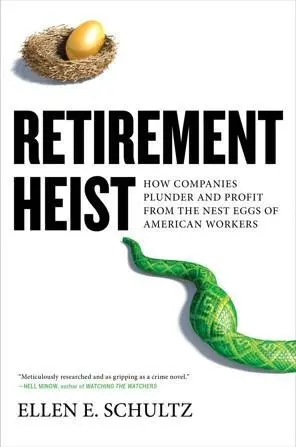
- Название:Retirement Heist
- Автор:
- Издательство:Penguin Group
- Жанр:
- Год:2011
- Город:New York
- ISBN:978-1-101-44607-2
- Рейтинг книги:3 / 5. Голосов: 1
-
Избранное:Добавить в избранное
- Отзывы:
-
Ваша оценка:
Retirement Heist: краткое содержание, описание и аннотация
Предлагаем к чтению аннотацию, описание, краткое содержание или предисловие (зависит от того, что написал сам автор книги «Retirement Heist»). Если вы не нашли необходимую информацию о книге — напишите в комментариях, мы постараемся отыскать её.
It’s no secret that hundreds of companies have been slashing pensions and health coverage earned by millions of retirees. Employers blame an aging workforce, stock market losses, and spiraling costs- what they call “a perfect storm” of external forces that has forced them to take drastic measures.
But this so-called retirement crisis is no accident. Ellen E. Schultz, award-winning investigative reporter for the
, reveals how large companies and the retirement industry-benefits consultants, insurance companies, and banks-have all played a huge and hidden role in the death spiral of American pensions and benefits.
A little over a decade ago, most companies had more than enough set aside to pay the benefits earned by two generations of workers, no matter how long they lived. But by exploiting loopholes, ambiguous regulations, and new accounting rules, companies essentially turned their pension plans into piggy banks, tax shelters, and profit centers.
Drawing on original analysis of company data, government filings, internal corporate documents, and confidential memos, Schultz uncovers decades of widespread deception during which employers have exaggerated their retiree burdens while lobbying for government handouts, secretly cutting pensions, tricking employees, and misleading shareholders. She reveals how companies:
Siphon billions of dollars from their pension plans to finance downsizings and sell the assets in merger deals
• Overstate the burden of rank-and-file retiree obligations to justify benefits cuts while simultaneously using the savings to inflate executive pay and pensions
• Hide their growing executive pension liabilities, which at some companies now exceed the liabilities for the regular pension plans
• Purchase billions of dollars of life insurance on workers and use the policies as informal executive pension funds. When the insured workers and retirees die, the company collects tax-free death benefits
• Preemptively sue retirees after cutting retiree health benefits and use other legal strategies to erode their legal protections.
Though the focus is on large companies—which drive the legislative agenda-the same games are being played at smaller companies, non-profits, public pensions plans and retirement systems overseas. Nor is this a partisan issue: employees of all political persuasions and income levels-from managers to miners, pro-football players to pilots-have been slammed.
Retirement Heist
Retirement Heist — читать онлайн бесплатно полную книгу (весь текст) целиком
Ниже представлен текст книги, разбитый по страницам. Система сохранения места последней прочитанной страницы, позволяет с удобством читать онлайн бесплатно книгу «Retirement Heist», без необходимости каждый раз заново искать на чём Вы остановились. Поставьте закладку, и сможете в любой момент перейти на страницу, на которой закончили чтение.
Интервал:
Закладка:
A lower court ruled for the retirees. GM appealed, and the Sixth Circuit Court of Appeals in Cincinnati ruled in 1998 that it didn’t matter what the company had told people verbally, and it didn’t matter that the company gave prospective retirees brochures that advised them that health coverage would be provided “at GM’s expense for your lifetime.”
What mattered, the appeals court said, in Sprague v. General Motors, was that GM had added an escape clause to the summary of the plan documents (SPD) it gave the first group of retirees. The clause, included in the documents that few employees read, and even fewer understand, stated that GM “reserved the right” to make changes to the plan. “We see no ambiguity in a summary plan description that tells participants both that the terms of the current plan entitle them to health insurance at no cost throughout retirement and that the terms of the current plan are subject to change,” the court said.
But wait—there wasn’t any reservation-of-rights clause in the SPD that GM gave this group of retirees. Score one for the retirees? You’d think so. But with the elastic logic so common in ERISA decisions, the court of appeals concluded that this was a summary plan description; “as such, it was a summary, so wouldn’t include everything, including such things as reservation of rights clauses.”
Further, the court concluded that an employer didn’t even need to write down a reservation-of-rights clause. So, even if the documents didn’t include such a clause, the court must infer that the company intended to reserve the right to cut benefits.
As for the retirees, just because the company promised orally and in writing that their benefits were to be paid by GM, the court could not infer that GM intended to pay the benefits. “GM never told the early retirees that their health care benefits would be fully paid up or vested upon retirement. What GM told many of them, rather, was that their coverage was to be paid by GM for their lifetimes.” In other words, because GM didn’t use the word “vested,” the benefits weren’t.
“Interpretive gymnastics,” scoffed one of the dissenting judges. The three dissenting judges said the majority’s ruling gave employers a green light to lie to employees by luring them into early retirement with promises of health coverage, then canceling the benefits once the people had made an irrevocable decision to retire. “When General Motors was flush with cash and health care costs were low, it was easy to promise employees and retirees lifetime health care…. Rather than pay off those perhaps ill-considered promises, it is easier for the current regime to say those promises were never made. There is the tricky little matter of the paper trail of written assurances of lifetime health care, but General Motors, with the en banc majority’s assistance, has managed to escape the ramifications of its now-regretted largesse.”
For years, union retirees generally had greater security because their benefits were protected by negotiated contracts, which fall under the federal Labor–Management Relations Act, as well as ERISA. When employers tried to cut health benefits for union retirees—pointing to reservation-of-rights clauses—the courts generally concluded that the contracts, not the companies’ unilaterally created plan descriptions were what mattered.
But after the GM ruling, employers began to argue that the benefits for union retirees should be governed by the same pro-employer inference that was applied in that ruling. To enhance their chances of success, some companies started to use a strategy outlined by the Varity managers: creeping take-aways. This involves taking small steps—increase premiums a small amount, or perhaps start charging premiums in the future. The retirees and unions ignore them. Then, a few years later, the company cuts benefits in a big way, saying that the retirees’ prior lack of legal action signaled tacit agreement that the company could change the plan.
Another ploy companies have used in an effort to increase the chances of appearing before a sympathetic judge is to sue retirees preemptively as they cut the benefits.
Chuck Yarter, a retired miner living in the Sonoran Desert outside Marana, Arizona, learned that he was being sued in 2003 when he got a phone call from a process server who was lost. Yarter gave the guy directions to his stucco home, which sits at the end of an unnamed dirt road, with a distant view of the open-pit Silver Bell copper mine, where Yarter had been a mechanic on ore crushers.
Yarter waited in his yard, curious. He’d never been sued in his life. The approaching trail of dust told him the car was arriving. When the process server pulled up, Yarter’s dog wouldn’t let him out of the car, so after exchanging a few pleasantries, he handed the papers through the car window before trundling away through the saguaro and mesquite.
The papers told Yarter that his former employer, Asarco, was suing him and other retirees in federal court in Phoenix. Asarco, an integrated copper producer that was once known as American Smelting and Refining Co., said it was asking the court to agree that it had the right to cut the union retirees’ benefits.
Asarco, a unit of Grupo Mexico SA, didn’t dispute that it had a contract with the retirees to provide health care until they were eligible for Medicare. But it said the agreements had expired when the labor contracts had, sometime back in the 1990s. The company then sent a letter to its 901 union retirees and dependents, explaining that falling copper prices and rising health care costs left it no choice but to reduce their health coverage. “The continuing low copper price has caused Asarco severe financial distress…. As a result, Asarco is no longer in a position to continue to provide health plan benefits at the current levels.”
The retirees were in a slightly better position than the GenCorp retirees: Some could pile into a van and drive to Mexico for their prescription drugs; others, however, dropped out of the plan as prices spiraled and went on public programs. Yarter appreciated the irony: Not only did his health care costs rise but, as a taxpayer, he would ultimately be picking up the tab for others.
Gonzalo Frias, a retiree-defendant who was a shovel operator at the Ray Mine in Kearny, Arizona, had been president of the local United Steelworkers union when the contracts were negotiated, and said it was ludicrous to think the workers would have agreed to lower wages in exchange for health coverage until sixty-five if the agreement meant the company could pull the plug at any time. The Steelworkers supported the retirees in the lawsuit. “ ‘Unforeseen circumstances’ do not justify a breach of contractual obligations… to persons living on fixed income who can ill afford to pay the costs the company has shifted upon them,” they told the court. It added that the “alleged ‘severe financial distress’ has not prevented the company from paying its top management quite handsomely.”
Like the GenCorp retirees, the Asarco retirees ultimately settled, in 2007, agreeing to pay some of the benefits, with the amounts remaining unchanged for six years. It was a reprieve of sorts. They felt lucky to get that: The company, facing a number of environmental lawsuits, filed for bankruptcy in 2005 and emerged in 2010.
CIRCUIT BREAKER
In early 2002, Rexam, a maker of cans for beverages, including Diet Coke, made a tiny increase in retirees’ share of the cost of prescription drugs. For more than a year, retirees complained to the company that it had no right to change the negotiated agreements, which stated that “Company-paid major medical coverage will be provided for all retirees.” Successive contracts noted that the parties had agreed that “the Company will continue to pay the entire cost.” But the changes weren’t a big enough deal for the retirees to take legal action.
Читать дальшеИнтервал:
Закладка:
Похожие книги на «Retirement Heist»
Представляем Вашему вниманию похожие книги на «Retirement Heist» списком для выбора. Мы отобрали схожую по названию и смыслу литературу в надежде предоставить читателям больше вариантов отыскать новые, интересные, ещё непрочитанные произведения.









Обсуждение, отзывы о книге «Retirement Heist» и просто собственные мнения читателей. Оставьте ваши комментарии, напишите, что Вы думаете о произведении, его смысле или главных героях. Укажите что конкретно понравилось, а что нет, и почему Вы так считаете.