Ellen Schultz - Retirement Heist
Здесь есть возможность читать онлайн «Ellen Schultz - Retirement Heist» весь текст электронной книги совершенно бесплатно (целиком полную версию без сокращений). В некоторых случаях можно слушать аудио, скачать через торрент в формате fb2 и присутствует краткое содержание. Город: New York, Год выпуска: 2011, ISBN: 2011, Издательство: Penguin Group, Жанр: economics, org_behavior, на английском языке. Описание произведения, (предисловие) а так же отзывы посетителей доступны на портале библиотеки ЛибКат.
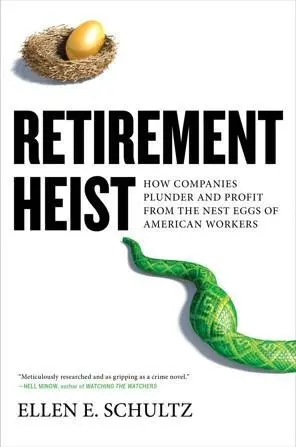
- Название:Retirement Heist
- Автор:
- Издательство:Penguin Group
- Жанр:
- Год:2011
- Город:New York
- ISBN:978-1-101-44607-2
- Рейтинг книги:3 / 5. Голосов: 1
-
Избранное:Добавить в избранное
- Отзывы:
-
Ваша оценка:
Retirement Heist: краткое содержание, описание и аннотация
Предлагаем к чтению аннотацию, описание, краткое содержание или предисловие (зависит от того, что написал сам автор книги «Retirement Heist»). Если вы не нашли необходимую информацию о книге — напишите в комментариях, мы постараемся отыскать её.
It’s no secret that hundreds of companies have been slashing pensions and health coverage earned by millions of retirees. Employers blame an aging workforce, stock market losses, and spiraling costs- what they call “a perfect storm” of external forces that has forced them to take drastic measures.
But this so-called retirement crisis is no accident. Ellen E. Schultz, award-winning investigative reporter for the
, reveals how large companies and the retirement industry-benefits consultants, insurance companies, and banks-have all played a huge and hidden role in the death spiral of American pensions and benefits.
A little over a decade ago, most companies had more than enough set aside to pay the benefits earned by two generations of workers, no matter how long they lived. But by exploiting loopholes, ambiguous regulations, and new accounting rules, companies essentially turned their pension plans into piggy banks, tax shelters, and profit centers.
Drawing on original analysis of company data, government filings, internal corporate documents, and confidential memos, Schultz uncovers decades of widespread deception during which employers have exaggerated their retiree burdens while lobbying for government handouts, secretly cutting pensions, tricking employees, and misleading shareholders. She reveals how companies:
Siphon billions of dollars from their pension plans to finance downsizings and sell the assets in merger deals
• Overstate the burden of rank-and-file retiree obligations to justify benefits cuts while simultaneously using the savings to inflate executive pay and pensions
• Hide their growing executive pension liabilities, which at some companies now exceed the liabilities for the regular pension plans
• Purchase billions of dollars of life insurance on workers and use the policies as informal executive pension funds. When the insured workers and retirees die, the company collects tax-free death benefits
• Preemptively sue retirees after cutting retiree health benefits and use other legal strategies to erode their legal protections.
Though the focus is on large companies—which drive the legislative agenda-the same games are being played at smaller companies, non-profits, public pensions plans and retirement systems overseas. Nor is this a partisan issue: employees of all political persuasions and income levels-from managers to miners, pro-football players to pilots-have been slammed.
Retirement Heist
Retirement Heist — читать онлайн бесплатно полную книгу (весь текст) целиком
Ниже представлен текст книги, разбитый по страницам. Система сохранения места последней прочитанной страницы, позволяет с удобством читать онлайн бесплатно книгу «Retirement Heist», без необходимости каждый раз заново искать на чём Вы остановились. Поставьте закладку, и сможете в любой момент перейти на страницу, на которой закончили чтение.
Интервал:
Закладка:
GenCorp argued that the retirees had knowingly released the company from its obligation to pay, and pointed to the enrollment forms retirees had filled out years earlier, saying coverage was “replaced.” In short, the retirees, not GenCorp, were trying to renege on a written agreement, company lawyers maintained.
The judge could have decided the case on the merits or sent it to trial. Instead, he insisted that the parties work it out. But when neither side budged, the judge scheduled a mediation meeting in Cleveland—a year later. A year passed. GenCorp then insisted that the retirees should include people from other locations, so several retirees traveled from Kentucky and Ohio, booking senior-discount rooms at the Holiday Inn. Kenneth Bottolfs, then in his eighties, came the farthest. His threeconnecting-flight trip from Waco, Texas, took eight hours.
When neither side backed down in this second mediation hearing, the judge ordered a third meeting. Eight months later, the retirees traveled to this third meeting, minus Wotus, who’d had a stroke. This meeting failed, too, so the judge finally ordered depositions and document production to proceed. This meant the retirees had to travel to Cleveland to be deposed by GenCorp lawyers. The May 2003 sessions took several hours each. The retirees whiled away their waits playing cards and trading war stories about their times at Okinawa and Iwo Jima.
END OF THE ROAD
The following August, the retirees’ lawyers filed to have the suit certified as a class action. Without this, even if the named plaintiffs won, no others would get their benefits restored. GenCorp opposed this. It said that the plaintiffs were too befuddled to represent the class. As was clear from their depositions, some had forgotten what they were thinking when they signed enrollment forms. One didn’t remember what was in GenCorp’s slide presentation explaining the benefit options eight years earlier.
GenCorp also accused the retirees of destroying evidence. The reason: They’d commingled their paperwork when they pooled their brochures in a cardboard box while searching for a lawyer. That constituted “spoliation,” GenCorp said, adding that it would “seek appropriate remedies at a later date.” Remedies in these situations can include charging retirees for a company’s legal fees.
Finally, GenCorp said the retirees should be denied class status because they were too dispersed, so that different legal standards governing different parts of the country would apply, and because the named plaintiffs were too sick to adequately represent everybody. The plaintiffs were, in fact, sick. Shortly after, in October 2003, Robert Berger, age sixty-nine, died. Polumbo died the next month, at eighty-nine. His widow, Mary Elizabeth, eighty-eight, volunteered to take his place. In December, the judge sided with GenCorp and denied the retirees’ request to be certified as a class.
The retirees had discovered another harsh reality: If he is so inclined, a judge can keep a case from ever reaching a trial. Judge Dan Polster had badgered the parties to settle and the retirees had to travel, time and again, to court hundreds of miles away, in some cases to attend incremental hearings that took only a short time.
The retirees figured that by denying the class action, the judge was just trying to get them to give up. But after this setback, the retirees rallied and signed up an additional 294 plaintiffs. They filed another suit in July 2004, in time to beat a statute of limitations that the company said was about to expire. The next month, the judge dismissed that case, telling the roughly four hundred retirees, mostly in their eighties, that each would have to file an individual case and pay the $150 filing fee for each one.
The retirees called the judge’s bluff. Payne and Stember filed four hundred individual suits, paying $60,000 in filing fees, rather than the $350 it would have cost if the judge hadn’t insisted on separate individual cases. They had to act fast: “They were dropping like flies,” Payne says. He told the judge that the average age of the retirees was eighty-two.
The judge’s reaction: He said he would grant each of the 342 retirees a trial. One at a time. Hearing one case individually, each month, minus vacation and holidays, would take years, and few of the retirees, whose average age was 82, would live long enough to see it be resolved.
The retirees were backed into a corner. They couldn’t appeal because an appeal can’t be made until a final judgment and there’s no final judgment until the end of a trial. They agreed to settle, and would pay a portion of their coverage. They did not, of course, get reimbursed for what they’d spent for the coverage over the prior six years.
The terms of the late 2005 settlement are confidential, but securities filings make one thing very clear: GenCorp accomplished exactly what the Varity HR managers had predicted would happen in these situations: It saved money. From 2000 to 2008, the company’s liabilities for retiree health care fell almost 70 percent, to $76 million, thanks to the number of retiree dropouts and deaths. And even with the settlement, the plan’s costs have continued to fall steadily. Every year after 2005, the retiree health plan actually contributed a total of $8.4 million to GenCorp’s quarterly earnings. Regardless of whether a company wins or loses its case, it always wins the game.
PREEMPTIVE STRIKE
As companies grew increasingly eager to cannibalize their retiree benefits over the past decade, they realized just how important it is to get their cases heard by the right court.
The first legal hurdle for many was that, like Varity, they had promised the benefits, often in writing. Ironically, one of their most powerful tools was federal pension law, which had been enacted in 1974 to protect employees and retirees. The ERISA law was intended to thwart employers who promised retiree benefits and then refused to pay them. Until then, pension and benefits agreements fell under state contract and trust laws. ERISA was supposed to be an improvement, because it overrode a patchwork of state laws.
The problem was that the law was written for pensions, so it had rules about funding and vesting. If someone had a vested right to a pension, the company couldn’t just decide not to pay it. But ERISA didn’t explicitly mention vesting of medical pensions. So employers argued that retiree health benefits weren’t vested but were merely the equivalent of a gratuity.
Until the early 1970s, all retiree benefits—pensions and medical coverage—fell loosely under state contract laws. If there was a dispute about benefits, the courts would examine the plan documents and handouts given to employees to see whether pensions and retiree health coverage were promised benefits, which must be paid, or, indeed, as employers later insisted, the equivalent of tips.
Employers attacked the problem of written promises by introducing ambiguity into the equation. They began inserting clauses, or sometimes a single sentence, into the technical documents that described the rules and workings of the benefits plans. These reservation-of-rights clauses state that the employer has reserved the right to change the benefits.
General Motors, which figures so prominently in discussions about troubled pension plans, has played a big, largely unsung role in the dismantling of retiree health benefits, for both union and salaried employees, across all industries. In the 1980s, GM promised lifetime health coverage as an incentive to get employees to retire. A total of 84,000 salaried employees ultimately took the bait.
When GM later cut the benefits, retirees sued for breach of contract, pointing to the written promises: “Your basic health care coverage will be provided at GM’s expense for your lifetime.” You’d think a sixyear-old could decipher that. A contract, after all, is a contract. Without contracts, the U.S. economy would fall apart. Think how this would play out in a small claims court. Judge Judy would ask the plaintiffs, “Do you have a written agreement?” She’d then ask GM to explain why it reneged on the deal. “Your honor,” GM would say, “Sure, we promised, in writing, to pay for health coverage, but costs have gone up, and now we don’t want to pay.” Judge Judy would say, “I’m not interested in your problems. You’re an idiot. Judgment for the plaintiff.” Not so under ERISA.
Читать дальшеИнтервал:
Закладка:
Похожие книги на «Retirement Heist»
Представляем Вашему вниманию похожие книги на «Retirement Heist» списком для выбора. Мы отобрали схожую по названию и смыслу литературу в надежде предоставить читателям больше вариантов отыскать новые, интересные, ещё непрочитанные произведения.












Обсуждение, отзывы о книге «Retirement Heist» и просто собственные мнения читателей. Оставьте ваши комментарии, напишите, что Вы думаете о произведении, его смысле или главных героях. Укажите что конкретно понравилось, а что нет, и почему Вы так считаете.