Ellen Schultz - Retirement Heist
Здесь есть возможность читать онлайн «Ellen Schultz - Retirement Heist» весь текст электронной книги совершенно бесплатно (целиком полную версию без сокращений). В некоторых случаях можно слушать аудио, скачать через торрент в формате fb2 и присутствует краткое содержание. Город: New York, Год выпуска: 2011, ISBN: 2011, Издательство: Penguin Group, Жанр: economics, org_behavior, на английском языке. Описание произведения, (предисловие) а так же отзывы посетителей доступны на портале библиотеки ЛибКат.
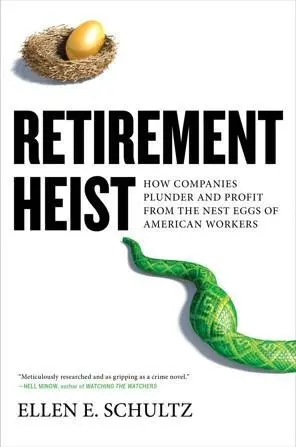
- Название:Retirement Heist
- Автор:
- Издательство:Penguin Group
- Жанр:
- Год:2011
- Город:New York
- ISBN:978-1-101-44607-2
- Рейтинг книги:3 / 5. Голосов: 1
-
Избранное:Добавить в избранное
- Отзывы:
-
Ваша оценка:
Retirement Heist: краткое содержание, описание и аннотация
Предлагаем к чтению аннотацию, описание, краткое содержание или предисловие (зависит от того, что написал сам автор книги «Retirement Heist»). Если вы не нашли необходимую информацию о книге — напишите в комментариях, мы постараемся отыскать её.
It’s no secret that hundreds of companies have been slashing pensions and health coverage earned by millions of retirees. Employers blame an aging workforce, stock market losses, and spiraling costs- what they call “a perfect storm” of external forces that has forced them to take drastic measures.
But this so-called retirement crisis is no accident. Ellen E. Schultz, award-winning investigative reporter for the
, reveals how large companies and the retirement industry-benefits consultants, insurance companies, and banks-have all played a huge and hidden role in the death spiral of American pensions and benefits.
A little over a decade ago, most companies had more than enough set aside to pay the benefits earned by two generations of workers, no matter how long they lived. But by exploiting loopholes, ambiguous regulations, and new accounting rules, companies essentially turned their pension plans into piggy banks, tax shelters, and profit centers.
Drawing on original analysis of company data, government filings, internal corporate documents, and confidential memos, Schultz uncovers decades of widespread deception during which employers have exaggerated their retiree burdens while lobbying for government handouts, secretly cutting pensions, tricking employees, and misleading shareholders. She reveals how companies:
Siphon billions of dollars from their pension plans to finance downsizings and sell the assets in merger deals
• Overstate the burden of rank-and-file retiree obligations to justify benefits cuts while simultaneously using the savings to inflate executive pay and pensions
• Hide their growing executive pension liabilities, which at some companies now exceed the liabilities for the regular pension plans
• Purchase billions of dollars of life insurance on workers and use the policies as informal executive pension funds. When the insured workers and retirees die, the company collects tax-free death benefits
• Preemptively sue retirees after cutting retiree health benefits and use other legal strategies to erode their legal protections.
Though the focus is on large companies—which drive the legislative agenda-the same games are being played at smaller companies, non-profits, public pensions plans and retirement systems overseas. Nor is this a partisan issue: employees of all political persuasions and income levels-from managers to miners, pro-football players to pilots-have been slammed.
Retirement Heist
Retirement Heist — читать онлайн бесплатно полную книгу (весь текст) целиком
Ниже представлен текст книги, разбитый по страницам. Система сохранения места последней прочитанной страницы, позволяет с удобством читать онлайн бесплатно книгу «Retirement Heist», без необходимости каждый раз заново искать на чём Вы остановились. Поставьте закладку, и сможете в любой момент перейти на страницу, на которой закончили чтение.
Интервал:
Закладка:
Soon after ascending the throne, Rice demanded a status report on retiree costs. The managers at the company’s Buffalo, New York, headquarters gave their boss what they assumed was good news. The pension was overfunded, and retiree health costs were “low.” But Rice wanted to cut retiree benefits anyway, even for the most elderly. A memo summarizing his “Philosophy & Objectives” made this clear. “The Company is not committed to maintenance of a retiree’s standard of living.”
Varity’s managers sprang into action, but nothing they suggested was dramatic enough to satisfy Rice. He told them to be a little more creative, and he didn’t let up. Under increased pressure to deliver a plan that would generate big savings, human resources manager Jill Wellman produced this snappish memo: “You have asked that I be inventive in coming up with a solution,” she wrote to her superiors a week before Christmas in 1986. “As far as I can determine there is only one solution” to save the company the most money, she concluded. “That would be the death of all existing retirees.” This happy outcome was, alas, many years in the future.
So Wellman’s memo went on to detail “more practical” but “not necessarily legal” solutions to help her employer meet its cost-cutting goals. One option: Establish “an offshore company responsible for the retirees but not accountable under United States law and have it go bankrupt and thus terminate the plans.” Another: Simply terminate the benefits, wait for the retirees to sue, and then drag out the litigation until the retirees gave up or died.
But Paul Pittman, a benefits and compensation manager, was worried that Wellman’s suggestion about provoking a lawsuit was risky. The company had promised the benefits to both salaried and union retirees. Varity’s lawyers prepared a “litigation risk” report, which noted that the company had promised the benefits. “Worse yet,” the report had said, “there is language in many of the contracts, booklets, and general descriptive material that implies a lifetime commitment. We would never succeed in court.”
Indeed, Wellman herself had drafted a form letter she called a “death letter,” which for years she sent out to widows of retirees, promising health coverage for life. A letter to one Flossie Pietila reassured her: “Mrs. Pietila, our health and dental benefits will continue for the rest of your life at no cost to you.”
Pittman suggested lying to the retirees. In his memo, he called this the “pleading” strategy. The company should tell retirees “that the burden of medical expenses amongst US retirees is unbearably high and would ultimately cause Varity Corporation to cease trading in the US,” Pittman suggested, “and that this would necessitate not only a loss of medical benefits, but also possibly the loss of some pension rights as well.” Although this wasn’t true, if the retirees believed it, they might agree to benefit reductions.
The company could also tell the employees and retirees that the pension plan was in bad shape, creating another burden on the company, Pittman suggested. He thought retirees would see through the maneuver, since it was widely known in the company that the pension plan was healthy, and even if Varity were to go under, he wrote, “the demise of Varity would not necessarily mean the loss of a pension.”
In short, he didn’t feel the company had much bargaining power with its retirees, but he was hoping it could fool the United Auto Workers, the main representative for Varity’s wage earners. “We could convince the union that unless we can reduce our retiree and employees costs we will be unable to continue to operate… thus creating significant hardship for their members,” he wrote in the memo.
If the union didn’t agree, it would be tough to cut their benefits, because they were backed up by negotiated contracts that companies couldn’t unilaterally change. So Pittman suggested a strategy he called “Creeping Take Aways.” Using this approach, Varity “would progressively introduce minor reductions and usage controls rules into the medical benefits plan.” These were “designed to be insufficient to warrant retirees incurring the legal cost and trouble to have the benefits reinstated.” A few years later, Varity could take an ax to the benefits, provoking the union to sue. In court, the company would say that because the union hadn’t objected to the earlier cuts, it tacitly agreed that the company had the right to cut their medical coverage unilaterally.
If that argument didn’t sway the judge, no problem. “There have been a number of companies that have [reduced benefits] knowing that they would lose in court if challenged,” he wrote. The company could simply drag out the case for years.
“The strategy works as follows: the employer implements a major reduction to employee benefits… retirees come together, pool resources or approach their union to fund their case and take the company to court. Financial pressure is applied to retirees during the potentially extended period leading up to the court hearing by forcing them to incur their own medical expenses, in addition to funding the legal proceedings. The next step is for the company, at a carefully chosen moment, to suggest to retirees that they agree to reinstatement of the plan, but at a much reduced level.” The longer Varity could drag out the case, Pittman noted, the better the odds that cash-strapped employees would settle for much less than they were due. Fundamentally, the company had nothing to lose.
PROJECT SUNSHINE
The human resources managers then came up with a surefire way to cut most or all of a unit’s retiree health benefits. “Organized liquidation,” Pittman dubbed it. “This action involves the transferring of all retiree medical liability into a separate or subsidiary company that is then put into receivership,” Pittman wrote. The retirees would sue, of course, but “if made to look realistic, the collapse of [the unit] could be part of a strategy leading to a negotiated reduction” of benefits. When the “financial pressure on retirees is greatest but before we appear to be losing [the] case,” the company could “agree to reinstatement at a reduced level.”
Rice and his executive team thought that was a great idea. Later that year, they organized a new corporate subsidiary, which they named Massey Combines. The bottom had fallen out of the agriculture industry, and demand for the tractors and combines had dried up. So the Varity executives loaded up this subsidiary with its money-losing farm equipment lines, plus millions of dollars in corporate debt, including benefit liabilities for four thousand retirees.
Varity executives then set about convincing active employees to transfer to the new entity, labeling the internal sales program “Project Sunshine.” With meetings, videos, and brochures, executives sought to persuade employees that the spin-off had a “bright future” and that, if they switched over to the new unit, their benefits would remain unchanged. Ultimately, fifteen hundred workers took the bait.
The new firm had a negative net worth of $46 million on its first day of business, and two years later it collapsed. The retirees’ medical coverage disappeared overnight. To celebrate, Victor Rice invited his business managers to his hotel suite in Chicago and boasted, over cognac and cigars, that he had “loaded all his losers in one wagon.”
Even as it pursued Project Sunshine, Varity had begun implementing the less dramatic suggestions presented by its human resource managers, including a series of creeping take-aways. In 1987, Varity stopped reimbursing retirees for Medicare Part B premiums; in 1989, it moved retirees into a managed-care health plan and raised their health care co-payments and deductibles.
Читать дальшеИнтервал:
Закладка:
Похожие книги на «Retirement Heist»
Представляем Вашему вниманию похожие книги на «Retirement Heist» списком для выбора. Мы отобрали схожую по названию и смыслу литературу в надежде предоставить читателям больше вариантов отыскать новые, интересные, ещё непрочитанные произведения.










Обсуждение, отзывы о книге «Retirement Heist» и просто собственные мнения читателей. Оставьте ваши комментарии, напишите, что Вы думаете о произведении, его смысле или главных героях. Укажите что конкретно понравилось, а что нет, и почему Вы так считаете.