T. Binyon - Pushkin
Здесь есть возможность читать онлайн «T. Binyon - Pushkin» — ознакомительный отрывок электронной книги совершенно бесплатно, а после прочтения отрывка купить полную версию. В некоторых случаях можно слушать аудио, скачать через торрент в формате fb2 и присутствует краткое содержание. Жанр: unrecognised, на английском языке. Описание произведения, (предисловие) а так же отзывы посетителей доступны на портале библиотеки ЛибКат.
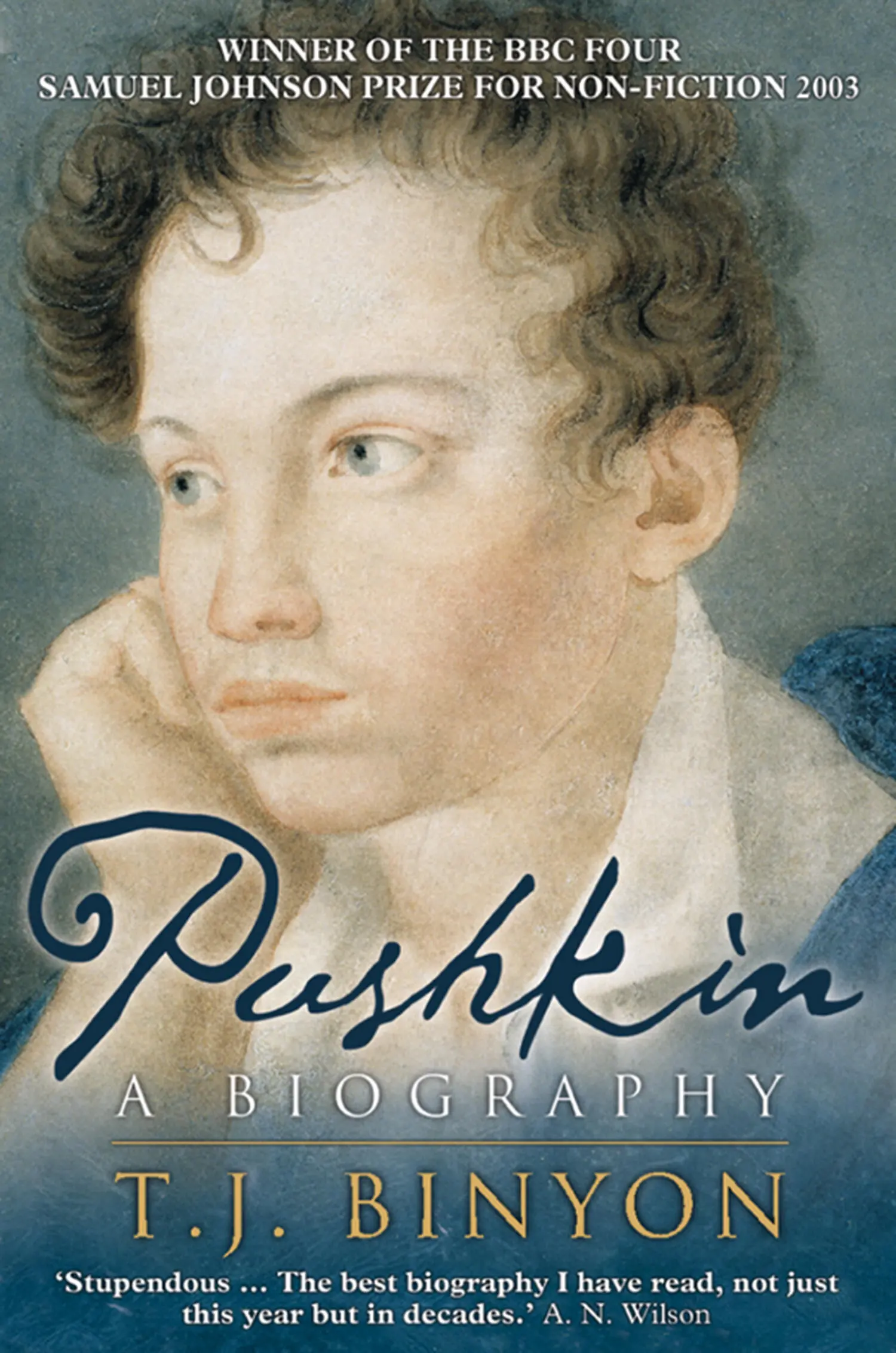
- Название:Pushkin
- Автор:
- Жанр:
- Год:неизвестен
- ISBN:нет данных
- Рейтинг книги:4 / 5. Голосов: 1
-
Избранное:Добавить в избранное
- Отзывы:
-
Ваша оценка:
Pushkin: краткое содержание, описание и аннотация
Предлагаем к чтению аннотацию, описание, краткое содержание или предисловие (зависит от того, что написал сам автор книги «Pushkin»). Если вы не нашли необходимую информацию о книге — напишите в комментариях, мы постараемся отыскать её.
Pushkin — читать онлайн ознакомительный отрывок
Ниже представлен текст книги, разбитый по страницам. Система сохранения места последней прочитанной страницы, позволяет с удобством читать онлайн бесплатно книгу «Pushkin», без необходимости каждый раз заново искать на чём Вы остановились. Поставьте закладку, и сможете в любой момент перейти на страницу, на которой закончили чтение.
Интервал:
Закладка:
In 1823 Count Mikhail Vorontsov was forty-one. He was the son of the former Russian ambassador in London, who had married into the Sidney family and settled in England permanently after his retirement. Vorontsov had received an English education, had studied at Cambridge, and was, like his father, a convinced Anglophile. His sister, Ekaterina, had married Lord Pembroke in 1808, and English relatives would occasionally visit Odessa. A professional soldier, Vorontsov had fought throughout the Napoleonic wars, being wounded at Borodino, and at Craonne in March 1814 had led the Russian corps that took on Napoleon himself in one of the bloodiest battles of the war. After Waterloo he commanded the Russian Army of Occupation in France, when Aleksandr Raevsky was one of his aides-de-camp. He was extremely wealthy, and had added to his fortune by marrying, in 1819, Elizaveta Branicka, who brought with her an enormous dowry: her mother, Countess Branicka, whose estate was at Belaya Tserkov, just south of Kiev, was one of the richest landowners in Russia. Before taking up his new appointment, he had invested massively in land in New Russia, buying immense estates near Odessa and Taganrog, and in the Crimea. He was âtall and thin, with remarkably noble features, as though they had been carved with a chisel, his gaze was unusually calm, and about his thin long lips there eternally played an affectionate and crafty smileâ. 10 âPerhaps only Alexander could be more charming, when he wanted to please,â remarked Wiegel. âHe had a certain exquisite gaucheness, the result of his English upbringing, a manly reserve and a voice which, while never losing its firmness, was remarkably tender.â 11 As a commander he had, like Orlov, discouraged brutality and cruelty in enforcing discipline and had set up regimental schools to educate the troops. He was close to a number of the future Decembrists, and had even, together with Nikolay Turgenev, Pushkinâs St Petersburg friend and fellow-Arzamasite, attempted to set up a society of noblemen with the aim of gradually emancipating the serfs. He had thus acquired the reputation of a liberal; a reputation which he was now strenuously attempting to live down, given the current climate in government circles: a mixture of mysticism and reaction, combined with â since the mutiny of the Semenovsky Life Guards in 1820 â paranoid suspicion of anything remotely radical.
When, at the beginning of August, Pushkin returned to Odessa in Vorontsovâs suite, he took a room in the Hotel Rainaud, where he lived throughout his stay. The hotel was on the corner of Deribasovskaya and Rishelevskaya Streets (named after the first two governors, de Ribas and Richelieu); behind it an annexe, which fronted on Theatre Square, housed the Casino de Commerce, or assembly-rooms: âThe great oval hall, which is surrounded by a gallery, supported on numerous columns, is used for the double purpose of ballroom, and an Exchange , where the merchants sometimes transact their affairs,â wrote Robert Lyall, who visited Odessa in May 1822. 12 Baron Rainaud, the owner of the hotel and casino, was a French émigré; he also possessed a charming villa on the coast three miles to the east of the city, with wonderful views over the Black Sea. Vorontsov rented it for his wife, who was in the final stages of pregnancy when she arrived from Belaya Tserkov on 6 September: she gave birth to a son two months later.
Pushkin had a corner room on the first floor with a balcony, which gave a view of the sea. The theatre and casino were two minutes away; five minutesâ walk down Deribasovskaya and Khersonskaya Streets took him to César Automneâs restaurant, the best in town â
What of the oysters? theyâre here! O joy!
Gluttonous youth flies
To swallow from their sea shells
The plump, living hermitesses,
With a slight squeeze of lemon.
Noise, arguments â light wine
From the cellars is borne
To the table by obliging Automne;
The hours fly, and the dread bill
Meanwhile invisibly mounts. 13
Wiegel, who had been recruited by Vorontsov to join his staff, soon moved into the room next to Pushkin. Before leaving St Petersburg he had been enjoined by Zhukovsky and Bludov to gain Pushkinâs confidence in order, if possible, to prevent him from behaving injudiciously. Unfortunately, Pushkin did not enjoy his company for long: Vorontsov sacked the vice-governor of Kishinev for dishonesty and appointed Wiegel in his place. âTell me, my dear atheist, how did you manage to live for several years in Kishinev?â he wrote to Pushkin on 8 October. âAlthough you should indeed have been punished by God for your lack of faith, surely not to such an extent. As far as I am concerned, I can say too: although my sins or, more accurately, my sin is great, it is not so great that fate should have destined this cesspit to be my abode.â 14 The sin Wiegel is referring to is his homosexuality. In a verse reply, Pushkin promised to visit him: âIâll be glad to serve you/With my crazy conversation â/With verses, prose or with my soul,/But, Wiegel, â spare my arse!â Continuing in prose, he answers a query raised by Wiegel about the Ralli brothers. âI think the smallest is best suited to your use; NB he sleeps in the same room as his brother Mikhail and they tumble about unmercifully â from this you can draw important conclusions, I leave them to your experience and good sense â the eldest brother, as you have already noticed, is as stupid as a bishopâs crozier â Vanka jerks off â so the devil with them â embrace them in friendly fashion from me.â 15
Two and a half years earlier, on 2 February 1821, in the governor of Kievâs drawing-room, Pushkin had been struck by the beauty of a woman wearing a poppy-red toque with a drooping ostrich feather, âwhich set off extraordinarily well her tall stature, luxuriant shoulders and fiery eyesâ. 16 This was Karolina SobaÅska, the twenty-seven-year-old daughter of Count Adam Rzewuski, one of several attractive and brilliantly clever brothers and sisters: her sister Ewa Hanska was Balzacâs Ãtrangère , who, after a long correspondence and liaison with the novelist, married him in 1850, a few months before his death. Karolina had been married at seventeen to Hieronim SobaÅski, a wealthy landowner and owner of one of the largest trading houses in Odessa. He was, however, thirty-three years older than her; she left him in 1816, and in 1819 met and began a long liaison with Colonel-General Count Jan Witt. * Since 1817 Witt had been in command of all the military colonies in the south of Russia; in addition he controlled a wide and efficient network of spies and secret police agents. He and SobaÅska lived openly together; the liaison was recognized by society, and though its more straitlaced members might have frowned at the irregularity of the relationship, there were few who wished to incur his enmity by cutting SobaÅska in public.
When Pushkin met her again, his interest was immediately rekindled: she was, indeed, almost irresistible â not only beautiful, but also lively, charming and provocative, and a talented musician: âWhat grace, what a voice, and what manners!â 17 Few, if any, knew at the time that, as well as being Wittâs mistress, she also worked for him, and was an extremely valuable Russian intelligence agent. Only Wiegel appears to have had an inkling of the truth. âWhen a few years later I learnt [â¦] that for financial gain she joined the ranks of the gendarme agents, I felt an invincible aversion to her. I will not mention the unproved crimes of which she was suspected. What vilenesses were concealed beneath her elegant appearance!â * 18 Witt, eager to obtain evidence of subversive activity, encouraged her friendship with Pushkin, as in 1825 he would encourage her liaison with the Polish poet Mickiewicz. She and Pushkin made an excursion by boat together; he accompanied her to the Roman Catholic church, where she dipped her fingers into the stoup and crossed his forehead with holy water; and there were âburning readingsâ of Constantâs Adolphe,19 a book so appropriate to their circumstances it might have been written with them in mind: the hero, Adolphe, falls in love with Ellénore, a Polish countess, celebrated for her beauty, who is older than he and is being kept by a M. de P***. But Sobanska did not appear to feel more than friendship for him; piqued, he concocted, together with Aleksandr Raevsky, a scheme to arouse her interest. Before it could be put into practice she left the city, and Pushkin consoled himself for her absence by falling in love with Amaliya Riznich, the daughter of an Austrian-Jewish banker, married to an Odessa shipping merchant.
Читать дальшеИнтервал:
Закладка:
Похожие книги на «Pushkin»
Представляем Вашему вниманию похожие книги на «Pushkin» списком для выбора. Мы отобрали схожую по названию и смыслу литературу в надежде предоставить читателям больше вариантов отыскать новые, интересные, ещё непрочитанные произведения.











Обсуждение, отзывы о книге «Pushkin» и просто собственные мнения читателей. Оставьте ваши комментарии, напишите, что Вы думаете о произведении, его смысле или главных героях. Укажите что конкретно понравилось, а что нет, и почему Вы так считаете.