T. Binyon - Pushkin
Здесь есть возможность читать онлайн «T. Binyon - Pushkin» — ознакомительный отрывок электронной книги совершенно бесплатно, а после прочтения отрывка купить полную версию. В некоторых случаях можно слушать аудио, скачать через торрент в формате fb2 и присутствует краткое содержание. Жанр: unrecognised, на английском языке. Описание произведения, (предисловие) а так же отзывы посетителей доступны на портале библиотеки ЛибКат.
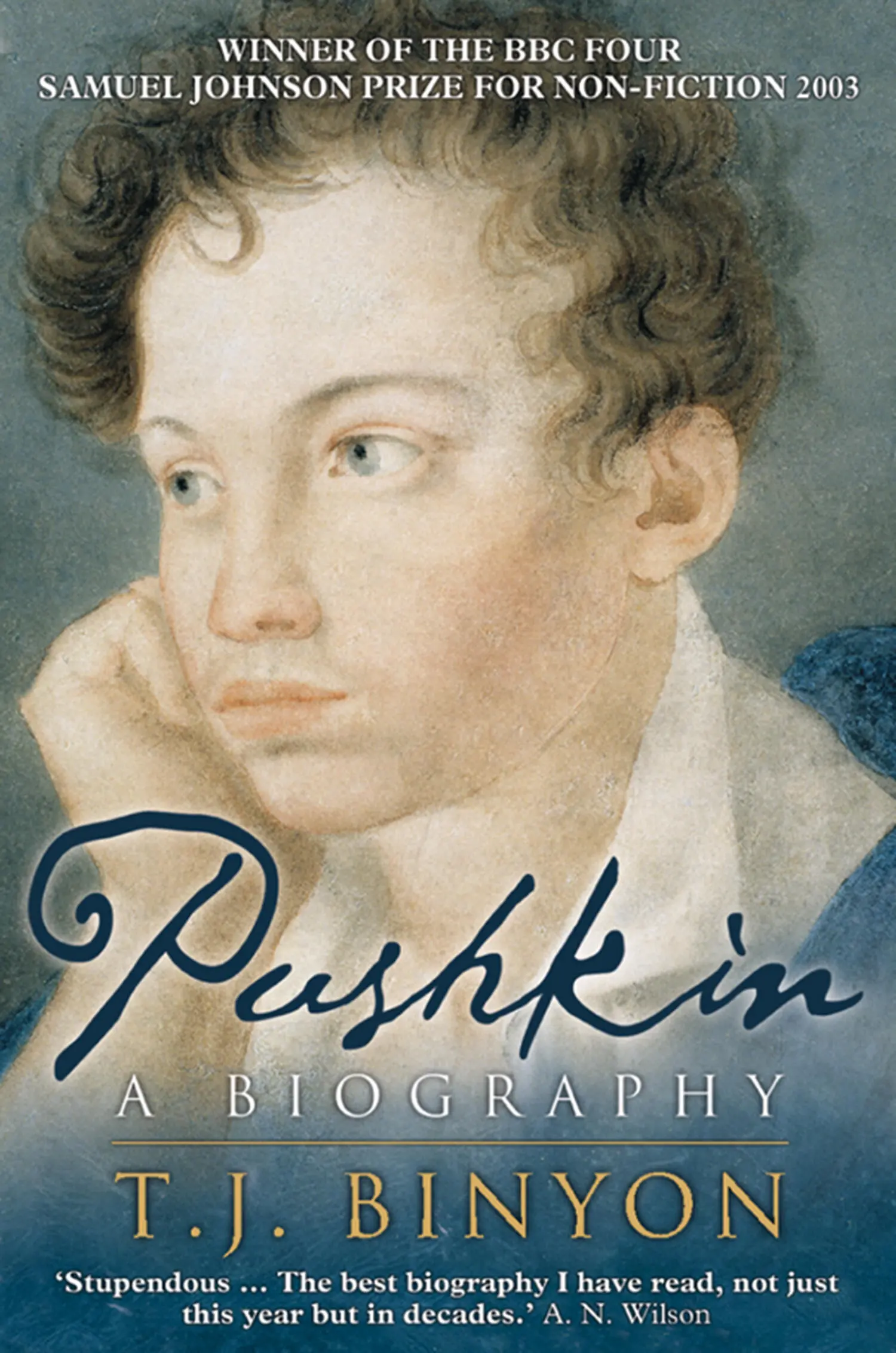
- Название:Pushkin
- Автор:
- Жанр:
- Год:неизвестен
- ISBN:нет данных
- Рейтинг книги:4 / 5. Голосов: 1
-
Избранное:Добавить в избранное
- Отзывы:
-
Ваша оценка:
Pushkin: краткое содержание, описание и аннотация
Предлагаем к чтению аннотацию, описание, краткое содержание или предисловие (зависит от того, что написал сам автор книги «Pushkin»). Если вы не нашли необходимую информацию о книге — напишите в комментариях, мы постараемся отыскать её.
Pushkin — читать онлайн ознакомительный отрывок
Ниже представлен текст книги, разбитый по страницам. Система сохранения места последней прочитанной страницы, позволяет с удобством читать онлайн бесплатно книгу «Pushkin», без необходимости каждый раз заново искать на чём Вы остановились. Поставьте закладку, и сможете в любой момент перейти на страницу, на которой закончили чтение.
Интервал:
Закладка:
âMrs Riznich was young, tall, graceful, and extraordinarily beautiful.
Particularly attractive were her fiery eyes, a neck of amazing form and whiteness, and a plait of black hair, nearly five feet long. But her feet were too large; in order to conceal this deficiency, she always wore a long dress, to the ground. She went about wearing a manâs hat and dressed in a semi-riding habit. All this gave her originality and attracted both young and not so young heads and hearts.â 20 She distinguished herself by going about much in society â âOur married ladies (with the exception of the beautiful and charming Mrs Riznich) avoid company, concealing under the guise of modesty either their simplicity or their ignorance,â Tumansky wrote to his cousin 21 â and entertained frequently at home. These were lively gatherings, at which much whist was played: a game of which she was passionately fond. Pushkin was soon obsessed with her. Profiles of âMadame Riznich, with her Roman noseâ 22 crept out of his pen to ornament the manuscript of the first chapter of Eugene Onegin. His emotions reached their zenith in the last weeks of October and the first of November with a sudden burst of poems. The passionate love, the burning jealousy they express are far deeper, far more powerful, far more agonizing than anything he had previously experienced. Though intense, the feelings were short-lived. In January or early February 1824, he bade her farewell with a final lyric. She had been pregnant when they first met; early in 1824 she gave birth to a son. Meanwhile her health had deteriorated; the Odessa climate had exacerbated a tendency towards consumption. At the beginning of May she left Odessa; a year later she died in Italy.
Beneath the blue sky of her native land
She languished, faded â¦
Faded finally, and above me surely
The young shade already hovered;
But there is an unapproachable line between us.
In vain I tried to awaken emotion:
From indifferent lips I heard the news of death,
And received it with indifference.
So this is whom my fiery soul loved
With such painful intensity,
With such tender, agonizing heartache,
With such madness and such torment!
Where now the tortures, where the love? Alas!
For the poor, gullible shade,
For the sweet memory of irretrievable days
In my soul I find neither tears nor reproaches. 23
Riznich did not long remain a widower. In March 1827 Tumansky wrote to Pushkin: âOne piece of our news, which might interest you, is Riznichâs marriage to the sister of SobaÅska, Wittâs mistress [â¦] The new Mme Riznich will probably not deserve either your or my verse on her death; she is a child with a wide mouth and Polish manners.â 24
The social scene in Odessa in the autumn and winter of 1823 was a lively one. Pushkin, in a black frock-coat, wearing a peaked cap or black hat over his cropped hair, and carrying an iron cane, hastened through the mud from one gathering to another. General Raevsky, his wife, and his two younger daughters, Mariya and Sofya, paid a lengthy visit to the town. âThe Raevskys are here,â Tumansky told his cousin, âMariya is the ideal of Pushkinâs Circassian maid (the poetâs own expression), ugly, but very attractive in the sharpness of her conversation and tenderness of her manner.â 25 A sketch of the sixteen-year-old girl with her short nose, heavy jaw and unruly hair escaping from an elaborate bonnet appears in the left-hand margin of a draft of several stanzas from Eugene Onegin.26 Pushkin had finished the first chapter on 22 October and embarked immediately on the second: âI am writing with a rapture which I have not had for a long time,â he told Vyazemsky. 27 Several other St Petersburg acquaintances were in Odessa. Aleksandr Sturdza, the subject, in 1819, of two hostile epigrams, turned out to be not such a pillar of reaction after all. âMonarchical Sturdza is here; we are not only friends, but also think the same about one or two things, without being sly to one another.â 28 However, he quarrelled with the Arzamasite Severin, relieving his anger with an epigram ridiculing Severinâs pretensions to nobility.
He saw, too, General Kiselev and his wife Sofya, who frequently travelled over from the headquarters of the Second Army at Tulchin. Earlier that year, after the officers of the Odessa regiment had revolted against their colonel, Kiselev had sacked the brigade commander, General Mordvinov. The latter had challenged him to a duel. Kiselev accepted the challenge, the two met, and Mordvinov was killed. Kiselev immediately sent the emperor an account of the affair, saying that the manner of the challenge left him âno choice between the strict application of the law and the most sacred obligations of honourâ. 29 Alexander pardoned him and retained him as chief of staff of the Second Army. The incident caused much stir at the time, and particularly fascinated Pushkin, who, âfor many days talked of nothing else, asking others for their opinion as to whose side was more honourable, who had been the more self-sacrificial and so onâ. 30 Though he inclined towards Mordvinov, he could not but admire Kiselevâs sangfroid. Also in Odessa were Sofyaâs twenty-two-year-old sister, Olga, and her recently acquired husband, General Lev Naryshkin, who was Vorontsovâs cousin. Olga was as beautiful as her sister, but âin her beauty there was nothing maidenly or touching [â¦] in the very flower of youth she seemed already armoured with great experience. Everything was calculated, and she preserved the arrows of coquetry for the conquest of the mighty.â 31 Wiegelâs last sentence is a hidden reference to a relationship which was well-known in Odessa: soon after her arrival Olga became Vorontsovâs mistress. Naryshkin, seventeen years older than his wife, lacked the character and energy to complain â âalways sleepy, always good-naturedâ was his brother-in-lawâs description of him 32 â and, in addition, his affection for his wife was lukewarm: he had long been hopelessly in love with his aunt, Mariya Naryshkina, for many years the mistress of Alexander I.
During the winter there were dances twice a week at the Vorontsovs; Pushkin was assiduous in attending. On 12 December they gave a large ball, at which his impromptu verses on a number of the ladies present caused some offence. On Christmas Day Vorontsov entertained the members of his staff to dinner; Wiegel arrived from Kishinev while they were at table, and Pushkin, learning this, slipped back to the hotel to see him. On New Yearâs Eve, Tumansky wrote, âwe had a good frolic at the masquerade, which the countess [Elizaveta Vorontsova] put on for us, and at which she herself played the fool very cleverly and smartly, that is, she had a charmingly satirical costume and intrigued with everyone in itâ. 33
Liprandi had not forgotten Pushkinâs disappointment at not being able to visit Charles XIIâs camp at Varnitsa during their trip in the winter of 1821. Planning another visit to the district, he invited Pushkin to accompany him. The latter accepted with alacrity. He had just been reading a manuscript copy of Ryleevâs narrative poem Voinarovsky. âRyleevâs Voinarovsky is incomparably better than all his Dumy,* his style has matured and is becoming a truly narrative one, which we still almost completely lack,â he wrote to Bestuzhev. 34 The hero of Ryleevâs poem is the nephew of Mazepa, the hetman of the Dnieper Cossacks who joined with Charles against Peter the Great and died at Varnitsa in 1709. Pushkin was attracted by the figure of Mazepa himself; three lines of Ryleevâs poem describing Mazepaâs nightmares, âHe often saw, at dead of night;/The wife of the martyr Kochubey/And their ravished daughter,â 35 planted the germ which grew into his own poem, Poltava. Byron, too, had devoted a poem to the hetman: his Mazeppa is an account of an early episode of the heroâs life, when, according to Voltaire, the poetâs source, âan affair he had with the wife of a Polish nobleman having been discovered, the husband had him bound naked to the back of a wild horse and sent him forth in this stateâ. 36
Читать дальшеИнтервал:
Закладка:
Похожие книги на «Pushkin»
Представляем Вашему вниманию похожие книги на «Pushkin» списком для выбора. Мы отобрали схожую по названию и смыслу литературу в надежде предоставить читателям больше вариантов отыскать новые, интересные, ещё непрочитанные произведения.









Обсуждение, отзывы о книге «Pushkin» и просто собственные мнения читателей. Оставьте ваши комментарии, напишите, что Вы думаете о произведении, его смысле или главных героях. Укажите что конкретно понравилось, а что нет, и почему Вы так считаете.