T. Binyon - Pushkin
Здесь есть возможность читать онлайн «T. Binyon - Pushkin» — ознакомительный отрывок электронной книги совершенно бесплатно, а после прочтения отрывка купить полную версию. В некоторых случаях можно слушать аудио, скачать через торрент в формате fb2 и присутствует краткое содержание. Жанр: unrecognised, на английском языке. Описание произведения, (предисловие) а так же отзывы посетителей доступны на портале библиотеки ЛибКат.
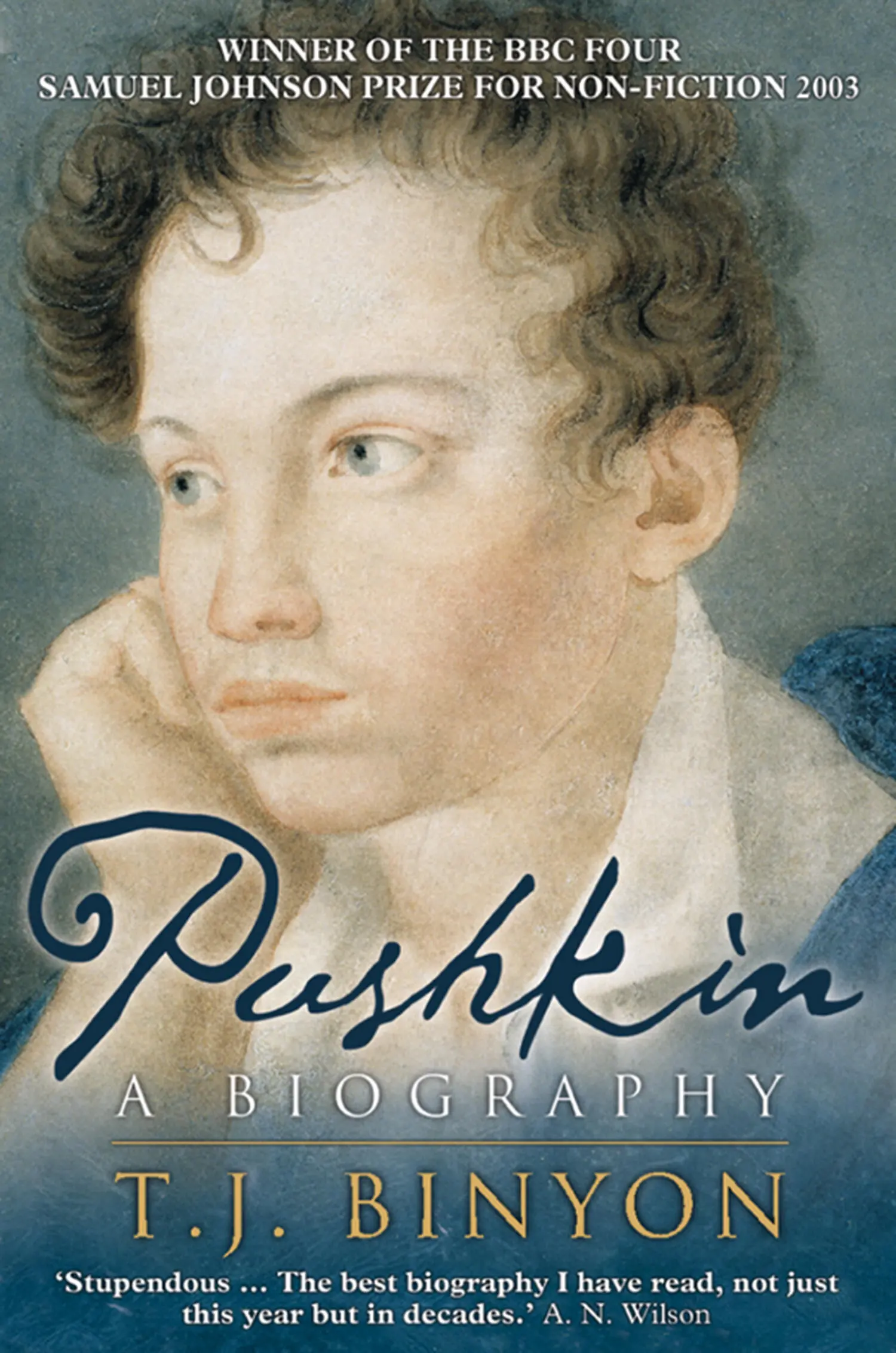
- Название:Pushkin
- Автор:
- Жанр:
- Год:неизвестен
- ISBN:нет данных
- Рейтинг книги:4 / 5. Голосов: 1
-
Избранное:Добавить в избранное
- Отзывы:
-
Ваша оценка:
Pushkin: краткое содержание, описание и аннотация
Предлагаем к чтению аннотацию, описание, краткое содержание или предисловие (зависит от того, что написал сам автор книги «Pushkin»). Если вы не нашли необходимую информацию о книге — напишите в комментариях, мы постараемся отыскать её.
Pushkin — читать онлайн ознакомительный отрывок
Ниже представлен текст книги, разбитый по страницам. Система сохранения места последней прочитанной страницы, позволяет с удобством читать онлайн бесплатно книгу «Pushkin», без необходимости каждый раз заново искать на чём Вы остановились. Поставьте закладку, и сможете в любой момент перейти на страницу, на которой закончили чтение.
Интервал:
Закладка:
Most of these critical remarks, though annoying, were too ludicrous to be taken seriously; and the success of the work was wonderfully consoling. However, Pushkin was hurt when Dmitriev, whom he had known since childhood, commented to Vyazemsky â who passed the remark on â of the poem: âI find in it much brilliant poetry, lightness in the narrative: but it is a pity that he should so often lapse into burlesque , and a still greater pity that he did not use as an epigraph the well-known line, slightly amended: âA mother will forbid her daughter to read itâ. * Without this caution the poem will fall from a good motherâs hand on the fourth page.â 14
Pushkin hardly conceals his multiple borrowings in the poem: from Zhukovsky, from Ossian, from the Russian folk epic, and, above all, from Ariosto and Voltaire. The first two are the least important: Zhukovskyâs influence is limited to the parody of âThe Twelve Sleeping Maidensâ, where Pushkinâs lively irreverence, his delight in the physical, his attention to detail are an invigorating contrast to Zhukovskyâs somewhat plodding gothic narrative with its lack of specificity. From Ossian Pushkin borrows a line from the poem âCarthonâ, âA tale of the times of old! The deeds of days of other yearsâ, which, translated, forms the first and last two lines of his poem. 15 He seems, too, to have adapted some names from this poem for his characters: Moina, the mother of Carthon, becoming Naina, and Reuthamir, her father, Ratmir. His debt to the Russian folk epic, the bylina , is somewhat greater. The poem employs the traditional setting of the Kievan bylina cycle: the court of Prince Vladimir in Kiev, and follows the folk epic in referring to the prince as âVladimir the Sunâ, a legendary figure who is seen as an amalgam of the Kievan rulers Vladimir I (d. 1015) and Vladimir II Monomakh (d. 1125). Pushkin, however, no doubt as a result of his reading of Karamzin, is more historically correct than his model: the nomadic army, one of a succession of invaders from the East, which besieges Kiev in Ruslan and Lyudmila , is that of the Pechenegs, against whom Vladimir I fought; in the byliny such enemies are usually generalized as Tatars.
But Pushkin had no intention of creating a modern bylina : he makes no use of the mythology of the genre, nor of its traditional heroes. Instead, he invents his own characters, who, on leaving Vladimirâs court, leave the world of the bylina and abruptly find themselves confronting the crenellated battlements of a Western European castle. Neither was he inclined to write a Russian heroic epic, as many wished him to do: the tone of Ruslan and Lyudmila is determinedly mock-heroic throughout, as Pushkinâs comic treatment of the most obviously heroic episodes demonstrates, such as Ruslanâs defeat of the Pecheneg army:
Wherever the dread sword whistles,
Wherever the furious steed prances,
Everywhere heads fly from shoulders
And with a wail rank on rank collapses;
In one moment the field of battle
Is covered with heaps of bloody bodies,
Living, squashed, decapitated,
With piles of spears, arrows, armour.
(VI, 299â306)
The models to which Ruslan and Lyudmila owes most are Ariostoâs Orlando Furioso (1532) â which Pushkin would have read in a French prose version â and Voltaireâs La Pucelle (1755), itself modelled on Ariosto, though Pushkinâs work is on a much smaller scale than its predecessors. * Like them, he will begin a canto with general remarks, often addressed to his readers, and tantalizingly break off the narration at a crucial moment to turn to the adventures of another character. His narrator, like those of Ariosto and Voltaire, is not contemporary with the events, but of the present day, intrusive, digressive, and constantly ironizing at the expense of the characters, the plot and its devices. Both Ariosto and Voltaire claim that their works are based upon actual chronicles; composed, in Ariostoâs case, by Tripten, Archbishop of Reims, a legendary figure; and, in Voltaireâs, by lâabbé Tritême, a real figure, but innocent of the authorship foisted upon him. Pushkin follows suit with another ecclesiastic, a âmonk, who preserved/For posterity the true legend/Of my glorious knightâ (V, 225â7).
It is here, however, that Pushkin parts company with his predecessors. Fantastic as the events in both Ariosto and Voltaire are, the narratives rest on some slight residue of fact, and the backgrounds against which the action unfolds have, for the most part, some semblance of geographical plausibility. With the exception of the Kievan court, however, Ruslan and Lyudmila is pure fantasy, set in a land of pure romance. If Ariostoâs aim is to please his patrons by extolling the glorious, if legendary past of the House of Este, and Voltaireâs to satirize â powerfully, if often crudely â religion, superstition and monarchical rule, Pushkinâs is far more intimate, as his poem is on a far more intimate scale: to entertain his friends and social acquaintances. In his asides, foreshadowing Eugene Onegin , he brings himself and St Petersburg society into the poem. When he compares Lyudmila with âsevere Delfiraâ, who âbeneath her petticoat is a hussar,/Give her only spurs and whiskers!â (V, 15â16), he is referring to Countess Ekaterina Ivelich, a distant relation of the Pushkins, who lived near them on the Fontanka, and was described by Delvigâs wife as âmore like a grenadier officer of the worst kind than a ladyâ. 16 He begins, too, at first timidly, to experiment with a literary device that was to become a favourite, both in verse and in prose: he plays with his readers, teasing them and subverting their expectations.
When, in the third stanza of Eugene Onegin , he calls on the âfriends of Lyudmila and Ruslanâ to meet his new hero, he is not merely attempting to capitalize on the popularity of the earlier poem, but hinting that those who had enjoyed it would also enjoy his latest work: despite the obvious dissimilarities â one a mock epic, set in a fabulous past, the other a contemporary novel in verse â the two share a common tone. Batyushkov was right when he spoke of the poemâs âtaste, wit, invention and gaietyâ; to these he could have added youthful exuberance, charm, and the effortless brilliance of the verse: characteristics which are also those of Eugene Onegin. The poem improves as it continues, and is at its best when Pushkinâs fantasy is least constrained by the demands of the plot or a traditional setting: Prince Ratmir in the hands of his female bath attendants, and Lyudmila in Chernomorâs castle and garden are episodes which outshine the rest.
One of the most colourful characters of this time â an age when they were not in short supply â was Count Fedor Tolstoy (his first cousin, Nikolay, was the father of Leo Tolstoy * ). Born in 1782, he joined the Preobrazhensky Life Guards, where he soon made a reputation for himself as a fire-eater, duellist â he was said to have killed eleven men in duels in the course of his life â and cardsharp. In 1803 he was a member of an embassy to Japan, taken there by Admiral Krusenstiern on his circumnavigation of the world. Tolstoy made himself so obnoxious on board that Krusenstiern abandoned him on one of the Aleutian Islands â together with a pet female ape, which he may later have eaten. Crossing the Bering Straits, he wandered slowly back through Siberia, arriving in St Petersburg at the end of 1805: hence his nickname âthe Americanâ. Coincidentally, Wiegel, who, as a member of Count Golovkinâs embassy to China, was travelling in the opposite direction in the summer of that year, met him at a post-station in Siberia. âWhat stories were not told about him! As a youth he was supposed to have had a passion for catching rats and frogs, opening their bellies with a pen-knife, and amusing himself by watching their mortal agonies for hours on end [â¦] in a word, there was no wild animal comparable in its fearlessness and bloodthirstiness with his propensities. In fact, he surprised us with his appearance. Nature had tightly curled the thick black hair on his head; his eyes, probably reddened with heat and dust, seemed to us injected with blood, his almost melancholy gaze and extremely quiet speech seemed to my terrified companions to conceal something devilish.â 17 Settling in Moscow â where in 1821 he married a beautiful gypsy singer, Avdotya Tugaeva â he spent his time gambling at the English Club, usually winning large sums through his skill in manipulating the deck. He was a close friend of Shakhovskoy â the two had been fellow-officers in the Preobrazhensky Guards â and of Vyazemsky.
Читать дальшеИнтервал:
Закладка:
Похожие книги на «Pushkin»
Представляем Вашему вниманию похожие книги на «Pushkin» списком для выбора. Мы отобрали схожую по названию и смыслу литературу в надежде предоставить читателям больше вариантов отыскать новые, интересные, ещё непрочитанные произведения.







Обсуждение, отзывы о книге «Pushkin» и просто собственные мнения читателей. Оставьте ваши комментарии, напишите, что Вы думаете о произведении, его смысле или главных героях. Укажите что конкретно понравилось, а что нет, и почему Вы так считаете.