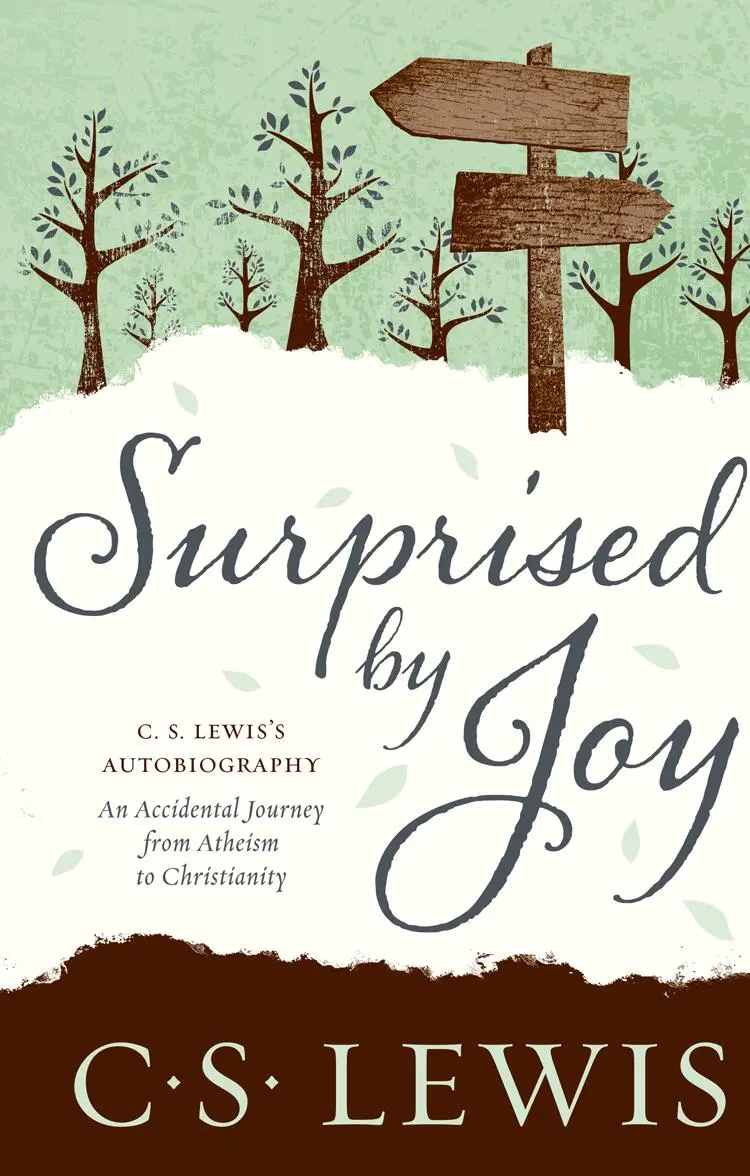
C. Lewis - Surprised by Joy
Здесь есть возможность читать онлайн «C. Lewis - Surprised by Joy» — ознакомительный отрывок электронной книги совершенно бесплатно, а после прочтения отрывка купить полную версию. В некоторых случаях можно слушать аудио, скачать через торрент в формате fb2 и присутствует краткое содержание. Жанр: unrecognised, на английском языке. Описание произведения, (предисловие) а так же отзывы посетителей доступны на портале библиотеки ЛибКат.
- Название:Surprised by Joy
- Автор:
- Жанр:
- Год:неизвестен
- ISBN:нет данных
- Рейтинг книги:4 / 5. Голосов: 1
-
Избранное:Добавить в избранное
- Отзывы:
-
Ваша оценка:
Surprised by Joy: краткое содержание, описание и аннотация
Предлагаем к чтению аннотацию, описание, краткое содержание или предисловие (зависит от того, что написал сам автор книги «Surprised by Joy»). Если вы не нашли необходимую информацию о книге — напишите в комментариях, мы постараемся отыскать её.
Surprised by Joy — читать онлайн ознакомительный отрывок
Ниже представлен текст книги, разбитый по страницам. Система сохранения места последней прочитанной страницы, позволяет с удобством читать онлайн бесплатно книгу «Surprised by Joy», без необходимости каждый раз заново искать на чём Вы остановились. Поставьте закладку, и сможете в любой момент перейти на страницу, на которой закончили чтение.
Интервал:
Закладка:
This case, I beg the court to note, Concerns a trespass by a goat.
My poor father, while he spoke, forgot not only the offence, but the capacities, of his audience. All the resources of his immense vocabulary were poured forth. I can still remember such words as ‘abominable’, ‘sophisticated’ and ‘surreptitious’. You will not get the full flavour unless you know an angry Irishman’s energy in explosive consonants and the rich growl of his R’s. A worse treatment could hardly have been applied. Up to a certain age these invectives filled me with boundless terror and dismay. From the wilderness of the adjectives and the welter of the unintelligible, emerged ideas which I thought I understood only too well, as I heard with implicit and literal belief that our Father’s ruin was approaching, that we should all soon beg our bread in the streets, that he would shut up the house and keep us at school all the year round, that we should be sent to the colonies and there end in misery the career of crime on which we had, it seemed, already embarked. All security seemed to be taken from me; there was no solid ground beneath my feet. It is significant that at this time if I woke in the night and did not immediately hear my brother’s breathing from the neighbouring bed, I often suspected that my father and he had secretly risen while I slept and gone off to America - that I was finally abandoned. Such was the effect of my father’s rhetoric up to a certain age; then, quite suddenly, it became ridiculous. I can even remember the moment of the change, and the story well illustrates both the justice of my father’s anger and the unhappy way in which he expressed it. One day my brother decided it would be a good thing to make a tent. Accordingly we procured a dust-sheet from one of the attics. The next step was to find uprights; the step-ladder in the wash-house suggested itself. For a boy with a hatchet it was the work of a moment to reduce this to a number of disconnected poles. Four of these were then planted in the earth and the sheet draped over them. To make sure that the whole structure was really reliable my brother then tried sitting on the top of it. We remembered to put away the ragged remains of the sheet but quite forgot about the uprights. That evening, when my father had come home from work and dined, he went for a stroll in the garden, accompanied by us. The sight of four slender wooden posts rising from the grass moved in him a pardonable curiosity. Interrogation followed; on this occasion we told the truth. Then the lightnings flashed and the thunder roared; and all would have gone now as it had gone on a dozen previous occasions, but for the climax - ‘Instead of which I find you have cut up the step-ladder. And what for, forsooth? To make a thing like an abortive Punch-and-Judy show.’ At that moment we both hid our faces; not, alas, to cry.
As will be seen from this anecdote one dominant factor in our life at home was the daily absence of our father from about nine in the morning till six at night. For the rest of the day we had the house to ourselves, except for the cook and housemaid with whom we were sometimes at war and sometimes in alliance. Everything invited us to develop a life that had no connection with our father. The most important of our activities was the endless drama of Animal-Land and India, and this of itself isolated us from him.
But I must not leave the reader under the impression that all the happy hours of the holidays occurred during our father’s absence. His temperament was mercurial, his spirits rose as easily as they fell, and his forgiveness was as thorough-going as his displeasure. He was often the most jovial and companionable of parents. He could ‘play the fool’ as well as any of us, and had no regard for his own dignity, ‘conned no state’. I could not, of course, at that age see what good company (by adult standards) he was, his humour being of the sort that requires at least some knowledge of life for its full appreciation; I merely basked in it as in fine weather. And all the time there was the sensuous delight of being at home, the delight of luxury - ‘civilisation’, as we called it. I spoke just now of Vice Versa. Its popularity was surely due to something more than farce. It is the only truthful school story in existence. The machinery of the Garuda Stone really serves to bring out in their true colours (which would otherwise seem exaggerated) the sensations which every boy had on passing from the warmth and softness and dignity of his home life to the privations, the raw and sordid ugliness, of school. I say ‘had’ not ‘has’; for perhaps homes have gone down in the world and schools gone up since then.
It will be asked whether we had no friends, no neighbours, no relatives. We had. To one family in particular our debt is so great that it had better be left, with some other matters, to the next chapter.
1 This punishment was for a mistake in a geometrical proof.
3 MOUNTBRACKEN AND CAMPBELL
For all these fair people in the hall were in their first age; none happier under the heaven; their king, the man of noblest temper. It would be a hard task to-day to find so brave a fellowship in any castle.
Gawain and the Green Knight
To speak of my nearer relatives is to remind myself how the contrast of Lewis and Hamilton dominated my whole early life. It began, for me, with the grandparents. Grandfather Lewis, deaf, slow-moving, humming his psalm chants, much concerned for his health and prone to remind the family that he would not be with them long, is contrasted with Grandmother Hamilton, the sharp-tongued, sharp-witted widow, full of heterodox opinions (even, to the scandal of the whole connection, a Home Ruler), every inch a Warren, indifferent to convention as only an old Southern Irish aristocrat could be, living alone in a large tumble-down house with half a hundred cats for company. To how many an innocent conversational gambit did she reply, ‘You’re talking great nonsense’? Born a little later, she would, I think, have been a Fabian. She met vague small talk with ruthless statements of ascertainable fact and well-worn maxims with a tart demand for evidence. Naturally, people called her eccentric. Coming down a generation I find the same opposition. My father’s elder brother ‘Uncle Joe’, with his family of two boys and three girls, lived very close to us while we were at the Old House. His younger son was my earliest friend, but we drifted apart as we grew older. Uncle Joe was both a clever man and a kind, and especially fond of me. But I remember nothing that was said by our elders in that house; it was simply ‘grown up’ conversation - about people, business, politics, and health, I suppose. But ‘Uncle Gussie’ - my mother’s brother, A. W. Hamilton - talked to me as if we were of an age. That is, he talked about Things. He told me all the science I could then take in, clearly, eagerly, without silly jokes and condescensions, obviously liking it as much as I did. He thus provided the intellectual background for my reading of H. G. Wells. I do not suppose he cared for me as a person half so much as Uncle Joe did; and that (call it an injustice or not) was what I liked. During these talks our attention was fixed not on one another but on the subject. His Canadian wife I have already mentioned. In her also I found what I liked best - an unfailing, kindly welcome without a hint of sentimentality, unruffled good sense, the unobtrusive talent for making all things at all times as cheerful and comfortable as circumstances allowed. What one could not have one did without and made the best of it. The tendency of the Lewises to re-open wounds and to rouse sleeping dogs was unknown to her as to her husband.
But we had other kin who mattered to us far more than our aunts and uncles. Less than a mile from our home stood the largest house I then knew, which I will here call Mountbracken, and there lived Sir W. E. Lady E. was my mother’s first cousin and perhaps my mother’s dearest friend, and it was no doubt for my mother’s sake that she took upon herself the heroic work of civilising my brother and me. We had a standing invitation to lunch at Mountbracken whenever we were at home; to this, almost entirely, we owe it that we did not grow up savages. The debt is not only to Lady E. (‘Cousin Mary’) but to her whole family; walks, motor-drives (in those days an exciting novelty), picnics, and invitations to the theatre were showered on us, year after year, with a kindness which our rawness, our noise, and our unpunctuality never seemed to weary. We were at home there almost as much as in our own house, but with this great difference, that a certain standard of manners had to be kept up. Whatever I know (it is not much) of courtesy and savoir faire I learned at Mountbracken.
Читать дальшеИнтервал:
Закладка:
Похожие книги на «Surprised by Joy»
Представляем Вашему вниманию похожие книги на «Surprised by Joy» списком для выбора. Мы отобрали схожую по названию и смыслу литературу в надежде предоставить читателям больше вариантов отыскать новые, интересные, ещё непрочитанные произведения.






Обсуждение, отзывы о книге «Surprised by Joy» и просто собственные мнения читателей. Оставьте ваши комментарии, напишите, что Вы думаете о произведении, его смысле или главных героях. Укажите что конкретно понравилось, а что нет, и почему Вы так считаете.