C. Lewis - Surprised by Joy
Здесь есть возможность читать онлайн «C. Lewis - Surprised by Joy» — ознакомительный отрывок электронной книги совершенно бесплатно, а после прочтения отрывка купить полную версию. В некоторых случаях можно слушать аудио, скачать через торрент в формате fb2 и присутствует краткое содержание. Жанр: unrecognised, на английском языке. Описание произведения, (предисловие) а так же отзывы посетителей доступны на портале библиотеки ЛибКат.
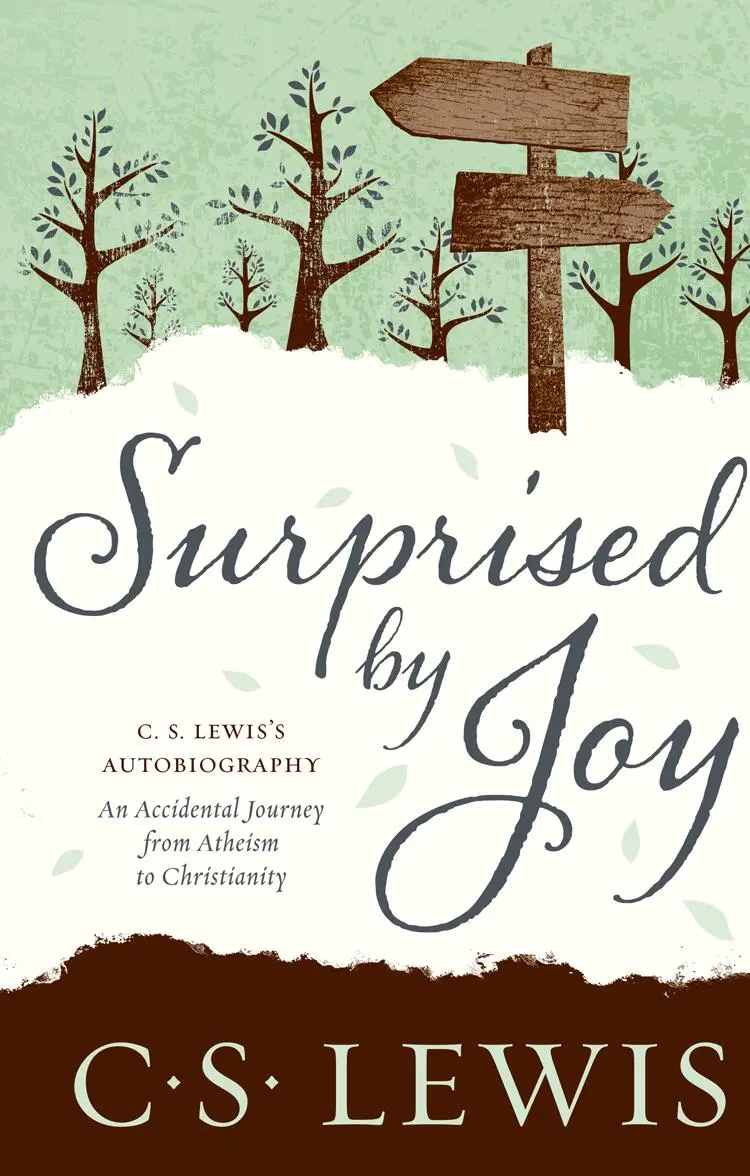
- Название:Surprised by Joy
- Автор:
- Жанр:
- Год:неизвестен
- ISBN:нет данных
- Рейтинг книги:4 / 5. Голосов: 1
-
Избранное:Добавить в избранное
- Отзывы:
-
Ваша оценка:
Surprised by Joy: краткое содержание, описание и аннотация
Предлагаем к чтению аннотацию, описание, краткое содержание или предисловие (зависит от того, что написал сам автор книги «Surprised by Joy»). Если вы не нашли необходимую информацию о книге — напишите в комментариях, мы постараемся отыскать её.
Surprised by Joy — читать онлайн ознакомительный отрывок
Ниже представлен текст книги, разбитый по страницам. Система сохранения места последней прочитанной страницы, позволяет с удобством читать онлайн бесплатно книгу «Surprised by Joy», без необходимости каждый раз заново искать на чём Вы остановились. Поставьте закладку, и сможете в любой момент перейти на страницу, на которой закончили чтение.
Интервал:
Закладка:
The reader who finds these three episodes of no interest need read this book no further, for in a sense the central story of my life is about nothing else. For those who are still disposed to proceed I will only underline the quality common to the three experiences; it is that of an unsatisfied desire which is itself more desirable than any other satisfaction. I call it Joy, which is here a technical term and must be sharply distinguished both from Happiness and from Pleasure. Joy (in my sense) has indeed one characteristic, and one only, in common with them; the fact that anyone who has experienced it will want it again. Apart from that, and considered only in its quality, it might almost equally well be called a particular kind of unhappiness or grief. But then it is a kind we want. I doubt whether anyone who has tasted it would ever, if both were in his power, exchange it for all the pleasures in the world. But then Joy is never in our power and pleasure often is.
I cannot be absolutely sure whether the things I have just been speaking of happened before or after the great loss which befell our family and to which I must now turn. There came a night when I was ill and crying both with headache and toothache and distressed because my mother did not come to me. That was because she was ill too; and what was odd was that there were several doctors in her room, and voices, and comings and goings all over the house and doors shutting and opening. It seemed to last for hours. And then my father, in tears, came into my room and began to try to convey to my terrified mind things it had never conceived before. It was in fact cancer and followed the usual course; an operation (they operated in the patient’s house in those days), an apparent convalescence, a return of the disease, increasing pain, and death. My father never fully recovered from this loss.
Children suffer not (I think) less than their elders, but differently. For us boys the real bereavement had happened before our mother died. We lost her gradually as she was gradually withdrawn from our life into the hands of nurses and delirium and morphia, and as our whole existence changed into something alien and menacing, as the house became full of strange smells and midnight noises and sinister whispered conversations. This had two further results, one very evil and one very good. It divided us from our father as well as our mother. They say that a shared sorrow draws people closer together; I can hardly believe that it often has that effect when those who share it are of widely different ages. If I may trust to my own experience, the sight of adult misery and adult terror has an effect on children which is merely paralysing and alienating. Perhaps it was our fault. Perhaps if we had been better children we might have lightened our father’s sufferings at this time. We certainly did not. His nerves had never been of the steadiest and his emotions had always been uncontrolled. Under the pressure of anxiety his temper became incalculable; he spoke wildly and acted unjustly. Thus by a peculiar cruelty of fate, during those months the unfortunate man, had he but known it, was really losing his sons as well as his wife. We were coming, my brother and I, to rely more and more exclusively on each other for all that made life bearable; to have confidence only in each other. I expect that we (or at any rate I) were already learning to lie to him. Everything that had made the house a home had failed us; everything except one another. We drew daily closer together (that was the good result) - two frightened urchins huddled for warmth in a bleak world.
Grief in childhood is complicated with many other miseries. I was taken into the bedroom where my mother lay dead; as they said, ‘to see her’, in reality, as I at once knew, ‘to see it’. There was nothing that a grown-up would call disfigurement - except for that total disfigurement which is death itself. Grief was overwhelmed in terror. To this day I do not know what they mean when they call dead bodies beautiful. The ugliest man alive is an angel of beauty compared with the loveliest of the dead. Against all the subsequent paraphernalia of coffin, flowers, hearse, and funeral I reacted with horror. I even lectured one of my aunts on the absurdity of mourning clothes in a style which would have seemed to most adults both heartless and precocious; but this was our dear Aunt Annie, my maternal uncle’s Canadian wife, a woman almost as sensible and sunny as my mother herself. To my hatred for what I already felt to be all the fuss and flummery of the funeral I may perhaps trace something in me which I now recognise as a defect but which I have never fully overcome - a distaste for all that is public, all that belongs to the collective; a boorish inaptitude for formality.
My mother’s death was the occasion of what some (but not I) might regard as my first religious experience. When her case was pronounced hopeless I remembered what I had been taught; that prayers offered in faith would be granted. I accordingly set myself to produce by willpower a firm belief that my prayers for her recovery would be successful; and, as I thought, I achieved it. When nevertheless she died I shifted my ground and worked myself into a belief that there was to be a miracle. The interesting thing is that my disappointment produced no results beyond itself. The thing hadn’t worked, but I was used to things not working, and I thought no more about it. I think the truth is that the belief into which I had hypnotised myself was itself too irreligious for its failure to cause any religious revolution. I had approached God, or my idea of God, without love, without awe, even without fear. He was, in my mental picture of this miracle, to appear neither as Saviour nor as Judge, but merely as a magician; and when He had done what was required of Him I supposed He would simply - well, go away. It never crossed my mind that the tremendous contact which I solicited should have any consequences beyond restoring the status quo. I imagine that a ‘faith’ of this kind is often generated in children and that its disappointment is of no religious importance; just as the things believed in, if they could happen and be only as the child pictures them, would be of no religious importance either.
With my mother’s death all settled happiness, all that was tranquil and reliable, disappeared from my life. There was to be much fun, many pleasures, many stabs of Joy; but no more of the old security. It was sea and islands now; the great continent had sunk like Atlantis.
1 For readers of my children’s books, the best way of putting this would be to say that Animal-Land had nothing whatever in common with Narnia except the anthropomorphic beasts. Animal-Land, by its whole quality, excluded the least hint of wonder.
1 Oh, I desire too much.
2 CONCENTRATION CAMP
Arithmetic with Coloured Rods.
Times Educational Supplement, 19 November 1954
Clop-clop-clop-clop … we are in a four-wheeler rattling over the uneven squaresets of the Belfast streets through the damp twilight of a September evening, 1908; my father, my brother, and I. I am going to school for the first time. We are in low spirits. My brother, who has most reason to be so, for he alone knows what we are going to, shows his feelings least. He is already a veteran. I perhaps am buoyed up by a little excitement, but very little. The most important fact at the moment is the horrible clothes I have been made to put on. Only this morning - only two hours ago - I was running wild in shorts and blazer and sandshoes. Now I am choking and sweating, itching too, in thick dark stuff, throttled by an Eton collar, my feet already aching with unaccustomed boots. I am wearing knickerbockers that button at the knee. Every night for some forty weeks of every year and for many a year I am to see the red, smarting imprint of those buttons in my flesh when I undress. Worst of all is the bowler-hat, apparently made of iron, which grasps my head. I have read of boys in the same predicament who welcomed such things as signs of growing up; I had no such feeling. Nothing in my experience had ever suggested to me that it was nicer to be a schoolboy than a child or nicer to be a man than a schoolboy. My brother never talked much about school in the holidays. My father, whom I implicitly believed, represented adult life as one of incessant drudgery under the continual threat of financial ruin. In this he did not mean to deceive us. Such was his temperament that when he exclaimed, as he frequently did, ‘There’ll soon be nothing for it but the workhouse,’ he momentarily believed, or at least felt, what he said. I took it all literally and had the gloomiest anticipation of adult life. In the meantime, the putting on of the school clothes was, I well knew, the assumption of a prison uniform.
Читать дальшеИнтервал:
Закладка:
Похожие книги на «Surprised by Joy»
Представляем Вашему вниманию похожие книги на «Surprised by Joy» списком для выбора. Мы отобрали схожую по названию и смыслу литературу в надежде предоставить читателям больше вариантов отыскать новые, интересные, ещё непрочитанные произведения.










Обсуждение, отзывы о книге «Surprised by Joy» и просто собственные мнения читателей. Оставьте ваши комментарии, напишите, что Вы думаете о произведении, его смысле или главных героях. Укажите что конкретно понравилось, а что нет, и почему Вы так считаете.