Sharan B. Merriam - Learning in Adulthood
Здесь есть возможность читать онлайн «Sharan B. Merriam - Learning in Adulthood» — ознакомительный отрывок электронной книги совершенно бесплатно, а после прочтения отрывка купить полную версию. В некоторых случаях можно слушать аудио, скачать через торрент в формате fb2 и присутствует краткое содержание. Жанр: unrecognised, на английском языке. Описание произведения, (предисловие) а так же отзывы посетителей доступны на портале библиотеки ЛибКат.
- Название:Learning in Adulthood
- Автор:
- Жанр:
- Год:неизвестен
- ISBN:нет данных
- Рейтинг книги:4 / 5. Голосов: 1
-
Избранное:Добавить в избранное
- Отзывы:
-
Ваша оценка:
Learning in Adulthood: краткое содержание, описание и аннотация
Предлагаем к чтению аннотацию, описание, краткое содержание или предисловие (зависит от того, что написал сам автор книги «Learning in Adulthood»). Если вы не нашли необходимую информацию о книге — напишите в комментариях, мы постараемся отыскать её.
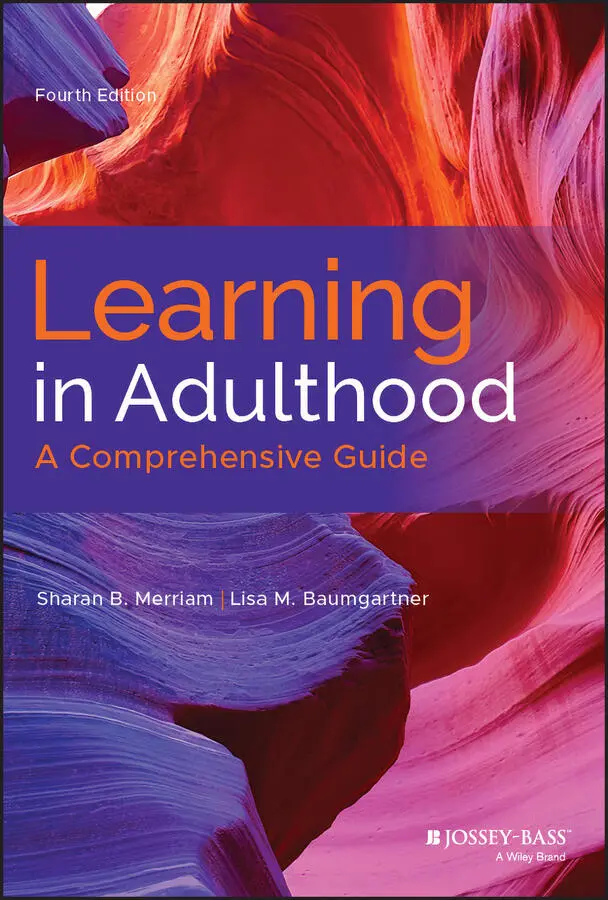
has been the definitive guide in the field of adult education. Now in its fourth edition, this comprehensive volume is fully revised to reflect the latest developments in theory, research, and practice. The authors integrate foundational research and current knowledge to present fresh, original perspectives on teaching and learning in adulthood. Written by internationally-recognized experts, this market-leading guide draws from work in sociology, philosophy, critical social theory, psychology, and education to provide an inclusive overview of adult learning.
Designed primarily for educators of adults, this book is accessible for readers new to adult education, yet suitably rigorous for those more familiar with the subject. Content is organized into four practical parts, covering topics such as the social context of adult learning, self-directed and transformational learning, postmodern and feminist perspectives, cognitive development in adulthood, and more. Offering the most comprehensive single-volume treatment of adult learning available, this landmark text:
Offers a wide-ranging perspective on adult learning Synthesizes the latest thinking and work in the field Includes coverage of the sociocultural perspectives of adult learning Explores the broader social implications of adult education
is an indispensable resource for educators and administrators involved in teaching adults, as well as faculty and students in graduate programs in adult education.
Learning in Adulthood — читать онлайн ознакомительный отрывок
Ниже представлен текст книги, разбитый по страницам. Система сохранения места последней прочитанной страницы, позволяет с удобством читать онлайн бесплатно книгу «Learning in Adulthood», без необходимости каждый раз заново искать на чём Вы остановились. Поставьте закладку, и сможете в любой момент перейти на страницу, на которой закончили чтение.
Интервал:
Закладка:
Although there were numerous small-scale studies of participation in the 40 years between the inauguration of the field of adult education and the 1960s, it was not until 1965 that the first national study of participation was published. Johnstone and Rivera's study, with its care in defining participation and selecting methods of data collection and analysis, remains a benchmark contribution to this literature. Subsequent surveys by the NCES, UNESCO (Valentine, 1997), and Program for the International Assessment of Adult Competencies-USA's (PIAAC-USA) (Patterson, 2018) have contributed to this database. Regardless of the study, the profile of the typical adult learner in formal educational activities remains remarkably consistent: White, middle class, employed, younger, and better educated than the nonparticipant. Further, employment-related reasons account for the majority of participant interest in continuing education.
Why adults do or do not participate in adult education is an important question, having implications for both theory and practice. Surveys have uncovered both reasons for, and barriers to, participation. The work on determining an underlying structure of motivational orientations begun by Houle (1961/1988) has been carried on most notably by Boshier's research using the EPS. Further, explanations of participation have been advanced from a sociological rather than a psychological perspective. In these analyses, people's decisions to participate have less to do with their needs and motives than with their position in society and the social experiences that have shaped their lives.
Finally, we “problematized” the current understanding of participation by questioning and critiquing four assumptions about participation presented by Crowther (2000). These four assumptions are that participation is a good thing, that participation equals formal learning, that learners are abstract, not socialized individuals, and that there are barriers, not resistance, to participating in formal adult learning activities.
Part II Adult Learning Theory
The accumulation of information and experiences grounded in practice often leads to thinking about how the parts of what we know might fit together to form some sort of explanatory framework. In Part II of Learning in Adulthood , we review a number of attempts to explain adult learning. Some of these efforts, as in the work on self-directed learning, are tentative frameworks for ordering research—that suggest future directions for theory. Other efforts can properly be labeled models, if we define model as a visual representation. A theory, which may have a model accompanying it, is a set of interrelated concepts that explain some aspect of the field in a parsimonious manner.
We begin Chapter 5with a discussion of Knowles's (1980) concept of andragogy, which he originally termed a theory of adult learning. Probably the best-known set of principles or assumptions to guide adult learning practice, andragogy actually tells us more about the characteristics of adult learners than about the nature of learning itself. The first half of the chapter is devoted to a thorough review and critique of andragogy. Also reviewed in Chapter 5is McClusky's (1970) theory of margin, a theory that resonates with adult learners, perhaps because the theory considers adult learning in relation to other activities of adult life.
Since Tough's work on adult learning projects was published in 1971, self-directed learning and individual learning projects have captured the imagination of researchers and educators across the lifespan and from all areas of education. Although learning on one's own is the way most adults go about acquiring new ideas, skills, and attitudes, this context has often been regarded as less important than learning that takes place in more formal settings. Chapter 6discusses three types of models—linear, interactive, and instructional—developed to describe the process of learning when that learning is primarily managed by the learners themselves. Most adults use more of an interactive model in that they do not necessarily plan what, how, or when they want to learn. Scholars have also focused on studying self-direction as a personal attribute of the learner. Two ideas that have received the greatest attention in this approach are the notion of readiness for self-directed learning and the concept of autonomy. The chapter concludes with a review of the major issues researchers need to address in building future research agendas in self-directed learning.
Changes in cognition and consciousness constitute the focus of transformational learning reviewed in Chapter 7. Mezirow's (2000) perspective transformation and Freire's (1970) conscientization contend that changes in perspective or consciousness are the defining characteristic of learning in adulthood. Mezirow's theory in particular has stimulated considerable debate and research during the past 10 years. Using Taylor's (2008) “lenses” for organizing the literature on transformational learning, the first half of the chapter reviews the various theoretical bases for transformational learning. Also examined are three concepts key to understanding transformative learning: the centrality of life experience, the nature of critical reflection, and the connection between transformative learning and adult development. We then discuss the extent to which transformative learning theory takes context into account, the role of emotions and relationships, the place of social action, and the educator's role in facilitating transformative learning. In the last chapter of Part II we explore the role of experience and learning, which has a long legacy in the writings on adult learning. Discussed first in the chapter are representative theories that offer varying conceptual views of the process of learning from experience, including the foundational work of Dewey (1938) and Kolb (1984), and the contemporary work of such scholars as Jarvis (2001), Boud and Walker (1991), Fenwick (2003), and Usher, Bryant, and Johnston (1997). Although the focus of this work has been on individual learners, in recent years there has been a shift to understanding how the context affects learning and how it is an integral component of the learning process. We then describe reflective practice, one of the primary ways in which educators have structured learning from experience. We conclude the chapter with an overview of situated cognition and descriptions of two instructional approaches—cognitive apprenticeship and anchored instruction—that are based in situated cognition, stressing how “authentic experiences” grounded in real-life situations are viewed as key components in operationalizing this concept.
Конец ознакомительного фрагмента.
Текст предоставлен ООО «ЛитРес».
Прочитайте эту книгу целиком, на ЛитРес.
Безопасно оплатить книгу можно банковской картой Visa, MasterCard, Maestro, со счета мобильного телефона, с платежного терминала, в салоне МТС или Связной, через PayPal, WebMoney, Яндекс.Деньги, QIWI Кошелек, бонусными картами или другим удобным Вам способом.
Интервал:
Закладка:
Похожие книги на «Learning in Adulthood»
Представляем Вашему вниманию похожие книги на «Learning in Adulthood» списком для выбора. Мы отобрали схожую по названию и смыслу литературу в надежде предоставить читателям больше вариантов отыскать новые, интересные, ещё непрочитанные произведения.









Обсуждение, отзывы о книге «Learning in Adulthood» и просто собственные мнения читателей. Оставьте ваши комментарии, напишите, что Вы думаете о произведении, его смысле или главных героях. Укажите что конкретно понравилось, а что нет, и почему Вы так считаете.