Sharan B. Merriam - Learning in Adulthood
Здесь есть возможность читать онлайн «Sharan B. Merriam - Learning in Adulthood» — ознакомительный отрывок электронной книги совершенно бесплатно, а после прочтения отрывка купить полную версию. В некоторых случаях можно слушать аудио, скачать через торрент в формате fb2 и присутствует краткое содержание. Жанр: unrecognised, на английском языке. Описание произведения, (предисловие) а так же отзывы посетителей доступны на портале библиотеки ЛибКат.
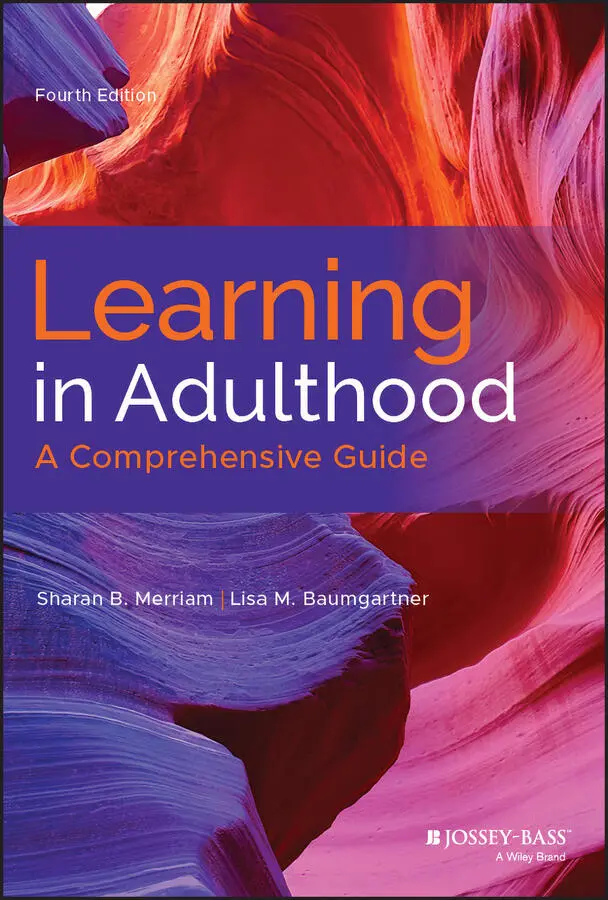
- Название:Learning in Adulthood
- Автор:
- Жанр:
- Год:неизвестен
- ISBN:нет данных
- Рейтинг книги:4 / 5. Голосов: 1
-
Избранное:Добавить в избранное
- Отзывы:
-
Ваша оценка:
Learning in Adulthood: краткое содержание, описание и аннотация
Предлагаем к чтению аннотацию, описание, краткое содержание или предисловие (зависит от того, что написал сам автор книги «Learning in Adulthood»). Если вы не нашли необходимую информацию о книге — напишите в комментариях, мы постараемся отыскать её.
has been the definitive guide in the field of adult education. Now in its fourth edition, this comprehensive volume is fully revised to reflect the latest developments in theory, research, and practice. The authors integrate foundational research and current knowledge to present fresh, original perspectives on teaching and learning in adulthood. Written by internationally-recognized experts, this market-leading guide draws from work in sociology, philosophy, critical social theory, psychology, and education to provide an inclusive overview of adult learning.
Designed primarily for educators of adults, this book is accessible for readers new to adult education, yet suitably rigorous for those more familiar with the subject. Content is organized into four practical parts, covering topics such as the social context of adult learning, self-directed and transformational learning, postmodern and feminist perspectives, cognitive development in adulthood, and more. Offering the most comprehensive single-volume treatment of adult learning available, this landmark text:
Offers a wide-ranging perspective on adult learning Synthesizes the latest thinking and work in the field Includes coverage of the sociocultural perspectives of adult learning Explores the broader social implications of adult education
is an indispensable resource for educators and administrators involved in teaching adults, as well as faculty and students in graduate programs in adult education.
Learning in Adulthood — читать онлайн ознакомительный отрывок
Ниже представлен текст книги, разбитый по страницам. Система сохранения места последней прочитанной страницы, позволяет с удобством читать онлайн бесплатно книгу «Learning in Adulthood», без необходимости каждый раз заново искать на чём Вы остановились. Поставьте закладку, и сможете в любой момент перейти на страницу, на которой закончили чтение.
Интервал:
Закладка:
Houle's research stimulated a number of studies attempting to affirm or refine the original typology. By far the most extensive work has been done with Boshier's 48-item Education Participation Scale (EPS), later refined to 42 items (Boshier, 1991). Factor analysis of the 42 items suggests the following seven factors, each containing six items: communication improvement of verbal and written skills; social contact, meaning meeting people and making friends; educational preparation, the remediation of past educational deficiencies; professional advancement, concerned with improving job status or moving to a better one; family togetherness, concerned with bridging generation gaps and improving relationships in families; social stimulation, meaning escaping boredom; and cognitive interest, seeking knowledge for its own sake (Boshier, 1991).
Boshier himself conducted an extensive test of Houle's typology using his EPS scale (Boshier & Collins, 1985). Using cluster analysis instead of factor analysis, because the technique is more congruent with Houle's original conceptualization of three separate but overlapping orientations, he analyzed the responses of 13,442 learners from Africa, Asia, New Zealand, Canada, and the United States. Boshier and Collins were able to effect a three-cluster solution “loosely isomorphic with Houle's topology” (p. 125). They found that “Cluster I consisted of the Cognitive Interest items and was congruent with his [Houle's] learning orientation.” Cluster II, the activity orientation, “was multifaceted and composed of items normally labeled Social Stimulation, Social Contact, External Expectations, and Community Service” (p. 125). Cluster III consisted of the Professional Advancement items and thus resembled Houle's goal orientation. The authors note that although their three-cluster solution is “loosely isomorphic,” the grouping of items to make up the activity cluster that matches Houle's typology is “overly generous.” They conclude that “Houle's intuition has been partly collaborated; two of the six clusters were as he described them” (p. 127).
Using Boshier's EPS, Fujita-Starck (1996) analyzed responses from 1,142 students in programs at a large state university. Results confirmed the seven-factor typology proposed by Boshier in 1991 (communication improvement, social contact, educational preparation, professional advancement, family togetherness, social stimulation, and cognitive interest). The author also found the scale to be reliable “in differentiating among a diverse group of students with varying reasons for participating in continuing education” (p. 38).
Despite the limitations of this line of research (Courtney, 1992), it has become evident that learners' motivations for participating in adult education are many, complex, and subject to change. The search for an underlying motivational structure related to participation is likely to continue, however, for such knowledge “can assist educators and administrators in identifying and meeting the needs of a wide spectrum of learners relative to program content, as well as the time, duration, and location of related activities” (Fujita-Starck, 1996, p. 39).
Barriers to Participation
Knowing why adults participate in formal adult education does not tell us why many do not. That is, we cannot assume that those who are not participating are happily employed and satisfied with their family, community, and leisure activities. In fact, one of the field's biggest mysteries is why more adults, especially those who might benefit the most, are not involved in adult education. This question has prompted research into why adults do not participate in adult education. One of the earlier models and one still used in research today is Cross’s (1981) conceptualizing of barriers to participation. She identified three major categories of barriers—situational, institutional, and dispositional. Situational barriers are those factors present in an adult's life at any point in time, such as lack of time and money, and home and work responsibilities. Institutional barriers include such factors as course scheduling, location of classes, lack of information, and parking. Dispositional barriers relate to “attitudes and self-perceptions about oneself as a learner” (Cross, 1981, p. 98) and include such things as lack of confidence, feeling “too old” to learn, and so on.
Using Cross’s (1981) framework of situational, institutional, and dispositional barriers to participation, Patterson (2018) analyzed two national studies of adult competencies, one conducted in 2012 with 5,010 adults and one conducted in 2014 with more than 8,000 adults. She summarizes reasons for nonparticipation in education as follows: “Situational deterrents of increasing age, parental education, low income, and work and family responsibilities contribute to nonparticipation. Dispositional deterrents include health and disability challenges, low social trust, and difficulties relating new ideas to real life. Institutional deterrents are education costs and little work schedule flexibility” (abstract, p. 41). Factors favoring participation included “liking to learn new things, use of computers, and getting information from television and trusted people in their lives” (p. 57). Patterson offers numerous suggestions for dealing with these barriers, including promoting flexible work hours to allow for participation, asking nonparticipants for suggestions about what they might want to learn, making use of computers and smartphones and even television for recruiting, and engaging nonparticipants through family, friends, and coworkers.
The two most often cited reasons for nonparticipation are lack of time and lack of money. These are socially acceptable reasons for not doing something, of course, and probably very legitimate reasons for adults who are busy people trying to become or stay economically solvent and take care of their families and themselves. Johnstone and Rivera (1965) in their national study of participation found that 43% cited cost as a reason for not attending adult education courses and 39% said they were too busy. These were also the two main reasons for nonparticipation cited in the UNESCO study (Valentine, 1997). Forty-five percent of respondents said lack of time was a barrier for job-related education; this figure climbs to 60.1% for non-job-related education. Interestingly, 33.4% gave cost as a barrier for job-related education, but 25.4% reported cost as a barrier for non-job-related education (Valentine, 1997). For both types of education, “family responsibilities” was cited as the next most salient barrier.
Reasons why adults do not participate have been clustered by several researchers into types of barriers. Johnstone and Rivera (1965) clustered 10 potential barriers into two categories: external, or situational, and internal, or dispositional, barriers. External barriers are “influences more or less external to the individual or at least beyond the individual's control” (p. 214), such as cost of the program. Internal barriers reflect personal attitudes, such as thinking one is too old to learn. Older adults, for example, cited more dispositional barriers, and younger people and women were more constrained by situational barriers. In contrast, Valentine's (1997) analysis of the UNESCO data revealed that situational barriers affected both men and women: “Women were more likely than men to report that family responsibilities interfered with both job-related and non-job-related education. Men were more likely than women to report that work demands interfered with non-job-related education” (p. 107).
Darkenwald and colleagues went beyond the three-part or four-part barrier typologies in developing a scale of deterrents to participation that can be factor-analyzed to reveal the structure of reasons underlying nonparticipation (in much the same way Boshier's EPS does for participation). A form of the Deterrents to Participation Scale (DPS) used with the general adult public revealed six factors of nonparticipation: lack of confidence, lack of course relevance, time constraints, low personal priority, cost, and personal problems (such as child care, family problems, and personal health; Darkenwald & Valentine, 1985). In a later analysis of the same data, Valentine and Darkenwald (1990) derived a typology of adult nonparticipants. According to their analysis, the adult nonparticipants in the general public cluster into five distinct groups. People are deterred from participating by personal problems, lack of confidence, educational costs, lack of interest in organized education generally, or lack of interest in available courses.
Читать дальшеИнтервал:
Закладка:
Похожие книги на «Learning in Adulthood»
Представляем Вашему вниманию похожие книги на «Learning in Adulthood» списком для выбора. Мы отобрали схожую по названию и смыслу литературу в надежде предоставить читателям больше вариантов отыскать новые, интересные, ещё непрочитанные произведения.









Обсуждение, отзывы о книге «Learning in Adulthood» и просто собственные мнения читателей. Оставьте ваши комментарии, напишите, что Вы думаете о произведении, его смысле или главных героях. Укажите что конкретно понравилось, а что нет, и почему Вы так считаете.