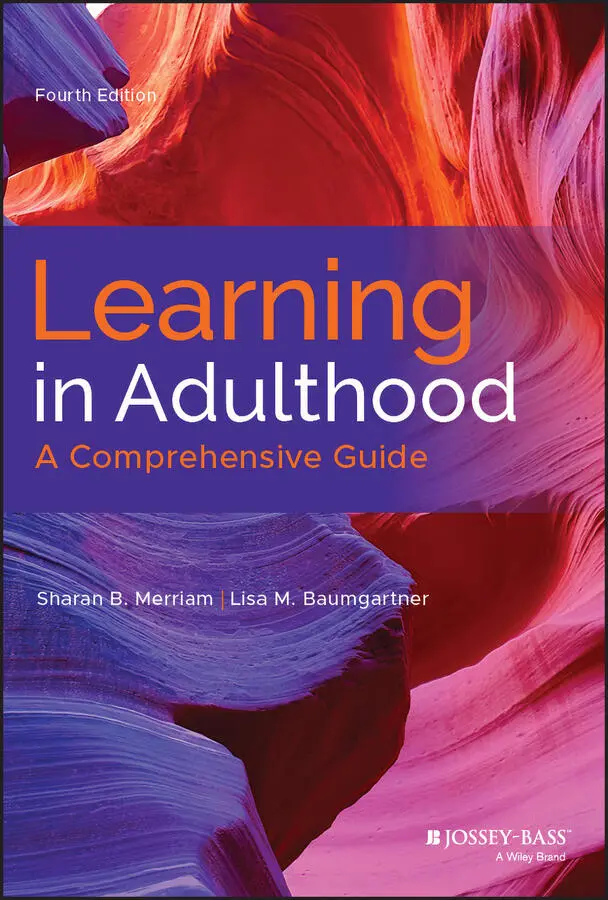
Sharan B. Merriam - Learning in Adulthood
Здесь есть возможность читать онлайн «Sharan B. Merriam - Learning in Adulthood» — ознакомительный отрывок электронной книги совершенно бесплатно, а после прочтения отрывка купить полную версию. В некоторых случаях можно слушать аудио, скачать через торрент в формате fb2 и присутствует краткое содержание. Жанр: unrecognised, на английском языке. Описание произведения, (предисловие) а так же отзывы посетителей доступны на портале библиотеки ЛибКат.
- Название:Learning in Adulthood
- Автор:
- Жанр:
- Год:неизвестен
- ISBN:нет данных
- Рейтинг книги:4 / 5. Голосов: 1
-
Избранное:Добавить в избранное
- Отзывы:
-
Ваша оценка:
Learning in Adulthood: краткое содержание, описание и аннотация
Предлагаем к чтению аннотацию, описание, краткое содержание или предисловие (зависит от того, что написал сам автор книги «Learning in Adulthood»). Если вы не нашли необходимую информацию о книге — напишите в комментариях, мы постараемся отыскать её.
has been the definitive guide in the field of adult education. Now in its fourth edition, this comprehensive volume is fully revised to reflect the latest developments in theory, research, and practice. The authors integrate foundational research and current knowledge to present fresh, original perspectives on teaching and learning in adulthood. Written by internationally-recognized experts, this market-leading guide draws from work in sociology, philosophy, critical social theory, psychology, and education to provide an inclusive overview of adult learning.
Designed primarily for educators of adults, this book is accessible for readers new to adult education, yet suitably rigorous for those more familiar with the subject. Content is organized into four practical parts, covering topics such as the social context of adult learning, self-directed and transformational learning, postmodern and feminist perspectives, cognitive development in adulthood, and more. Offering the most comprehensive single-volume treatment of adult learning available, this landmark text:
Offers a wide-ranging perspective on adult learning Synthesizes the latest thinking and work in the field Includes coverage of the sociocultural perspectives of adult learning Explores the broader social implications of adult education
is an indispensable resource for educators and administrators involved in teaching adults, as well as faculty and students in graduate programs in adult education.
Learning in Adulthood — читать онлайн ознакомительный отрывок
Ниже представлен текст книги, разбитый по страницам. Система сохранения места последней прочитанной страницы, позволяет с удобством читать онлайн бесплатно книгу «Learning in Adulthood», без необходимости каждый раз заново искать на чём Вы остановились. Поставьте закладку, и сможете в любой момент перейти на страницу, на которой закончили чтение.
Интервал:
Закладка:
Although participation in nonformal and informal learning activities remains difficult to assess on a national level, there are many studies that focus on a particular activity or segment of the adult population. For example, Aberg (2016) looked at the link between nonformal learning and well-being among older adults in nonformal Swedish study circles while Carragher and Golding (2015) studied men's sheds, which are community-based organizations accessible to all men for working on projects and socializing. Digby (2013) investigated the influence of sociodemographic factors in nonformal and informal learning about environmental issues, and others have looked at informal learning in virtual communities (Chunngam, Chanchalor, & Murphy, 2014) and self-directed and nonformal learning in the process of blogging (Harju, Pehkonen, & Niemi, 2016). In an interesting study of gender differences in non-formal and informal learning, Boeren (2011) found that men favored “printed materials such as books or using computers and digital learning environments” (p. 340) whereas women preferred learning in a social environment in which they had contact with other people. Finally, Krupar, Horvatek, and Byun (2017) found some support that first-generation immigrants in Canada participating in nonformal education increased their literacy and numeracy skills.
In summary, the answer to the question of who participates in adult learning activities depends on whether we are talking about formal, nonformal, or informal settings. For formal adult education, participation rates have steadily increased to 44% recorded in the 2005 NCES study. Further, the profile of the typical adult learner in formal, instructor-led educational or training activities has remained remarkably consistent across studies. We have much less national data on participation in nonformal and informal adult education; however, what we do have suggests high rates of participation. Next we discuss why adults do or do not choose to participate in learning activities.
Why Adults Do or Do Not Participate
Adults are busy people. Most spend at least 8 hours a day working and often as many hours attending to family, household, and community concerns. Why do literally millions of these adults enroll in adult education classes, seek instruction informally, or engage in independent learning projects? Teachers, counselors, administrators, and policymakers all have a keen interest in understanding why people do or do not participate in learning activities. One approach to answering this question is to ask people their reasons for participating, and this has been done as part of the national survey studies already cited. Another approach is to try to determine the underlying motivational orientations or barriers to participation of certain groups of learners. These approaches are discussed in the following section.
Employment and Life Transitions as Motives
Hundreds of local, state, and national studies have asked adults their reasons for engaging in educational pursuits. In most of these studies, respondents are presented with a list of reasons why people might participate in organized learning activities and asked to indicate which ones apply to them. Most respondents report multiple reasons. If asked to indicate the main reason (as they were in the NCES surveys), however, they most commonly cite job-related motives.
The strength of employment-related motives was first uncovered by Johnstone and Rivera (1965). Thirty-six percent of respondents indicated that they were “preparing for a new job or occupation” (p. 144), and 32% said they participated in education “for the job I held at that time.” The authors concluded that “vocational goals most frequently direct adults into continuing education” (p. 144). The 11 surveys of participation conducted by the NCES have consistently revealed job-related reasons as the most frequently cited.
In a study conducted by the United Nations Educational, Scientific, and Cultural Organization (UNESCO; Valentine, 1997), fully 90.6% of those surveyed in the United States cited career- or job-related reasons for participation and 9.4% cited “personal interest.” When asked about the goal of the learning activity, the largest percentage (58%) said it was professional or career upgrading, 18.3% “other,” 17.6% to earn a college or university degree, 3.8% to earn a vocational or apprenticeship certificate, and 2.3% to complete secondary school (Valentine, 1997). Clearly, there is a strong linkage between one's work life and participation in adult education.
Approaching people's reasons for participating in adult education from a somewhat different angle, Aslanian and Brickell (1980) sought to test the hypothesis that life transitions motivate adults to seek out learning experiences. Of the 1,519 adults over age 25 randomly sampled, 744, or 49%, reported having learned something formally or informally in the year prior to the study. They found that 83% of the learners in their sample could describe some past, present, or future change in their lives as reasons for learning. The other 17% were engaged in learning for its own sake—that is, to stay mentally alert—or for the social aspects or because learning is a satisfying activity. Those going through transitions, such as marriage, retirement, job changes, birth of children, and so on, were able to identify specific events, such as getting fired or promoted, that triggered their transition. The authors noted seven kinds of transitions. Those relating to career and family accounted for 56% and 16% of the transitions, respectively. The other transitions, in descending importance, concerned leisure (13%), art (5%), health (5%), religion (4%), and citizenship (1%). “To know an adult's life schedule,” the authors conclude, “is to know an adult's learning schedule” (pp. 60–61).
In a similarly designed study, Aslanian (2001) also found that participation in higher and continuing education is largely due to a life transition. Of seven possible transitions, 85% named a career transition as their reason for wanting to learn, and hence participate, in higher and continuing education courses.
The survey studies have been helpful in identifying the reasons adults give for participating in learning activities. Because the majority of adult learners are employed or looking for work (only 28% of adults surveyed in the 2004–2005 NCES study reported not being in the labor force) and derive much of their identity from their work, it is not surprising to find that at least half of them are involved in education for job-related reasons. Other investigations have sought to go beyond these self-reported data in trying to understand the why of participation.
Motivational Orientations of Learners
Interest in categorizing the various reasons given for participating in adult learning has spurred a line of inquiry in addition to the above survey studies. This area of investigation was initiated with the publication by Houle of The Inquiring Mind in 1961. Choosing a small, select sample of 22 adults “conspicuously engaged in various forms of continuing learning” (1961/1988, p. 13), Houle conducted in-depth interviews that explored his subjects' history of learning, factors that led them to be continuing learners, and their views of themselves as learners. An analysis of the interview data revealed three separate learning orientations held by the adults. The now-famous typology consists of goal-oriented learners, who use education as a means of achieving some other goal; activity-oriented learners, who participate for the sake of the activity itself and the social interaction; and learning-oriented participants, who seek knowledge for its own sake. For example, a person might take a French language class in preparation for a trip to France; or they might take the class to do something in their leisure time and to meet people with similar interests; or they may have always wanted to learn another language and so take the class for that reason alone.
Читать дальшеИнтервал:
Закладка:
Похожие книги на «Learning in Adulthood»
Представляем Вашему вниманию похожие книги на «Learning in Adulthood» списком для выбора. Мы отобрали схожую по названию и смыслу литературу в надежде предоставить читателям больше вариантов отыскать новые, интересные, ещё непрочитанные произведения.










Обсуждение, отзывы о книге «Learning in Adulthood» и просто собственные мнения читателей. Оставьте ваши комментарии, напишите, что Вы думаете о произведении, его смысле или главных героях. Укажите что конкретно понравилось, а что нет, и почему Вы так считаете.