Sharan B. Merriam - Learning in Adulthood
Здесь есть возможность читать онлайн «Sharan B. Merriam - Learning in Adulthood» — ознакомительный отрывок электронной книги совершенно бесплатно, а после прочтения отрывка купить полную версию. В некоторых случаях можно слушать аудио, скачать через торрент в формате fb2 и присутствует краткое содержание. Жанр: unrecognised, на английском языке. Описание произведения, (предисловие) а так же отзывы посетителей доступны на портале библиотеки ЛибКат.
- Название:Learning in Adulthood
- Автор:
- Жанр:
- Год:неизвестен
- ISBN:нет данных
- Рейтинг книги:4 / 5. Голосов: 1
-
Избранное:Добавить в избранное
- Отзывы:
-
Ваша оценка:
Learning in Adulthood: краткое содержание, описание и аннотация
Предлагаем к чтению аннотацию, описание, краткое содержание или предисловие (зависит от того, что написал сам автор книги «Learning in Adulthood»). Если вы не нашли необходимую информацию о книге — напишите в комментариях, мы постараемся отыскать её.
has been the definitive guide in the field of adult education. Now in its fourth edition, this comprehensive volume is fully revised to reflect the latest developments in theory, research, and practice. The authors integrate foundational research and current knowledge to present fresh, original perspectives on teaching and learning in adulthood. Written by internationally-recognized experts, this market-leading guide draws from work in sociology, philosophy, critical social theory, psychology, and education to provide an inclusive overview of adult learning.
Designed primarily for educators of adults, this book is accessible for readers new to adult education, yet suitably rigorous for those more familiar with the subject. Content is organized into four practical parts, covering topics such as the social context of adult learning, self-directed and transformational learning, postmodern and feminist perspectives, cognitive development in adulthood, and more. Offering the most comprehensive single-volume treatment of adult learning available, this landmark text:
Offers a wide-ranging perspective on adult learning Synthesizes the latest thinking and work in the field Includes coverage of the sociocultural perspectives of adult learning Explores the broader social implications of adult education
is an indispensable resource for educators and administrators involved in teaching adults, as well as faculty and students in graduate programs in adult education.
Learning in Adulthood — читать онлайн ознакомительный отрывок
Ниже представлен текст книги, разбитый по страницам. Система сохранения места последней прочитанной страницы, позволяет с удобством читать онлайн бесплатно книгу «Learning in Adulthood», без необходимости каждый раз заново искать на чём Вы остановились. Поставьте закладку, и сможете в любой момент перейти на страницу, на которой закончили чтение.
Интервал:
Закладка:
Two studies examined how the social structure determines participation. Nordhaug (1990) examined participation in Norwegian adult education not from the individual participant's perspective but from macrolevel variables over which individuals have no control, such as material resources and population density related to the structure of municipalities. He found that the amount of educational resources (as measured by the community's level of educational attainment) was “the most efficient predictor of adult education activity … on a regional level” (p. 205). In a U.S. study, Jung and Cervero (2002) used national data sets on postsecondary education to determine which contextual variables in each of the 50 U.S. states would best predict the rate of participation of adults in higher education. Out of 11 variables, the two best predictors of adult participation in a state's higher education system were availability of undergraduate education (number of seats available, public and private) and educational attainment of the state's adult population (percentage of adults with high school or higher).
The most recent work on participation accounts for both the individual and the social structure in which the individual is embedded. Desjardin's (2017) book-length theoretical analysis of participation situates individual participation within the larger political and economic system. Karalis (2017) investigated the same connection by examining participation in Greece during a period of economic crisis. How participation intersects with policy issues that surround the provision, governance, and financing of adult education in Korea, Norway, and Vietnam was explored by Desjardins, Melo, and Lee (2016). Ward and Taylor (2014) focused on adult education and the working class, or as the subtitle of their book suggests, “the missing millions.” Head, Van Hoeck, and Garson (2015) reviewed 185 research articles on participation published between 2008 and 2015 and identified four areas of research suggesting interest in both individual and systemic factors: (a) organizational climate, (b) learner characteristics and attitudes, (c) market, social policy, and regulatory forces, and (d) underserved populations. They also noted research interest in the challenges of globalization and aging populations, the Internet's impact, and equity issues pertaining to access and availability of training and learning. These are just a few examples of how participation studies are now accounting for not only the individual learner's motivation but also the social, cultural, and political context of adult learning.
Boeren (2011, 2017; Boeren & Holford, 2016; Boeren, Nicaise, & Baert, 2010) has written extensively on adult lifelong learning participation including reviewing many of the models presented in this chapter—models with a decidedly psychological focus. She makes a strong case for including not just the individual learner but also the availability of education and training providers and the role of countries' policies in understanding participation. She writes, “it would be too easy to conclude that every example of non-participation is the result of a lack of motivation or because the person did not come from a strong socio-economic background” (2017; p. 165). “In fact,” she points out, “participation can only take place if both the individual and a suitable education or training offer successfully match” (p. 165). Further, the fact that “participation rates widely vary across countries” (p. 166) suggests that the macro-level of system characteristics “cannot be ignored … even in research concentrating on one single country” (p. 167). As can be seen in Figure 4.1, there are three cogs representing the individual, the learning providers, and the countries' policies and labor market conditions. As she explains, “all cogs need to be turning around. If one cog blocks, participation will be much more difficult to achieve” (p. 168).
Boeren also has recommendations for future research on adult learning participation including attending to the providers as well as the individual learners, attending to geographical issues, especially how rural adults can be served, and conducting more research in developing countries as “a wider range of countries and contexts would increase the chances of finding out more about the underlying hard-to-measure cultural aspects of learning” (p. 171).
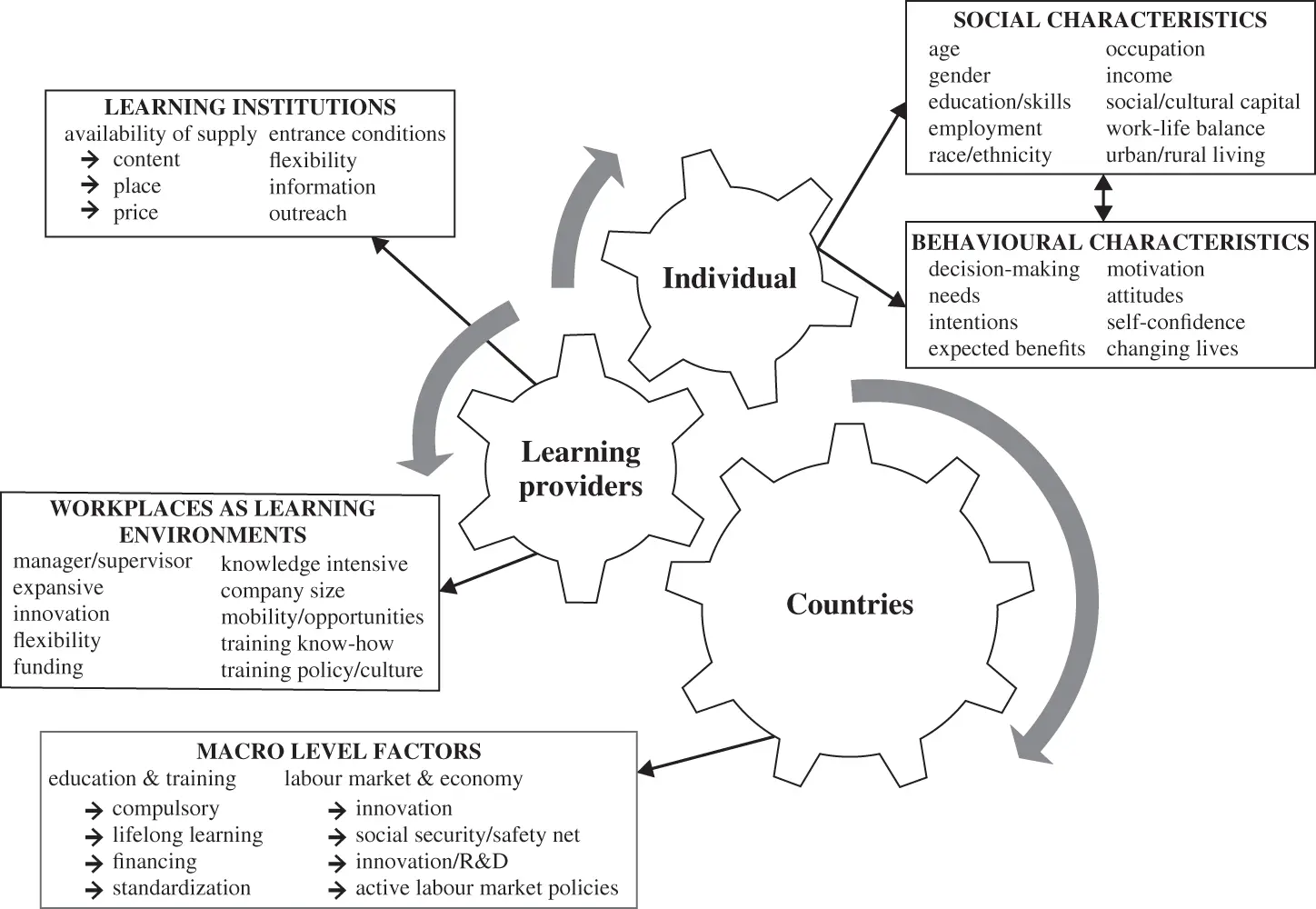
Figure 4.1 Comprehensive lifelong learning participation model.
SOURCE: Boeren, 2017, p. 168.
In summary, looking at social structure rather than just individual needs and interests reveals some very different explanations as to why adults do or do not participate in adult learning activities. These competing perspectives imply different strategies for increasing participation. If individual interests and motivation account for participation, then recruitment efforts would center on responding to an adult's perceived learning needs and stimulating motivation. If, in contrast, participation or nonparticipation is seen as a function of the social structure, then one would work toward changing aspects of this structure in ways that would facilitate participation. The most robust explanation of participation is likely to be found in considering both the psychological and sociological perspectives.
Problematizing the Concept of Participation
Most of what we have presented thus far on participation reflects what we know about who participates and the reasons for participating (or not) in mostly formal adult education. In this section of the chapter we stand back and question some of the assumptions that underlie the dominant discourse of participation. As Crowther (2000) points out, this discourse has been narrowly conceived around four assumptions: (a) participation is a good thing; (b) participation equals formal learning; (c) learners are abstract, not socialized, individuals; and (d) there are barriers to participation, not resistance. We take each one of these assumptions in turn to critique the concept of participation.
Participation Is a Good Thing
Studies of participation assume that everyone should want to engage in adult education because it is a good thing to do. Underlying many of the stated purposes of adult education in the United States is the assumption that the ideal of a democratic society must be maintained and that education is one way to do this. Individualism, independence, and a Protestant-capitalist work ethic frame the actual provision of adult education in America. Further, because this is a democratic society, all individuals have access and the opportunity to benefit from education. As Lindeman (1926/1989) proposed early in the founding of the field, adult education had a dual purpose of improving both society and the individual. In practice, however, a case can be made that education is “an agent of social control” (Torres, 2013, p. 9) rather than empowerment and that adult education in the United States is elitist and exclusionary. As evidence of adult education's elite bias, Cunningham (1988, p. 133) points to middle-class participation patterns, the homogeneous, technically oriented training of adult educators, the “psychology of individual deficit” that serves as a basis for explaining social inequities, and the erosion of the voluntary nature of adult education.
Most societies in fact use education to preserve the status quo rather than to bring about change or address inequities. In reviewing the common functions of adult education, Jarvis (1985/2012) points out how they can be used in the service of maintaining the status quo. Adult education maintains the social system and existing social relations because “people have internalized that culture in previous learning experiences, even when they act alone, they do so from the perspective of their social history. Hence, they are actually acting within a social context” (Jarvis, 1985/2012, p.134). Individual advancement and selection, although appearing to develop individuals, is actually a selective process carefully monitored by the system itself. Another function—offering a second chance and legitimization—also promotes the dominant culture because “second chance education actually produces an appearance of greater equality of opportunity and, hence, reinforces the existing social structures” (Jarvis, 1985/2012, p. 143). Even leisure-time pursuits have as a latent function “the retention of stability in the social system at a time when many people do not have work to occupy their time and their minds” (Jarvis, 1985/2012, p. 147). Finally, development and liberation can be goals of adult education, although one should be aware that such development and liberation may actually be designed to enable people to fit more easily into the existing social system.
Читать дальшеИнтервал:
Закладка:
Похожие книги на «Learning in Adulthood»
Представляем Вашему вниманию похожие книги на «Learning in Adulthood» списком для выбора. Мы отобрали схожую по названию и смыслу литературу в надежде предоставить читателям больше вариантов отыскать новые, интересные, ещё непрочитанные произведения.












Обсуждение, отзывы о книге «Learning in Adulthood» и просто собственные мнения читателей. Оставьте ваши комментарии, напишите, что Вы думаете о произведении, его смысле или главных героях. Укажите что конкретно понравилось, а что нет, и почему Вы так считаете.