Sharan B. Merriam - Learning in Adulthood
Здесь есть возможность читать онлайн «Sharan B. Merriam - Learning in Adulthood» — ознакомительный отрывок электронной книги совершенно бесплатно, а после прочтения отрывка купить полную версию. В некоторых случаях можно слушать аудио, скачать через торрент в формате fb2 и присутствует краткое содержание. Жанр: unrecognised, на английском языке. Описание произведения, (предисловие) а так же отзывы посетителей доступны на портале библиотеки ЛибКат.
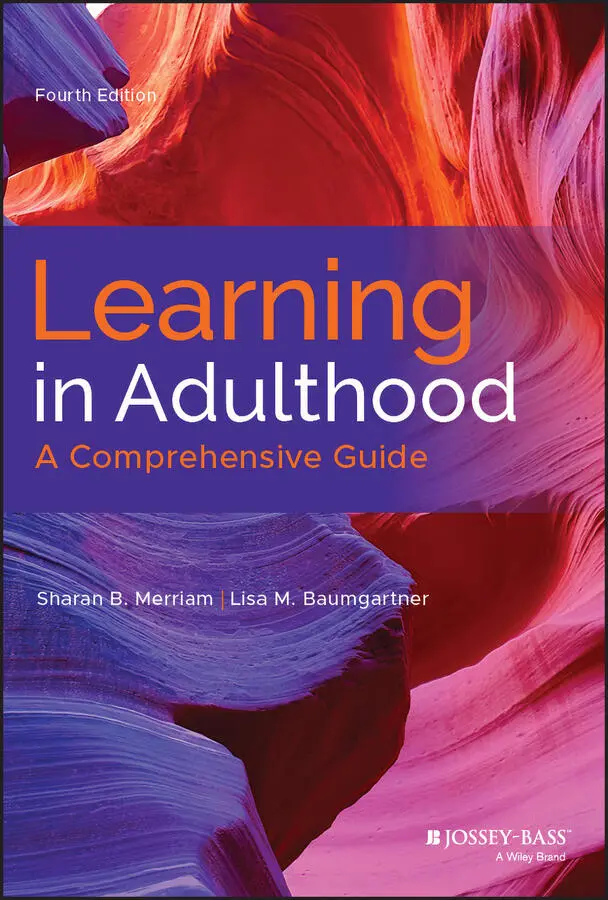
- Название:Learning in Adulthood
- Автор:
- Жанр:
- Год:неизвестен
- ISBN:нет данных
- Рейтинг книги:4 / 5. Голосов: 1
-
Избранное:Добавить в избранное
- Отзывы:
-
Ваша оценка:
Learning in Adulthood: краткое содержание, описание и аннотация
Предлагаем к чтению аннотацию, описание, краткое содержание или предисловие (зависит от того, что написал сам автор книги «Learning in Adulthood»). Если вы не нашли необходимую информацию о книге — напишите в комментариях, мы постараемся отыскать её.
has been the definitive guide in the field of adult education. Now in its fourth edition, this comprehensive volume is fully revised to reflect the latest developments in theory, research, and practice. The authors integrate foundational research and current knowledge to present fresh, original perspectives on teaching and learning in adulthood. Written by internationally-recognized experts, this market-leading guide draws from work in sociology, philosophy, critical social theory, psychology, and education to provide an inclusive overview of adult learning.
Designed primarily for educators of adults, this book is accessible for readers new to adult education, yet suitably rigorous for those more familiar with the subject. Content is organized into four practical parts, covering topics such as the social context of adult learning, self-directed and transformational learning, postmodern and feminist perspectives, cognitive development in adulthood, and more. Offering the most comprehensive single-volume treatment of adult learning available, this landmark text:
Offers a wide-ranging perspective on adult learning Synthesizes the latest thinking and work in the field Includes coverage of the sociocultural perspectives of adult learning Explores the broader social implications of adult education
is an indispensable resource for educators and administrators involved in teaching adults, as well as faculty and students in graduate programs in adult education.
Learning in Adulthood — читать онлайн ознакомительный отрывок
Ниже представлен текст книги, разбитый по страницам. Система сохранения места последней прочитанной страницы, позволяет с удобством читать онлайн бесплатно книгу «Learning in Adulthood», без необходимости каждый раз заново искать на чём Вы остановились. Поставьте закладку, и сможете в любой момент перейти на страницу, на которой закончили чтение.
Интервал:
Закладка:
The problems to which adult educators respond tend to be identified by those who have a value perspective not necessarily shared by the target population. As Cunningham (1988, p. 141) has noted, much program planning is based on an individual deficit model rather than an examination of “the oppressive structures in which people live.” Programs are thus designed around learner deficiencies that may or may not be of concern to the learner. What is necessary, Cunningham and others assert, is for socially responsible adult educators to become aware of the “social as well as personal dimensions of learning and the capacity of education to respond” (Cunningham, 2000, p. 574). Cunningham goes on to point out that “if one conceptualized any nation as composed of the state (governmental sector), civil society (voluntary sector), and the market (economic sector), then how these sectors are related and how education serves these sectors become critical questions in understanding the relationships between adult education and society” (p. 574).
Nevertheless, “adult education is given public support when the public can see the connection between education and the solution to a threatening situation” (Griffith & Fujita-Starck, 1989, p. 172). Most “threatening” are challenges to economic stability and social order. However, the emphasis may shift with changes in society's social, cultural, and economic structures. Literacy education in colonial America was invested in for a greater religious purpose; this gave way to a citizenship orientation in the wake of independence during the mid-eighteenth century, which in turn was eclipsed by vocational training and immigrant education at the turn of the twentieth century. Torres (2013) points out that we are undergoing a further shift in moving away from the notion of adult education to the concept of lifelong learning. This is a positive shift in that the focus moves “from teacher to learner, and from formal to nonformal and informal learning experiences, within and outside of educational institutions, within the workplace and given the virtuality of the new cybernetic culture, virtually everywhere” (p. 9). The concept of lifelong learning, Torres feels, is a better concept to address today's “challenges to immigration, multiculturalism and affirmative action” (p. 9).
In light of the social forces documented in Chapter 1—demographics, economics, and technology—the purposes of adult education today for which there is public support cluster around the United States sustaining a competitive edge in a global economy. This translates into preparing and then maintaining an informed and efficient workforce. Along with this economic imperative is the assumption that social stability is both a product and a goal of adult education and training. Thousands of restless, illiterate, unemployed, or underemployed adults pose a threat to the stability of the social order, not to mention a drain on social resources. So although the rhetoric of adult education suggests some rather lofty ideals for the purpose of the endeavor, the reality suggests a more conservative purpose: maintenance of the status quo, which today means a capitalist economic system that values individuality, independence, and entrepreneurialism. Thus we see a growing emphasis on human resource development and training, continued provision for basic skill acquisition, and ever-expanding postsecondary opportunities for adults.
Participation Equals Formal Learning
In writing this chapter on participation we would have liked to present as comprehensive a picture as possible. However, as we stated earlier, nearly all of the studies are of participation in formal institutionally sponsored programs. Yet we know that adults engage in learning activities sponsored by community-based nonformal groups. Further, adults learn informally on their own. Even in business and industry it has been estimated that upwards of 75% of learning in the workplace is informal (Bancheva & Ivanova, 2015).
What accounts for this bias in participation studies? It has to do in part with the ease of collecting information from educational institutions; in part it is due to adult learners themselves not recognizing the informal learning embedded in their everyday lives. And certainly the bias in part has to do with policy and funding. Although the field is proud of its service orientation and the voluntary nature of participation, in reality what is offered cannot be uncoupled from the question of who finances the various adult learning opportunities. And the answer to this question of who finances adult education is easier to find in reference to formal adult education.
In North America, there are many providers of formal learning opportunities, including government at all levels, employers, educational institutions, and community institutions such as libraries. Because much of the expenditure for this form of learning is hidden under a variety of budgetary labels—at one time more than 270 federal programs alone had some adult learning component (Griffith & Fujita-Starck, 1989)—it is difficult to measure the relative financial power of various providers.
To complicate the matter, what is offered at any particular time “will almost inevitably relate to the pressures generated in the social system. Social pressures act in such a manner as to create an imbalance in the system to which institutions, other than that generating pressure, respond by seeking to restore the system to some form of equilibrium” (Jarvis, 1986, p. 57). Institutions are currently being pressured to respond to the issues of an increasingly diverse workforce, technological obsolescence, and health threats such as obesity. This notion of mobilizing institutions in the service of maintaining social equilibrium is but one explanation for the shifts in curriculum emphasis.
Crowther (2000) points out that it could be argued that the monopoly of formal adult education is being challenged “by developments in experiential learning, the growth of new educational technologies, distance learning and procedures such as the accreditation of prior learning” (p. 485). He goes on to ask, “Are these not examples of a more democratic, pluralistic, learning process which both facilitates access and disperses control over the curriculum?” (p. 485). However, these mechanisms of dealing with and recognizing informal experiential learning can also be seen as “reaffirming, rather than undermining, the dominant assumptions about control over definitions of educationally relevant knowledge” (p. 485). In other words, when the recognition of informal learning is tied to the formal system as in accreditation of prior learning, control still rests with the system that has predetermined what counts as learning. That the formal system will serve its own interests is underscored by an interesting article in Training & Development about “free agent learners” (Caudron, 1999). Acknowledging the rise of employees learning on their own, Caudron warns that “companies have to be willing to accept the new ideas such employees are bringing to work” and that “free agent learners threaten corporate governance because the more that people learn, the more competent and confident they become” (p. 30). Speaking of the skills and competencies needed for the twenty-first century, Xanthoudaki (2015) observes that today's learners “decide what and how to learn, emerging as expert in their own right. This is not because we suddenly recognize the value of personalized learning, but because it seems to be the only way to face change.” Indeed, “opportunities for personalized, self-motivated education move away from the model of learning organized around stable, usually hierarchical institutions” (p. 249).
Participation equals formal learning because of ease of measurement but also because the formal system controls what gets “counted” as adult education. In a pluralistic society such as ours, there is no single answer to the question of who decides what learning opportunities to offer. The field is indeed complex with “demographic changes, globalization, and the intertwined explosion of technology and information” all contributing to the “expansion of adult education” in terms of providers, learners, and sites of learning (Ross-Gordon, Rose, & Kasworm, 2017, p. 27). In reality, for formal learning programs at least, decisions are made by those who pay—whether that means the learners themselves, government, employers, or educational institutions. And those who pay are in positions of power to determine which social pressures will be addressed and how those responses will be structured. Those not in positions of power rarely decide what learning opportunities are offered. Their role is limited to deciding whether to participate.
Читать дальшеИнтервал:
Закладка:
Похожие книги на «Learning in Adulthood»
Представляем Вашему вниманию похожие книги на «Learning in Adulthood» списком для выбора. Мы отобрали схожую по названию и смыслу литературу в надежде предоставить читателям больше вариантов отыскать новые, интересные, ещё непрочитанные произведения.








Обсуждение, отзывы о книге «Learning in Adulthood» и просто собственные мнения читателей. Оставьте ваши комментарии, напишите, что Вы думаете о произведении, его смысле или главных героях. Укажите что конкретно понравилось, а что нет, и почему Вы так считаете.