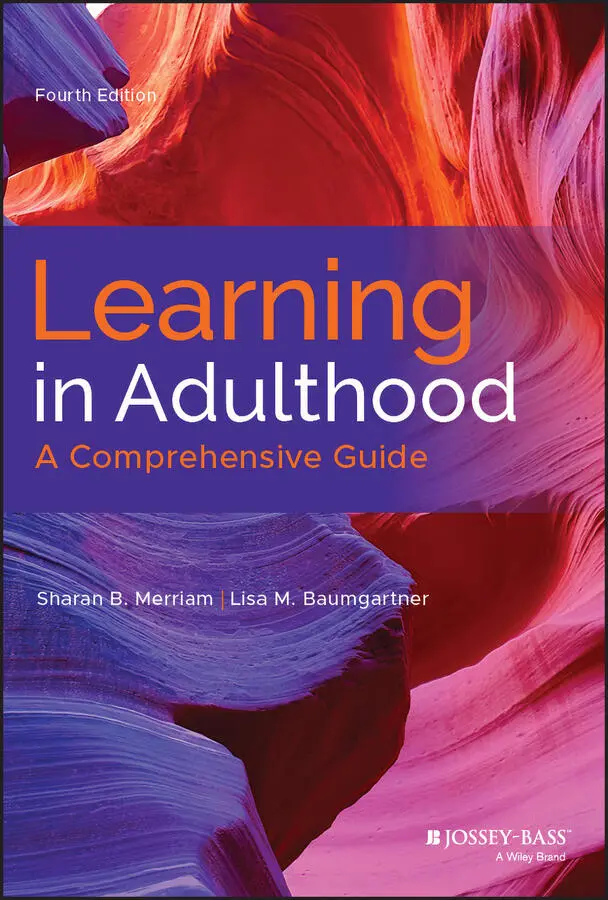
Sharan B. Merriam - Learning in Adulthood
Здесь есть возможность читать онлайн «Sharan B. Merriam - Learning in Adulthood» — ознакомительный отрывок электронной книги совершенно бесплатно, а после прочтения отрывка купить полную версию. В некоторых случаях можно слушать аудио, скачать через торрент в формате fb2 и присутствует краткое содержание. Жанр: unrecognised, на английском языке. Описание произведения, (предисловие) а так же отзывы посетителей доступны на портале библиотеки ЛибКат.
- Название:Learning in Adulthood
- Автор:
- Жанр:
- Год:неизвестен
- ISBN:нет данных
- Рейтинг книги:4 / 5. Голосов: 1
-
Избранное:Добавить в избранное
- Отзывы:
-
Ваша оценка:
Learning in Adulthood: краткое содержание, описание и аннотация
Предлагаем к чтению аннотацию, описание, краткое содержание или предисловие (зависит от того, что написал сам автор книги «Learning in Adulthood»). Если вы не нашли необходимую информацию о книге — напишите в комментариях, мы постараемся отыскать её.
has been the definitive guide in the field of adult education. Now in its fourth edition, this comprehensive volume is fully revised to reflect the latest developments in theory, research, and practice. The authors integrate foundational research and current knowledge to present fresh, original perspectives on teaching and learning in adulthood. Written by internationally-recognized experts, this market-leading guide draws from work in sociology, philosophy, critical social theory, psychology, and education to provide an inclusive overview of adult learning.
Designed primarily for educators of adults, this book is accessible for readers new to adult education, yet suitably rigorous for those more familiar with the subject. Content is organized into four practical parts, covering topics such as the social context of adult learning, self-directed and transformational learning, postmodern and feminist perspectives, cognitive development in adulthood, and more. Offering the most comprehensive single-volume treatment of adult learning available, this landmark text:
Offers a wide-ranging perspective on adult learning Synthesizes the latest thinking and work in the field Includes coverage of the sociocultural perspectives of adult learning Explores the broader social implications of adult education
is an indispensable resource for educators and administrators involved in teaching adults, as well as faculty and students in graduate programs in adult education.
Learning in Adulthood — читать онлайн ознакомительный отрывок
Ниже представлен текст книги, разбитый по страницам. Система сохранения места последней прочитанной страницы, позволяет с удобством читать онлайн бесплатно книгу «Learning in Adulthood», без необходимости каждый раз заново искать на чём Вы остановились. Поставьте закладку, и сможете в любой момент перейти на страницу, на которой закончили чтение.
Интервал:
Закладка:
Learners Are Abstract, Not Socialized, Individuals
As we have already noted in this chapter, the predominant view of adult learner participation is through the lens of individual learners who have chosen to participate in a learning activity. Much of the discourse on participation explains nonparticipation from an individual deficit stance—that is, there is something wrong with or deficient about nonparticipants or they would be clamoring to be in our adult education programs. Further, these nonparticipants are probably most in need of what adult education has to offer.
This discourse fails to take into account the sociocultural context of adult learners and the structural characteristics of the adult education enterprise itself. Although we have addressed some of these factors in the preceding section, “Adding a Sociological Lens to Explanations of Participation,” there is more that can be said about this major misconception about participation.
The democratic ideals of equal opportunity and open access make the current reality of uneven and unequal participation in formal adult learning particularly worrisome to some policymakers, educators, and researchers. Most explanations focus on a person's stated reasons for nonparticipation, such as cost, time, transportation, and lack of confidence. When viewed from a social perspective, other explanations emerge. Rubenson (1989, p. 64) argues, for example, that “through socialization within the family, the school, and, later on, in working life, a positive disposition towards adult education becomes a part of some group's habitus but not of others.”
Those adults who have been socialized into valuing and acquiring the attitudes and skills of the middle class will be the ones to take advantage of learning opportunities. Because most providers of such opportunities are themselves middle class, little effort is expended trying to understand and provide for other populations. The modus operandi of most providers is to offer a set of activities that they assume learners will want. A response, however, is predicated on the assumptions that learners know about the program, can attend at the time it is offered, and can afford it; that the subculture of the institution is conducive to their own; and that what is offered corresponds with what they need. Rubenson (1989, p. 65) argues that “a system of adult education that implicitly takes for granted that the adult is a conscious, self-directed individual in possession of the instruments vital to making use of the available possibilities for adult education—a system that relies on self-selection to recruit the participants—will by necessity widen, not narrow, the educational and cultural gaps in society.”
There are other reasons why certain adults have more access to learning opportunities than other adults. Where one happens to live; what one's primary language is; what color, age, or sex one happens to be; what one does for a living and level of educational attainment (Boeren & Holford, 2016; Boyadjieva & Illieva-Trichkova, 2017; Patterson, 2018) all contribute to the participation pattern in adult education. Cropley (1989, p. 146) calls these factors “framework conditions,” which “are largely a function of the circumstances in which people live, especially of factors such as the values, attitudes, habits, priorities and the like of the social groups to which they belong, the economic structure of their society, even features of the education system itself.” The result is that “some individuals are more equal than others in the choices available to them” (p. 146).
By way of illustrating how these framework conditions can determine who is more likely to benefit from adult learning opportunities, where and how one lives make a difference. It is common knowledge that there is less accessibility in rural areas than in urban or suburban centers. The picture is a bit more complicated than just a rural-urban split, however. Those in small-town rural areas are better off than those living in isolated areas, and some urban centers are as impoverished as the most rural areas. Worldwide, access to learning opportunities in rural areas is a problem at all levels of education. Further, there are those who lack a geographical place altogether—migrant, transient, homeless, and refugee populations. Migrants, for example, “are the most undereducated major subgroup in the United States, with a high school dropout rate larger than that of any other group. Their mobility, their language differences, and the cultural differences experienced as they move from one community to another combine with health and nutritional problems to negatively affect school achievement. Migrant lifestyles revolve around working, moving on to find other work, and working again” (Velazquez, 1996, p. 28). For any of these geographically mobile groups, there is little more than sporadic access to education or social services.
Age is another condition that often determines who benefits from learning opportunities. Older adults not only have the lowest levels of participation in adult education generally but also receive far less training in the workplace than younger workers (Czaja & Sharit, 2016). In some settings and in other parts of the world, age in combination with gender makes for another condition affecting access. For example, in the United States, because managerial and professional workers and all nonmanual workers receive more training than manual workers—and women are underrepresented in these positions—women, and older women in particular, are much less likely to receive employer-sponsored training than are men (Stacy & To, 1994).
There Are Barriers, Not Resistance
Readers will recall that there is a section of this chapter on barriers to participation. In that section we reviewed the studies that identify personal barriers such as lack of interest, personal problems, thinking one is too old to learn, and so on as well as situational barriers such as lack of time and money. We also pointed out that the individual's motivation, beliefs, and behaviors and life situation explain only part of the picture. Social structural factors such as family of origin, class, race, and so on shape one's level of participation in formal adult education.
What Crowther (2000) is proposing from a critical theory perspective is that nonparticipation can be construed as an act of resistance. Rather than being prevented from participating because of some insurmountable barrier, the learner chooses not to participate—that is, resistance is a matter of deliberate choice. Although resistance has been studied more frequently with secondary school populations, several adult educators have written about this phenomenon, especially in reference to literacy education (Belzer, 2004; Quigley, 1990; Sandlin, 2000).
In summarizing this notion of nonparticipation as resistance rather than barriers, Crowther (2000, pp. 489–490) writes:
It seems reasonable to surmise that many people find adult education unattractive and irrelevant to their daily lives. Despite many well-intentioned efforts to attract people the sense of frustration felt by their failure to respond to what is offered is often evident. It is easy thereafter to assume people are “apathetic” and have limited horizons. Redefining non-participation as a form of resistance may, however, open up the possibility of rethinking what adult education is for and where it occurs. … If we started to think about participation in these terms then the problem of participation could be faced the right way round—that is, that adult education is part of the problem rather than simply the solution.
Summary
Participation is one of the more thoroughly studied areas in adult education. We have a sense of who participates, what is studied, and what motivates some adults and not others to enroll in a course or undertake an independent learning project.
Читать дальшеИнтервал:
Закладка:
Похожие книги на «Learning in Adulthood»
Представляем Вашему вниманию похожие книги на «Learning in Adulthood» списком для выбора. Мы отобрали схожую по названию и смыслу литературу в надежде предоставить читателям больше вариантов отыскать новые, интересные, ещё непрочитанные произведения.












Обсуждение, отзывы о книге «Learning in Adulthood» и просто собственные мнения читателей. Оставьте ваши комментарии, напишите, что Вы думаете о произведении, его смысле или главных героях. Укажите что конкретно понравилось, а что нет, и почему Вы так считаете.