Charles S. Cockell - Astrobiology
Здесь есть возможность читать онлайн «Charles S. Cockell - Astrobiology» — ознакомительный отрывок электронной книги совершенно бесплатно, а после прочтения отрывка купить полную версию. В некоторых случаях можно слушать аудио, скачать через торрент в формате fb2 и присутствует краткое содержание. Жанр: unrecognised, на английском языке. Описание произведения, (предисловие) а так же отзывы посетителей доступны на портале библиотеки ЛибКат.
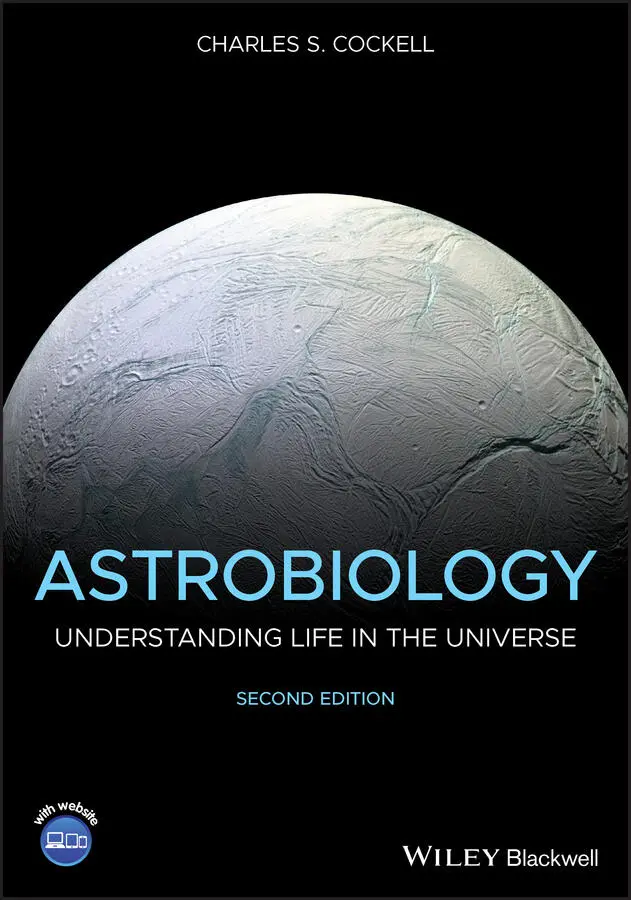
- Название:Astrobiology
- Автор:
- Жанр:
- Год:неизвестен
- ISBN:нет данных
- Рейтинг книги:3 / 5. Голосов: 1
-
Избранное:Добавить в избранное
- Отзывы:
-
Ваша оценка:
Astrobiology: краткое содержание, описание и аннотация
Предлагаем к чтению аннотацию, описание, краткое содержание или предисловие (зависит от того, что написал сам автор книги «Astrobiology»). Если вы не нашли необходимую информацию о книге — напишите в комментариях, мы постараемся отыскать её.
offers an introductory text that explores the structure of living things, the formation of the elements required for life in the Universe, the biological and geological history of the Earth, and the habitability of other planets. Written by a noted expert on the topic, the book examines many of the major conceptual foundations in astrobiology, which cover a diversity of traditional fields including chemistry, biology, geosciences, physics, and astronomy.
The book explores many profound questions such as: How did life originate on Earth? How has life persisted on Earth for over three billion years? Is there life elsewhere in the Universe? What is the future of life on Earth?
is centered on investigating the past and future of life on Earth by looking beyond Earth to get the answers. Astrobiology links the diverse scientific fields needed to understand life on our own planet and, potentially, life beyond. This new second edition:
Expands on information about the nature of astrobiology and why it is useful Contains a new chapter “What is Life?” that explores the history of attempts to understand life Contains 20% more material on the astrobiology of Mars, icy moons, the structure of life, and the habitability of planets New ‘Discussion Boxes’ to stimulate debate and thought about key questions in astrobiology New review and reflection questions for each chapter to aid learning New boxes describing the careers of astrobiologists and how they got into the subject Offers revised and updated information throughout to reflect the latest advances in the field Written for students of life sciences, physics, astronomy and related disciplines, the updated edition of
is an essential introductory text that includes recent advances to this dynamic field.
Astrobiology — читать онлайн ознакомительный отрывок
Ниже представлен текст книги, разбитый по страницам. Система сохранения места последней прочитанной страницы, позволяет с удобством читать онлайн бесплатно книгу «Astrobiology», без необходимости каждый раз заново искать на чём Вы остановились. Поставьте закладку, и сможете в любой момент перейти на страницу, на которой закончили чтение.
Интервал:
Закладка:
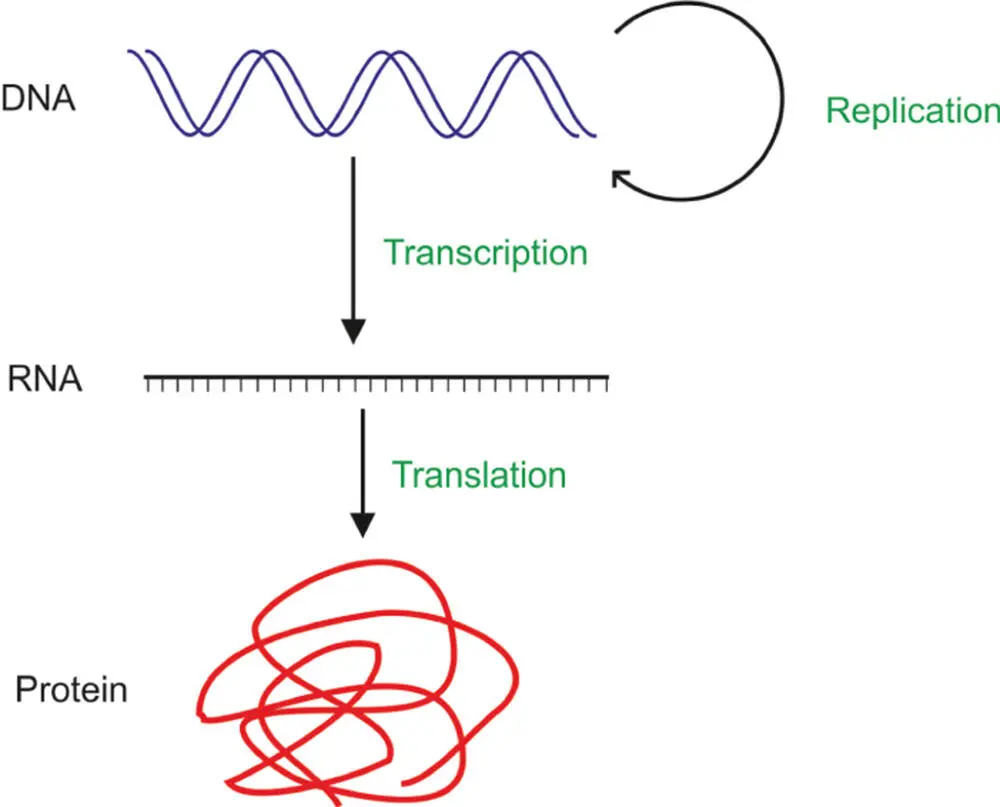
Figure 5.13 A summary of the two steps in reading from DNA to RNA to protein.
5.6.3 A Remarkable Code
There are a few remarkable things about this process worth mentioning. First, the table of codons shown in Figure 5.12, bar some minor modifications in some organisms, is essentially universal to all life forms. This not only shows the great antiquity of the genetic code, but also strongly suggests that all life on Earth was derived from a single common ancestor in which this code first emerged, presumably from more simple codes and structures that preceded it.
Second, the table is astounding because it is a code that allows a one-dimensional piece of information – the strand of a DNA molecule – to be transformed into the three-dimensional structure of a chemically active molecule. How did the structures emerge and what was the evolutionary process that linked one-dimensional information storage to three-dimensional biological function? This is one of the most fascinating questions in astrobiology, linked explicitly into our attempts to understand the origin of life. We come back to this when we consider the origin of life.
5.6.4 The Evolution of the Codons
How did the codon table evolve? It is instructive to notice that the amino acids are bunched together in the table. This has not gone unnoticed. One early hypothesis was that this arrangement leads to the minimization of errors. If the third location in the codon, which has a certain degree of “wobble,” changes, then the amino acid in the final protein is not changed. Mathematical models show that the codon table, as constituted, can achieve this error minimization. There are also other intriguing observations. For example, arginine is able to bind directly to the RNA codes represented by the codons in the table, without the transfer RNAs. The same is true for isoleucine. Could these amino acids have once bound directly to the RNA with the transfer RNA molecules becoming adaptors between the RNA and the amino acids later? It is possible that none of these ideas is mutually exclusive. Error minimization and direct associations between codons and amino acids and other factors may all have played a role in evolving the table early in the history of life.
Discussion Point: The Universality of the Genetic Structure and Machinery
The DNA molecule seems a thing of remarkable peculiarity with its four bases and the code that links the amino acids to particular codons. However, is all this a “frozen accident” as Francis Crick once famously called it, or is there something more behind it? There are possible alternative bases that might be used in a genetic code. For example, the base pairs xanthosine with 2,4-diaminopyrimidine and isoguanine with isocytosine might offer alternative base structures. However, research work testing the base pairing of a range of other bases across a molecular landscape of possibilities found them to be limited. By making RNA molecules with alternative bases, base pairs can be tested for their efficacy. Some bases, such as the hexopyranoses, which have a six-carbon ring in them, instead of the familiar five carbon ring, are too large and do not allow binding. Other bases were found to allow for even stronger base pairing than our own RNA, but in these cases, the pairing may be too strong, failing to provide the flexibility needed. These experiments suggest that the bases used in DNA and RNA may not be a frozen accident, but may have been selected by evolution from a wide range of possibilities. Explore the literature on the incorporation of new bases into DNA and discuss whether you think the genetic bases are a matter of chance or a frozen accident, or whether they were selected specifically by the evolutionary process.
Eschenmoser, A. (1999). Chemical etiology of nucleic acid structure. Science 284: 2118–2124.
Hoshika, S., Leal, N.A., Kim, M-Y. et al. (2019). Hachimoji DNA and RNA: A genetic system with eight building blocks. Science 363: 884–887.
Malyshev, D.A., Dhami, K., Lavergne, T. et al. (2014). A semi-synthetic organism with an expanded genetic alphabet. Nature 509: 385–388.
Piccirilli, J.A., Benner, S.A., Krauch, T. et al. (1990). Enzymatic incorporation of a new base pair into DNA and RNA extends the genetic alphabet. Nature 343: 33–37.
Focus: Astrobiologists: Nicol Caplin
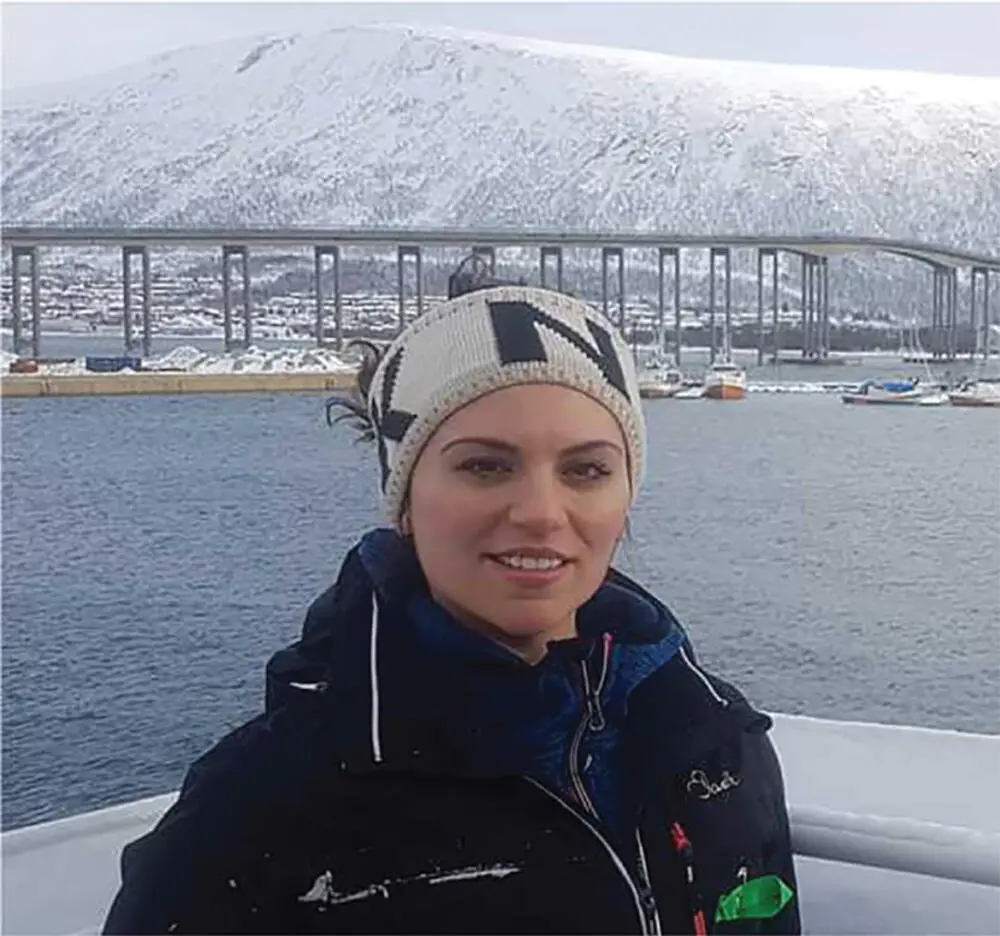
Affiliation: European Space Research and Technology Centre (ESTEC), European Space Agency (ESA), The Netherlands
What was your first degree? Environmental Science at The University of the West of England, Bristol.
What do you study? I work as a science coordinator (Research Fellow) for the European Space Agency in the European Space Research and Technology Centre (ESTEC) in The Netherlands. My primary role is to support research scientists and ensure that requirements for carrying out biology experiments in space are defined, understood, and met by our engineering and operations teams.
What science questions do you address? The astrobiology experiments that I am involved in organizing address a range of physiological and morphological endpoints that can provide information about life in the universe, particularly the limits of life in extreme environments. All of the projects I am assigned to are run on the International Space Station. They can be divided into two main categories of exposure to space conditions, internal and external. The internal experiments predominantly address effects of weightlessness (microgravity) while external ones expose samples to full space conditions (albeit within Earth's magnetic field but outside of the atmosphere). Such work must be carried out in space, as many of the conditions (and a combination of them) cannot be replicated on Earth.
How did you get involved in astrobiology research? As part of my PhD in environmental radioactivity, I studied biological effects of low-dose ionizing radiation on Earth and later, in samples that had been in space. I chose to study the effects in a well-established plant model ( Arabidopsis thaliana ) and used analytical techniques such as morphometrics and physiological assays that can be applied to other organisms. When searching for a postdoctoral position, I focused on trying to find a job where specialist research knowledge could be useful in examining fundamental science questions relating to various organisms in space.
5.6.5 DNA Replication
One of the most crucial events in the cell is DNA replication during cell division. This event underpins what many consider to be at least one characteristic of life – reproduction. DNA replication proceeds in three coordinated steps: initiation, elongation, and termination. This process is worth examining because it illustrates that cells today are complex machines. The enzymes involved in DNA replication amount to a highly coordinated process that cannot have all come together at once. Questions that immediately arise from looking at DNA replication are: What is the minimum molecular requirement for replicating a strand of DNA? When did the parts of the DNA replication apparatus evolve? How did the earliest cells on Earth replicate their DNA? The answers to these questions are not precisely known, but it is instructive to investigate how DNA replication proceeds to understand what is involved in this process in present-day biology.
Читать дальшеИнтервал:
Закладка:
Похожие книги на «Astrobiology»
Представляем Вашему вниманию похожие книги на «Astrobiology» списком для выбора. Мы отобрали схожую по названию и смыслу литературу в надежде предоставить читателям больше вариантов отыскать новые, интересные, ещё непрочитанные произведения.











Обсуждение, отзывы о книге «Astrobiology» и просто собственные мнения читателей. Оставьте ваши комментарии, напишите, что Вы думаете о произведении, его смысле или главных героях. Укажите что конкретно понравилось, а что нет, и почему Вы так считаете.