Charles S. Cockell - Astrobiology
Здесь есть возможность читать онлайн «Charles S. Cockell - Astrobiology» — ознакомительный отрывок электронной книги совершенно бесплатно, а после прочтения отрывка купить полную версию. В некоторых случаях можно слушать аудио, скачать через торрент в формате fb2 и присутствует краткое содержание. Жанр: unrecognised, на английском языке. Описание произведения, (предисловие) а так же отзывы посетителей доступны на портале библиотеки ЛибКат.
- Название:Astrobiology
- Автор:
- Жанр:
- Год:неизвестен
- ISBN:нет данных
- Рейтинг книги:3 / 5. Голосов: 1
-
Избранное:Добавить в избранное
- Отзывы:
-
Ваша оценка:
Astrobiology: краткое содержание, описание и аннотация
Предлагаем к чтению аннотацию, описание, краткое содержание или предисловие (зависит от того, что написал сам автор книги «Astrobiology»). Если вы не нашли необходимую информацию о книге — напишите в комментариях, мы постараемся отыскать её.
offers an introductory text that explores the structure of living things, the formation of the elements required for life in the Universe, the biological and geological history of the Earth, and the habitability of other planets. Written by a noted expert on the topic, the book examines many of the major conceptual foundations in astrobiology, which cover a diversity of traditional fields including chemistry, biology, geosciences, physics, and astronomy.
The book explores many profound questions such as: How did life originate on Earth? How has life persisted on Earth for over three billion years? Is there life elsewhere in the Universe? What is the future of life on Earth?
is centered on investigating the past and future of life on Earth by looking beyond Earth to get the answers. Astrobiology links the diverse scientific fields needed to understand life on our own planet and, potentially, life beyond. This new second edition:
Expands on information about the nature of astrobiology and why it is useful Contains a new chapter “What is Life?” that explores the history of attempts to understand life Contains 20% more material on the astrobiology of Mars, icy moons, the structure of life, and the habitability of planets New ‘Discussion Boxes’ to stimulate debate and thought about key questions in astrobiology New review and reflection questions for each chapter to aid learning New boxes describing the careers of astrobiologists and how they got into the subject Offers revised and updated information throughout to reflect the latest advances in the field Written for students of life sciences, physics, astronomy and related disciplines, the updated edition of
is an essential introductory text that includes recent advances to this dynamic field.
Astrobiology — читать онлайн ознакомительный отрывок
Ниже представлен текст книги, разбитый по страницам. Система сохранения места последней прочитанной страницы, позволяет с удобством читать онлайн бесплатно книгу «Astrobiology», без необходимости каждый раз заново искать на чём Вы остановились. Поставьте закладку, и сможете в любой момент перейти на страницу, на которой закончили чтение.
Интервал:
Закладка:
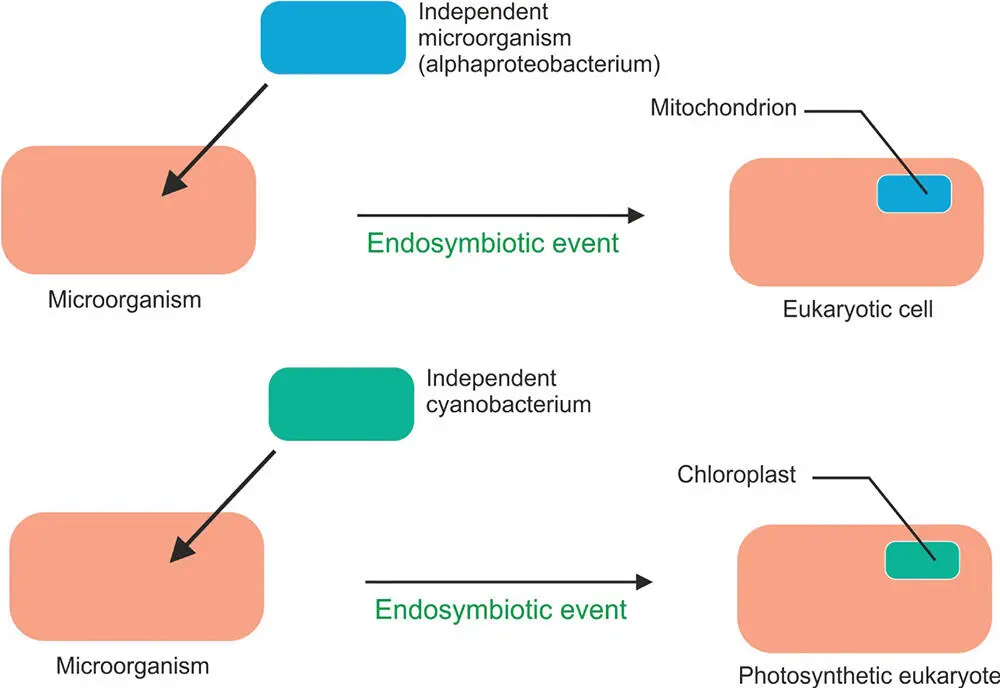
Figure 5.17 A schematic illustration of the concept of endosymbiosis. Chloroplasts and mitochondria were acquired initially as independent prokaryotic cells.
Endosymbiosis has even been invoked to explain the emergence of the eukaryotic nucleus. Another explanation is that the nucleus was a part of the original eukaryotic membrane that split off to form a separate structure (the exomembrane hypothesis). The origins of the eukaryotic nucleus remain an intriguing problem in cell biology.
5.8 The Reproduction of Cells
In cellular organisms (the prokaryotes and in most eukaryotic cell division) cells divide by mitosis(called binary fissionin the prokaryotes; Figure 5.18). During mitosis, DNA is replicated, generating two cells with exactly the same genetic composition as the original cell. All prokaryotes divide in this way. It is also referred to as asexual reproduction. In prokaryotes, the rate of cell division can be sufficiently high that a cycle of DNA replication can be begun before the previous one is completed. Mitosis is used in multicellular eukaryotes for replicating cells such as skin cells.
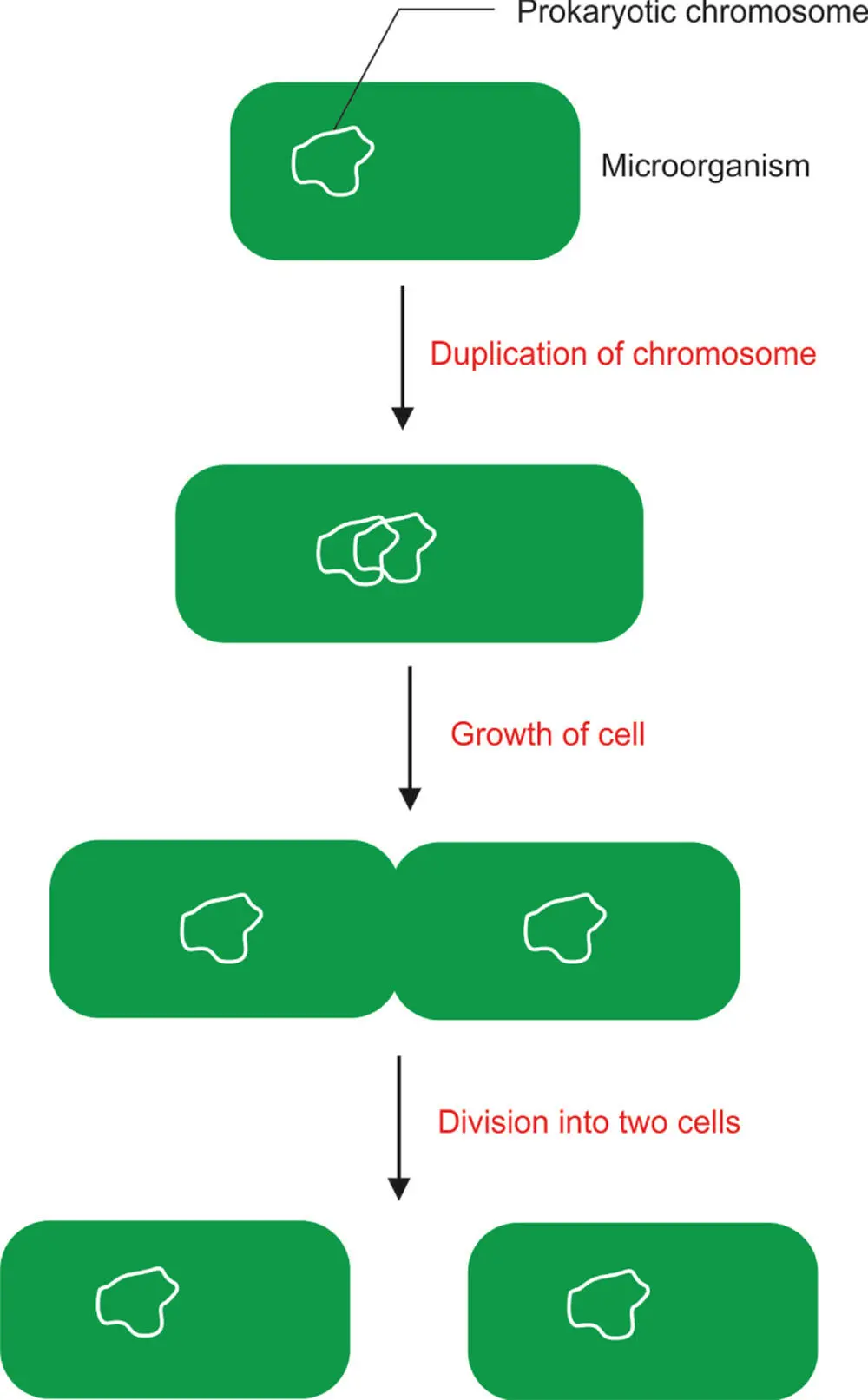
Figure 5.18 The process of mitosis or “binary fission.”
In many eukaryotes, including animals, plants and fungi, an additional form of replication is achieved, referred to as meiosis(Figure 5.19). Meiosis, put simply, is the process of making sex cells that can come together to make new individuals – this defines sexual reproduction. It seems logical, then, that the central process of meiosis is to make cells with half the genetic complement, so that when the mother's and father's sex cells come together, they produce a full complement again.
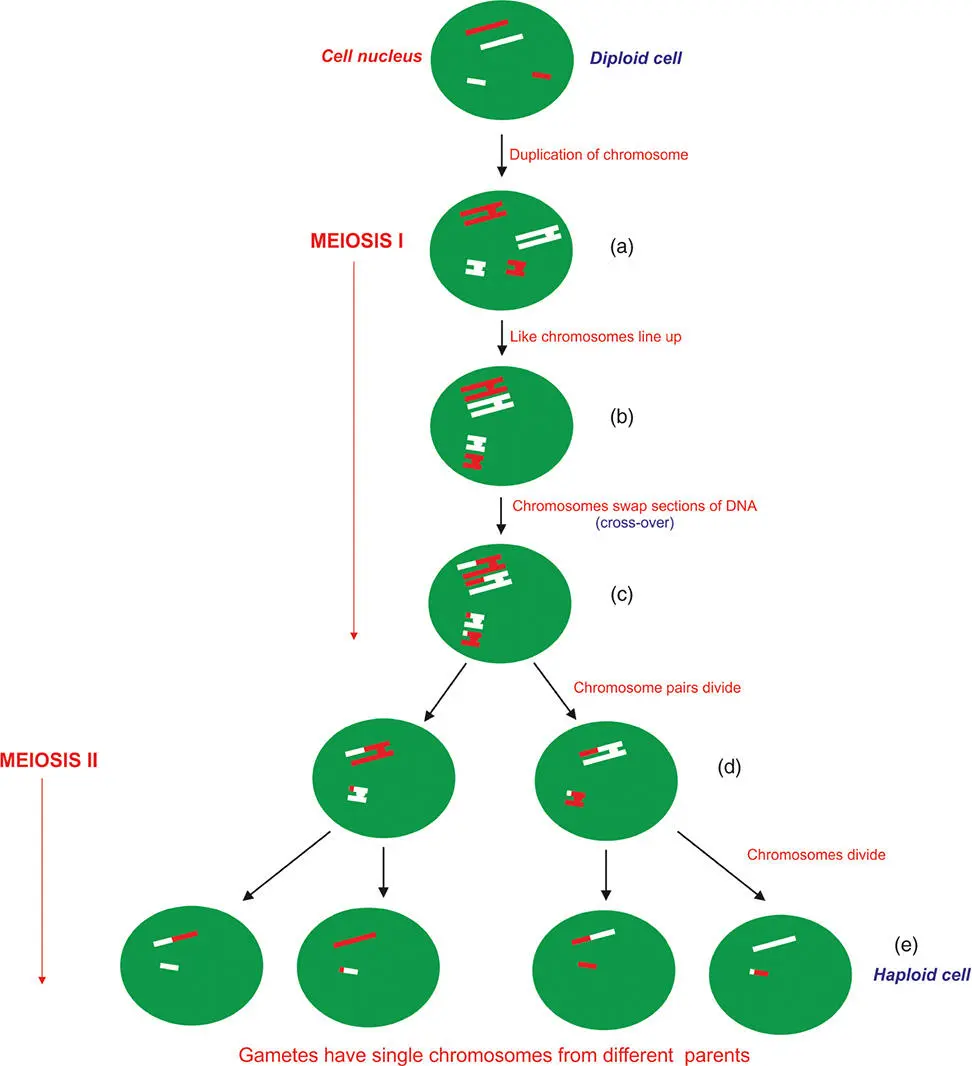
Figure 5.19 The process of meiosis.
Meiosis can be explained by reference to typical animal cells involved in this process (Figure 5.19). Animal cells contain two sets of chromosomes. As a consequence, they are called diploidcells. One set of chromosomes has come from the mother and one set from the father. In the first stage of meiosis, these sets of chromosomes are replicated in a diploid cell (Figure 5.19a). This process occurs before mitosis or meiosis. In mitosis these chromosomes would just separate into daughter cells, creating identical cells to the parent cell. However, in doubling up the chromosomes in meiosis, the cell has entered into the stage called Meiosis I. In the next step, the sets of doubled up chromosomes line up (Figure 5.19b) and then exchange genetic information (Figure 5.19c), generating chromosomes that are no longer identical to one another. This event is unique to meiosis and is called cross-over. By crossing over, segments of the chromosomes are mixed, generating variation. These chromosomes can now be divided into two new cells (Figure 5.19d). In Meiosis II, the next stage of meiosis, these cells are again divided in an identical way to mitosis, generating four cells (Figure 5.19e). These are the sex cells. These sperm or eggs (gametes) contain half the genetic complement and are called haploidcells. They can join together in sexual reproduction in which chromosomes from the mother and father come together to generate new adult diploid cells, which begin the process again in the new individuals.
5.9 Why Did Sexual Reproduction Evolve?
Asexual reproduction seems to be an extraordinarily successful way to propagate. It accounts for the pervasive presence of prokaryotic single-celled organisms in a vast diversity of habitats on Earth. Yet sexual reproduction persists, and it dominates the reproductive mode of multicellular life. This is a mystery because sex has a twofold cost. What the “twofold cost” means is that because only females of some species can bear young, a 50:50 female:male split of a population of 100 sexually reproducing organisms can only produce 50 offspring in the first generation if each female produces one offspring. However, a population of 100 asexually reproducing organisms dividing once can produce 100 offspring. So why would sex evolve given these costs? Clearly, however, once it did evolve, sex was successful, and it has been selected for since.
We do not know exactly why sex evolved, but there are a number of hypotheses that need not be mutually exclusive. First, we should note that the twofold cost is not strictly true for all species. Isogamousspecies are species in which males and females are not distinguished, and all members of a species can produce offspring. This counter-argument does not apply to all species, however, so other explanations are required.
Many ideas to explain sex lie in the genetic cross-over process that occurs in meiosis. One potential benefit is that it allows for radical genetic reorganization, with its potential to pass on many genes with combined beneficial effects. Asexually reproducing organisms must wait until different mutations collect over time that together can produce improvements. In sexual reproduction, because an entire segment of chromosome can be passed on from both parents, new large-scale genetic combinations can be tested. Cross-over may further allow genes to escape their surrounding genes, which may be deleterious, and recombine in new beneficial combinations.
Another theory is that sex may have arisen to protect against parasites. Organisms are constantly in a race to catch up with the deleterious effects of parasites. Even without changing physical environments, organisms must adapt constantly to deal with this on-going evolutionary pressure. This has been termed the Red Queen Hypothesis, named after the Red Queen in Lewis Carroll's book Alice in Wonderland , who had to constantly keep running just to stay in one place. Sexual reproduction allows for multiple genes that might be needed in new combinations to resist new parasites to be passed on to offspring and for new arrangements of these genes to be fabricated quickly in evolutionary time.
Yet another concept is that cross-over is a type of DNA repair process. As large segments of DNA are crossed over to form the chromosomes of the progeny, they can be used to patch-up segments of damaged DNA. Related to this concept is the idea that sex is a way of reducing mutational load. Asexually reproducing organisms continue to build up mutations sequentially in their DNA with each round of replication, ratcheting up, generation after generation. This “Muller's ratchet” (first discussed by geneticist Hermann Muller) eventually loads an organism with many potentially lethal mutations. Sexual combinations of genes may provide a mechanism to reduce this load by generating new genetic assortments from mixing of chromosomes from different lineages.
The mystery of sex is interesting because, to return to a time-honored question we have discussed already multiple times, would we presume such a process to be universal? Could we imagine a planet covered in asexually reproducing organisms in which stable genetic systems and populations could persist without sex? Is sex an idiosyncratic system that was “discovered” by evolution and because it provides advantages in certain situations, it has spread and persisted, or is it a system that is somehow essential for the development and emergence of multicellular life? These questions are difficult to answer without a definitive understanding of how sex evolved and what advantages it provides, but they are nevertheless profound. They strongly influence our view of how living things can reproduce and to what different extent systems of reproduction are an ineluctable part of biological evolution or chance events in our own particular evolutionary experiment.
Читать дальшеИнтервал:
Закладка:
Похожие книги на «Astrobiology»
Представляем Вашему вниманию похожие книги на «Astrobiology» списком для выбора. Мы отобрали схожую по названию и смыслу литературу в надежде предоставить читателям больше вариантов отыскать новые, интересные, ещё непрочитанные произведения.









Обсуждение, отзывы о книге «Astrobiology» и просто собственные мнения читателей. Оставьте ваши комментарии, напишите, что Вы думаете о произведении, его смысле или главных героях. Укажите что конкретно понравилось, а что нет, и почему Вы так считаете.