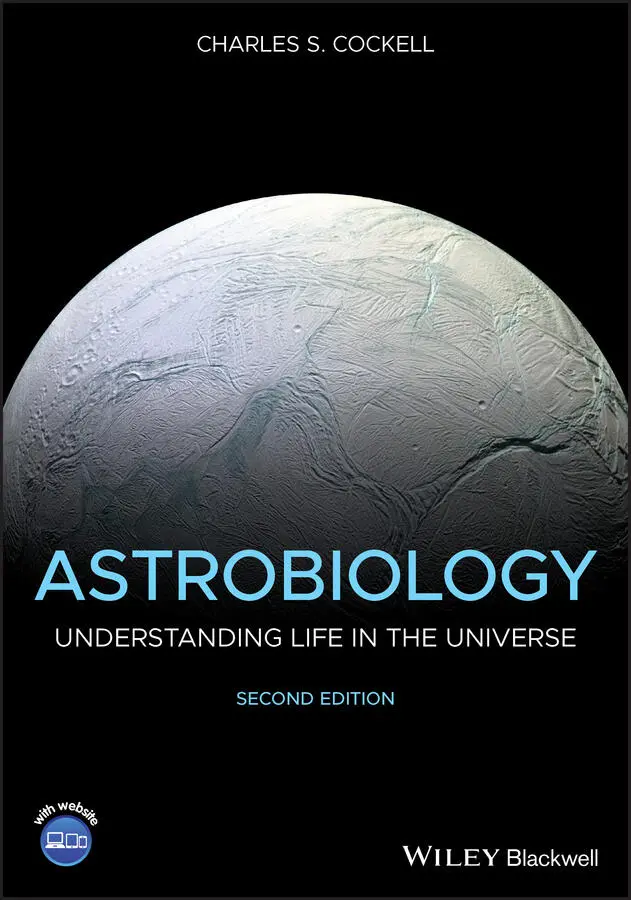
Charles S. Cockell - Astrobiology
Здесь есть возможность читать онлайн «Charles S. Cockell - Astrobiology» — ознакомительный отрывок электронной книги совершенно бесплатно, а после прочтения отрывка купить полную версию. В некоторых случаях можно слушать аудио, скачать через торрент в формате fb2 и присутствует краткое содержание. Жанр: unrecognised, на английском языке. Описание произведения, (предисловие) а так же отзывы посетителей доступны на портале библиотеки ЛибКат.
- Название:Astrobiology
- Автор:
- Жанр:
- Год:неизвестен
- ISBN:нет данных
- Рейтинг книги:3 / 5. Голосов: 1
-
Избранное:Добавить в избранное
- Отзывы:
-
Ваша оценка:
Astrobiology: краткое содержание, описание и аннотация
Предлагаем к чтению аннотацию, описание, краткое содержание или предисловие (зависит от того, что написал сам автор книги «Astrobiology»). Если вы не нашли необходимую информацию о книге — напишите в комментариях, мы постараемся отыскать её.
offers an introductory text that explores the structure of living things, the formation of the elements required for life in the Universe, the biological and geological history of the Earth, and the habitability of other planets. Written by a noted expert on the topic, the book examines many of the major conceptual foundations in astrobiology, which cover a diversity of traditional fields including chemistry, biology, geosciences, physics, and astronomy.
The book explores many profound questions such as: How did life originate on Earth? How has life persisted on Earth for over three billion years? Is there life elsewhere in the Universe? What is the future of life on Earth?
is centered on investigating the past and future of life on Earth by looking beyond Earth to get the answers. Astrobiology links the diverse scientific fields needed to understand life on our own planet and, potentially, life beyond. This new second edition:
Expands on information about the nature of astrobiology and why it is useful Contains a new chapter “What is Life?” that explores the history of attempts to understand life Contains 20% more material on the astrobiology of Mars, icy moons, the structure of life, and the habitability of planets New ‘Discussion Boxes’ to stimulate debate and thought about key questions in astrobiology New review and reflection questions for each chapter to aid learning New boxes describing the careers of astrobiologists and how they got into the subject Offers revised and updated information throughout to reflect the latest advances in the field Written for students of life sciences, physics, astronomy and related disciplines, the updated edition of
is an essential introductory text that includes recent advances to this dynamic field.
Astrobiology — читать онлайн ознакомительный отрывок
Ниже представлен текст книги, разбитый по страницам. Система сохранения места последней прочитанной страницы, позволяет с удобством читать онлайн бесплатно книгу «Astrobiology», без необходимости каждый раз заново искать на чём Вы остановились. Поставьте закладку, и сможете в любой момент перейти на страницу, на которой закончили чтение.
Интервал:
Закладка:
United States National Research Council (1999). Size Limits of Very Small Microorganisms: Proceedings of a Workshop, 1999 . Washington, DC: National Academies Press (available online: http://www.nap.edu/books/0309066344/html).
5.6.7 eDNA
One of the more enigmatic occurrences of DNA is extracellular deoxyribonucleic acid (eDNA), which is found outside the cell. Once thought to be DNA that had simply been released from dead cells, it is now understood to be involved in a variety of processes, including the formation of biofilms in bacteria. It may also provide a rich source of genetic information that can be sequestered by other organisms in the process of transformation, whereby naked DNA in the environment is taken up and incorporated into the genome of organisms. This process is discussed in more detail in Chapter 8.
5.7 Eukaryotic Cells
Eukaryotic cells have a number of crucial differences from prokaryotic cells (Figure 5.16), the most notable is the presence of a cell nucleus. In the prokaryotic cell, the DNA is free floating in the fluid, or cytoplasm, of the cell and is sometimes referred to as the nucleoid. It is not surrounded by a nuclear membrane. In contrast, in eukaryotic cells, the DNA is found in the nucleus. Transcription occurs in the nucleus before the mRNA is moved into the cytoplasm for processing. The nucleus is constructed with a nuclear membrane containing pores allowing for the movement of material, such as the transcribed mRNA, in and out. Eukaryotic DNA also has important differences to prokaryotic DNA. The DNA contains sequences called introns. These are removed once the mRNA has been synthesized in the nucleus to leave only the exons(the parts of the mature mRNA that will be used to translate the genes). Eukaryotic cells contain histones. These are proteins around which the chromosomal DNA is packaged. Without them, the DNA would be long and unwieldy. For example, a typical diploidhuman cell contains about 1.8 m of DNA. Wound around the histones, the DNA can be effectively packaged in the nucleus.
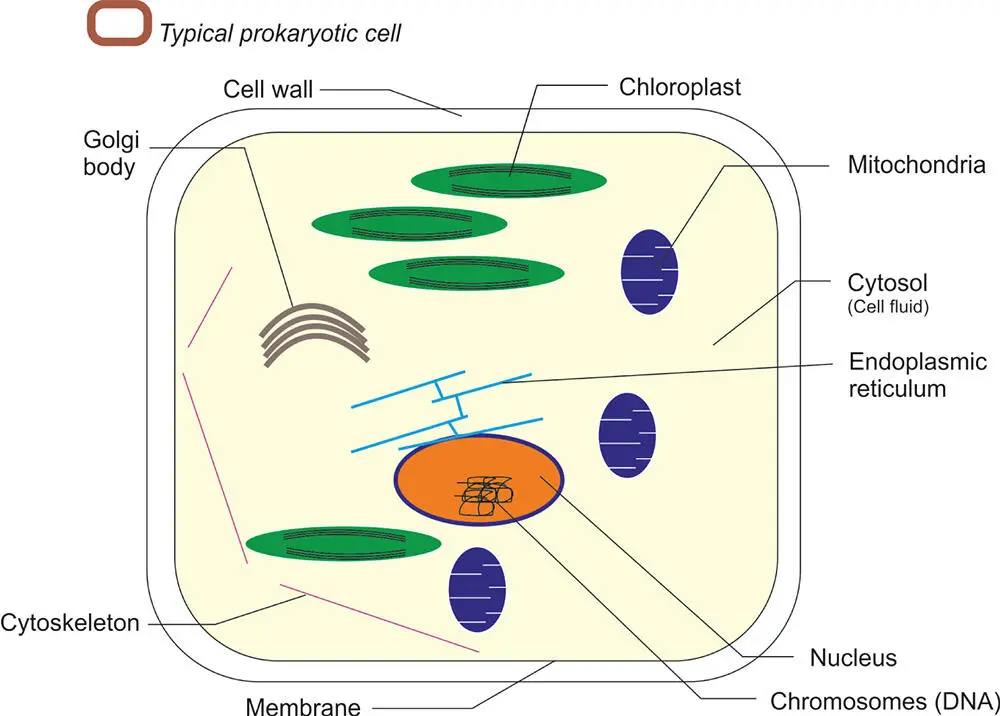
Figure 5.16 A typical plant eukaryotic cell with some of its components. The cell shown is about 10 microns across. A typical size of a prokaryotic cell is shown for comparison.
A variety of other adaptations are found in specific eukaryotic cells (Figure 4.16). For example, a cell wall made of the polysaccharide, cellulose, which is constructed from repeating glucose molecules ( Chapter 4), is found in plants. In fungi, the cell wall contains chitin, a polysaccharide made from N -acetylglucosamine, a derivative of glucose. Keratins are another type of tough filamentous protein. These are excreted in mammalian skin cells and account for the tough exterior of skin. When excreted outside the cell, keratins make hair and nails.
Many eukaryotic cells have a cytoskeleton, made up of a variety of structures including tubes and filaments of the proteins tubulin (microtubules) and actin (microfilaments). These molecules provide a rigid structure to the cell and can allow it to change shape, such as when it is involved in tissue formation or movement toward nutrients and resources. The cytoskeleton plays a particularly important role in cell division, providing a scaffold during the separation of chromosomes. It is also used as a network for moving cell components around within the cell. Components travel along the microtubules like a railway track, attached to molecules such as kinesin. This is an adenosine triphosphate (ATP)-requiring process.
The cytoskeleton may not be completely unique to eukaryotes. Prokaryotes have been shown to have simple cytoskeletal structures made up of proteins such as crescentin, which seems to form a ring structure, providing shape to some bacterial cells. These observations show that although in gross characteristics eukaryotic cells seem very different from prokaryotic cells, they share common characteristics that likely reflect their common origins.
Eukaryotic cells can contain a number of other organelles in which separate tasks are undertaken. For example, plant cells contain chloroplasts, the site of photosynthetic reactions, which we explore in more detail in Chapter 6. Eukaryotic cells contain the endoplasmic reticulum, which is split into two types. “Rough” endoplasmic reticulum is the site of protein synthesis, “smooth” endoplasmic reticulum, the site of lipid synthesis. The Golgi body (or Golgi apparatus) is involved in packaging proteins from the endoplasmic reticulum, particularly proteins that are to be excreted from the cells.
Animal cells have lysosomes, which are organelles containing enzymes that allow the cell to break down engulfed molecules as a source of food. Secretory vesicles are involved in the excretion of hormones and other chemical messengers.
A particularly important organelle within the eukaryotes is the mitochondrion(plural mitochondria), found in most eukaryotic cells. They are ATP-producing organelles, the site of aerobic respiration, although they also have roles to play in cell signaling and differentiation. Although plants trap energy in chloroplasts, they still use mitochondria to break down the glucose they produce in photosynthesis as a source of energy for the cell. The mitochondria are important because they are the energy-yielding factories, if you like, of the eukaryotic cell and in many ways define the eukaryotic cell. By tapping into aerobic respiration, which is much more energy-yielding than oxygen-free modes of acquiring energy, and by having many mitochondria, the eukaryotic cell was able to harness much greater quantities of energy to allow for greater complexity and for the energy-intensive processes we associate with multicellular life. In that sense, the acquisition and taming of the mitochondrion by the earliest eukaryotic cell likely allowed for the revolution we associate with the emergence of complex multicellular life. You might like to consider this paragraph again when you have investigated energy acquisition in cells, discussed in the next chapter.
The diversity of cellular structures made possible by the plethora of component parts allows for a wide variety of cell types. For example, the human body contains over 200 types of cells specialized for functions as diverse as passing electrical signals (neurons) or providing an external barrier (skin cells). Together these cells comprise the ∼40 trillion cells that make up the human organism. Some of these cells last for a lifetime (such as some neurons), and some, such as white blood cells, can last for just a day. It is now recognized that this is not just a random case of cells dying when they get damaged or otherwise compromised. Many cells have a programmed cell death or apoptosis, which can be triggered by cell damage or when the cells are no longer required. These pathways presumably evolved to prevent rogue cells from causing damage to the organism.
5.7.1 Endosymbiosis
Where did these organelles in eukaryotes come from? It was long suspected that maybe some of them had begun their origins as independent cells. For example in the mitochondria, the physically circular nature of their DNA and the content of the genetic code suggested that they were once bacteria that were acquired by eukaryotes, eventually becoming dependent on the host cell (Figure 5.17). The ancestral bacterium is thought to have been an alphaproteobacterium, a subphylum of bacteria. This process of endosymbiosis, championed by biologist Lynn Margulis (1938–2011), explains the origin of chloroplasts in eukaryotic photosynthetic organisms such as plants and algae. The chloroplasts were once independent photosynthetic cyanobacteria.
Читать дальшеИнтервал:
Закладка:
Похожие книги на «Astrobiology»
Представляем Вашему вниманию похожие книги на «Astrobiology» списком для выбора. Мы отобрали схожую по названию и смыслу литературу в надежде предоставить читателям больше вариантов отыскать новые, интересные, ещё непрочитанные произведения.









Обсуждение, отзывы о книге «Astrobiology» и просто собственные мнения читателей. Оставьте ваши комментарии, напишите, что Вы думаете о произведении, его смысле или главных героях. Укажите что конкретно понравилось, а что нет, и почему Вы так считаете.