Charles S. Cockell - Astrobiology
Здесь есть возможность читать онлайн «Charles S. Cockell - Astrobiology» — ознакомительный отрывок электронной книги совершенно бесплатно, а после прочтения отрывка купить полную версию. В некоторых случаях можно слушать аудио, скачать через торрент в формате fb2 и присутствует краткое содержание. Жанр: unrecognised, на английском языке. Описание произведения, (предисловие) а так же отзывы посетителей доступны на портале библиотеки ЛибКат.
- Название:Astrobiology
- Автор:
- Жанр:
- Год:неизвестен
- ISBN:нет данных
- Рейтинг книги:3 / 5. Голосов: 1
-
Избранное:Добавить в избранное
- Отзывы:
-
Ваша оценка:
Astrobiology: краткое содержание, описание и аннотация
Предлагаем к чтению аннотацию, описание, краткое содержание или предисловие (зависит от того, что написал сам автор книги «Astrobiology»). Если вы не нашли необходимую информацию о книге — напишите в комментариях, мы постараемся отыскать её.
offers an introductory text that explores the structure of living things, the formation of the elements required for life in the Universe, the biological and geological history of the Earth, and the habitability of other planets. Written by a noted expert on the topic, the book examines many of the major conceptual foundations in astrobiology, which cover a diversity of traditional fields including chemistry, biology, geosciences, physics, and astronomy.
The book explores many profound questions such as: How did life originate on Earth? How has life persisted on Earth for over three billion years? Is there life elsewhere in the Universe? What is the future of life on Earth?
is centered on investigating the past and future of life on Earth by looking beyond Earth to get the answers. Astrobiology links the diverse scientific fields needed to understand life on our own planet and, potentially, life beyond. This new second edition:
Expands on information about the nature of astrobiology and why it is useful Contains a new chapter “What is Life?” that explores the history of attempts to understand life Contains 20% more material on the astrobiology of Mars, icy moons, the structure of life, and the habitability of planets New ‘Discussion Boxes’ to stimulate debate and thought about key questions in astrobiology New review and reflection questions for each chapter to aid learning New boxes describing the careers of astrobiologists and how they got into the subject Offers revised and updated information throughout to reflect the latest advances in the field Written for students of life sciences, physics, astronomy and related disciplines, the updated edition of
is an essential introductory text that includes recent advances to this dynamic field.
Astrobiology — читать онлайн ознакомительный отрывок
Ниже представлен текст книги, разбитый по страницам. Система сохранения места последней прочитанной страницы, позволяет с удобством читать онлайн бесплатно книгу «Astrobiology», без необходимости каждый раз заново искать на чём Вы остановились. Поставьте закладку, и сможете в любой момент перейти на страницу, на которой закончили чтение.
Интервал:
Закладка:
Gould, S.J. (1983). Kingdoms without wheels. In: Hen's Teeth and Horse's Toes , 158–165. London: Penguin.
LaBarbera, M. (1983). Why the wheels won't go. The American Naturalist 121: 395–408.
In the simplest arrangement of the flagellum on the cell, there is one flagellum, or a group of flagella, at one end of the microbe, propelling the microbe forwards. To change direction, the flagella briefly rotate in the opposite direction, which causes the microbe to “tumble” and so change the direction in which it is facing (Figure 5.23). When the direction of original rotation is resumed, the microbe moves off in a new direction. In this way, a microbe can change its direction to move away from noxious substances or toward nutrients.
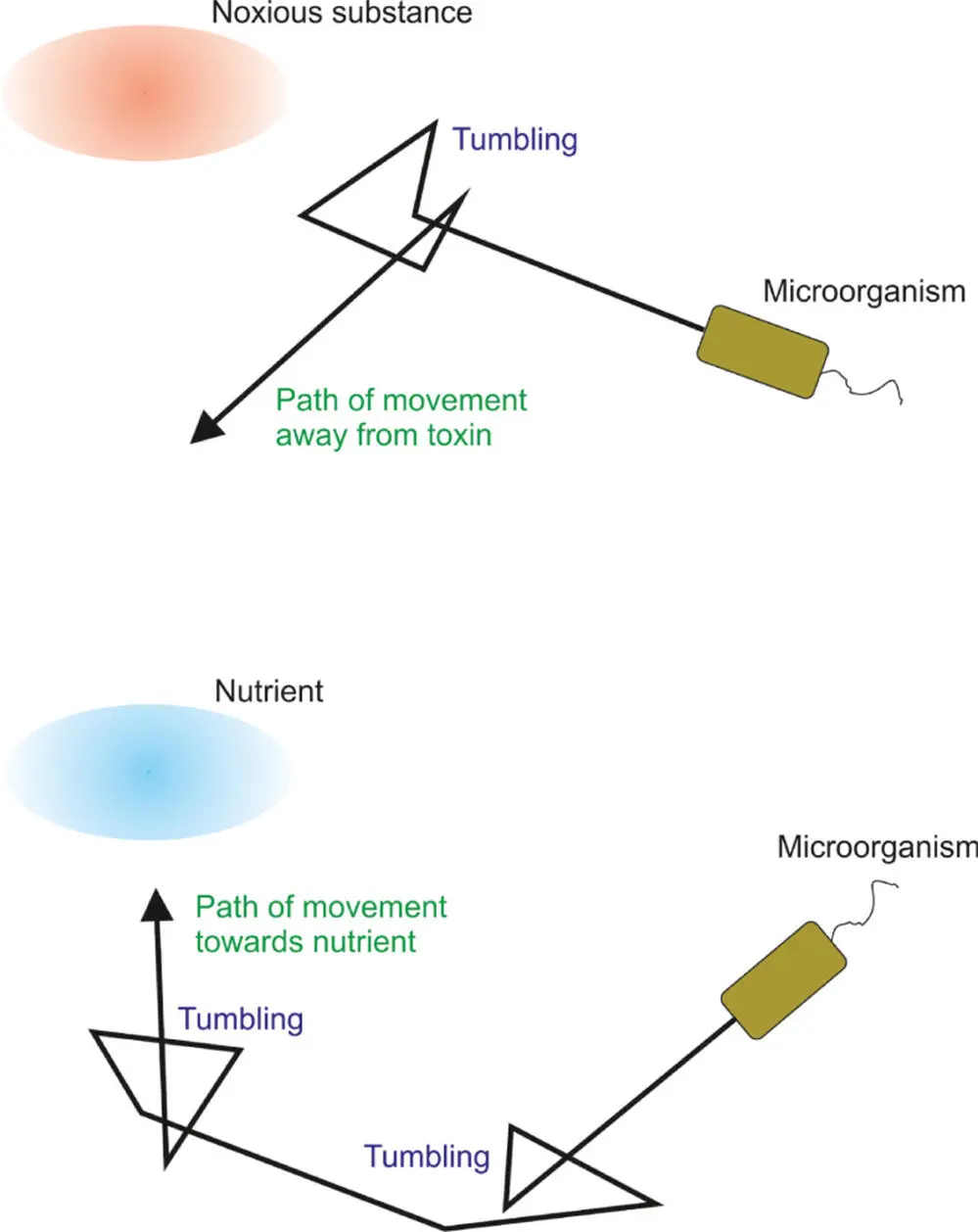
Figure 5.23 Microbial movements toward nutrients and away from toxins. A possible track of a microorganism that encounters a noxious substance or nutrients. Tumbling allows for the organism to randomize direction and, depending on whether it detects a greater concentration of noxious substance or nutrients after changing direction, it may initiate further tumbling events until it is moving either away or toward the concentration gradient.
Not all microbes have flagella just at one end of the cell; some have groups of them at both ends. Some members of the family Vibrionaceae, which are widely found in the environment and include the organism responsible for causing the disease cholera, either can have flagella at one end of the cell or can be all over the outside surface of the microbe, depending on whether they are attached to a surface or are free-swimming. Some of these different arrangements are shown in Figure 5.24.
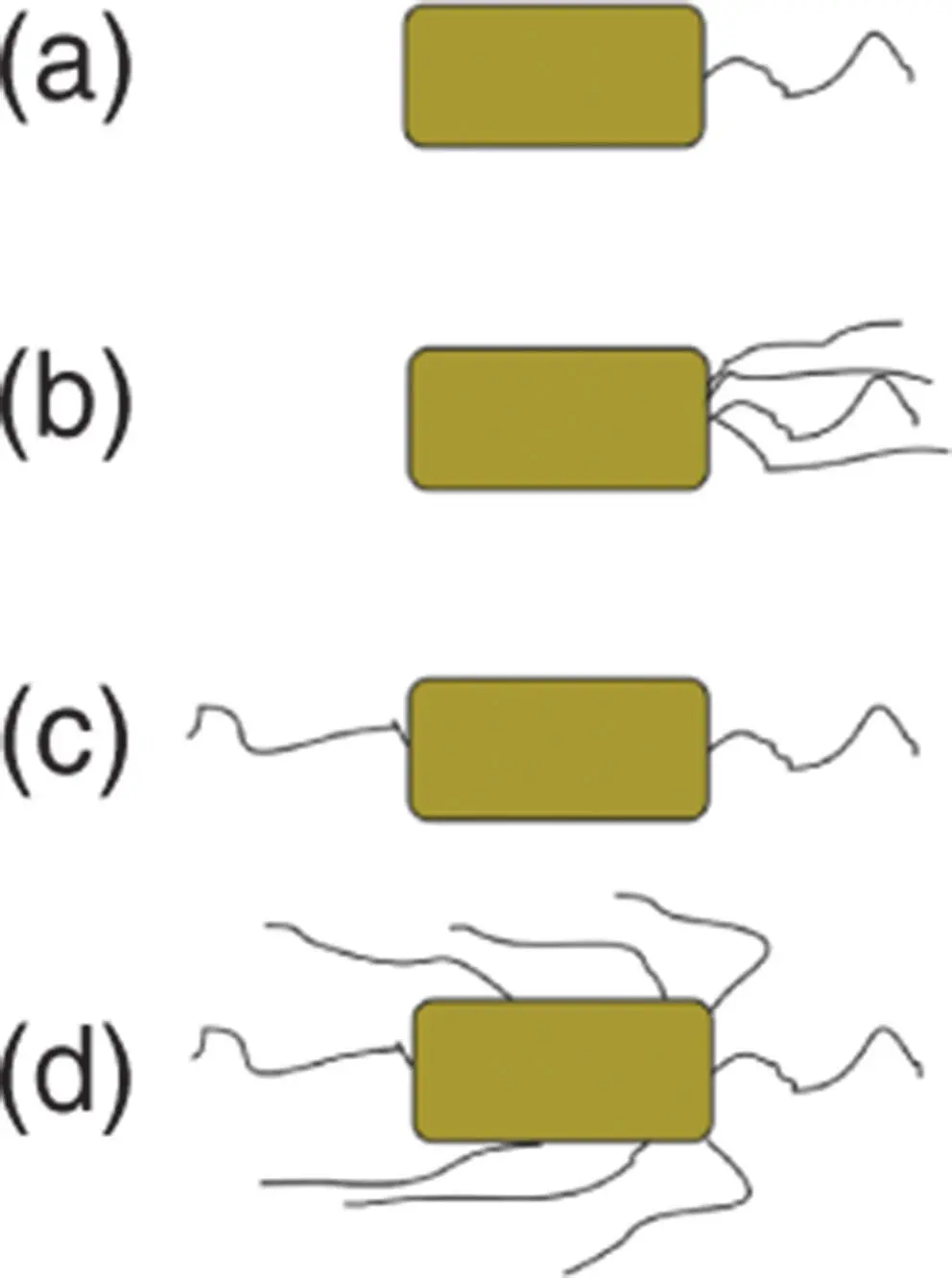
Figure 5.24 Sketch showing different arrangements of flagella. (a) A single flagellum (monotrichous), (b) many flagella bundled at one end of the cell (lophotrichous), (c) one or more flagella at both ends (amphitrichous), (d) flagella distributed randomly over the surface (peritrichous).
Although flagella on the outside of cells are by far the most common means of achieving locomotion, it is by no means the only way microbes are able to move. Bacteria belonging to the group, the Spirochaetes, have numerous flagella located between the cell membrane and the cell wall. The microbes are helically shaped and can move using these internal flagella. However, to be able to move forwards, the flagella at both ends of the cell must move in opposite directions; if they moved in the same direction, the actions would cancel each other out, and the cells would be stationary.
Pseudomonas aeruginosa is a common and well-studied microbe, found in soil, water, and other moist locations. This species is an example of a type of microorganism that moves using much shorter structures than flagella, called pili(singular pilus). Pili can be extended from the cell surface, and they achieve movement by “twitching.” Short jerks can be observed as a slow movement of organisms when viewed under a microscope.
5.11.2 Communication in Prokaryotes
Multicellular eukaryotes communicate with a large array of methods from making noises to body movements. They are interpreted by other organisms through touch, eyesight, and hearing. However, prokaryotes also communicate. Known as quorum sensing, this allows microbes to sense whether other microbes are close to them, and to regulate their chemical processes accordingly.
Quorum sensing was first discovered in the microbe Vibrio fischeri that colonizes the light-producing organs of some fish and squid, where the microbes are responsible for producing the light through bioluminescence. When the V. fischeri microbes are in normal seawater, where they rarely come into contact with another member of the same species, they do not produce any light. However, once they reach a high concentration, such as inside the squid's light-producing organ, they sense the presence of others, and the light-producing chemical reactions are triggered.
Why would microbes sense other microbes? Quorum sensing provides microbes with a means to sense how much competition there might be for resources and to regulate their activity accordingly. In some ways, it is a type of cooperation, but it also benefits each individual microbe to sense whether it is alone or not. For example, if there is intense competition for resources, it might be better to use less energy and become more inactive. An example is to be found in the microbe P. aeruginosa , which can live as individual cells, but at a certain concentration of cells, they form a structured biofilm which can allow them to be more resistant to environmental extremes. Quorum sensing is mediated by organic molecules such as very small chains of amino acids (peptides). The prokaryotic ability to engage in rudimentary forms of communication shows us that interactions between cells and complex social dynamics are not just the preserve of multicelled eukaryotes, but communication can also modify and shape prokaryotic populations.
5.11.3 “Multicellularity” in Prokaryotes and Single-Celled Eukaryotes
Prokaryotic cells, and some eukaryotic cells such as certain amoeba, are often described using the term “single-celled” to differentiate them from so-called “multicellular” organisms. I have used these terms in many places in this textbook. It is important to gain some clarity on the use of these terms. In animals and plants, multicellularity refers to the fact that the cells are permanently differentiated, such as, for example, into liver or skin cells. Although each cell generally has a full genome that contains all the information required to make any cell, once cells differentiate into particular types, they tend to stay that way. Furthermore, often cells are dependent on other cells for their continuation. Except in a laboratory, a liver cell, for example, cannot exist in the natural environment on its own, although some cells, such as stem cells, or cuttings from plants, can be used to make a new organism.
However, the terms “single-celled” and “multi-celled” hide the fact that there are many intermediate states. For example, prokaryotes can exhibit a form of multicellularity in that single cells come together to form multicellular structures. For example, different prokaryotes that carry out different metabolisms can come together to form a microbial mator biofilm, in which each microbe performs a chemical transformation linked to other organisms in the mat. This is explored in greater detail in the next chapter when we see how energy demands in the environment often encourage these associations. The difference between this structure and many plant or animal multicellular eukaryotic cells is that the mat can be dispersed, and the cells can continue to exist as independent entities.
Other remarkable multicellular behaviors are observed in some organisms, such as in slime molds, which are eukaryotic single-celled organisms (Figure 5.25). Cellular slime molds include a wide diversity of species, one of the most common being Physarum polycephalum , which often forms a slimy yellow mass on forest logs. Slime molds exist as single amoeba-like cells that feed on bacteria. The cells are haploid, but can mate with other cells to form a plasmodium, a large mass of nuclei enclosed in a large cell membrane that can reach meters in diameter. The plasmodia form protoplasmic streams that can move rapidly out across the environment in search of food. When food is scarce, the plasmodia contract, and the cells transform into fruiting bodies, another type of cell structure. These bodies are sporangia (singular sporangium) and they mature and release spores that can be blown in the wind to more favorable conditions.
Читать дальшеИнтервал:
Закладка:
Похожие книги на «Astrobiology»
Представляем Вашему вниманию похожие книги на «Astrobiology» списком для выбора. Мы отобрали схожую по названию и смыслу литературу в надежде предоставить читателям больше вариантов отыскать новые, интересные, ещё непрочитанные произведения.











Обсуждение, отзывы о книге «Astrobiology» и просто собственные мнения читателей. Оставьте ваши комментарии, напишите, что Вы думаете о произведении, его смысле или главных героях. Укажите что конкретно понравилось, а что нет, и почему Вы так считаете.