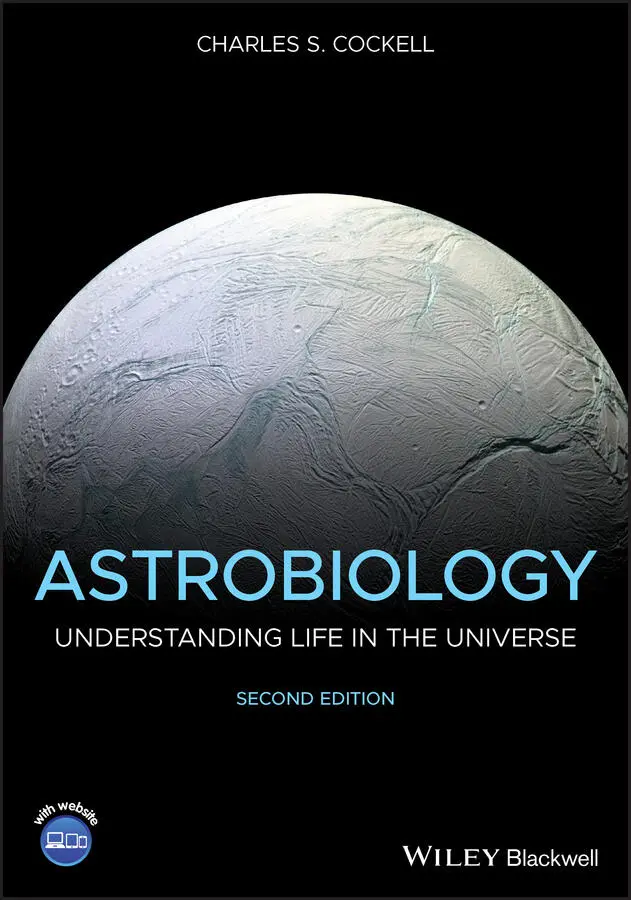
Charles S. Cockell - Astrobiology
Здесь есть возможность читать онлайн «Charles S. Cockell - Astrobiology» — ознакомительный отрывок электронной книги совершенно бесплатно, а после прочтения отрывка купить полную версию. В некоторых случаях можно слушать аудио, скачать через торрент в формате fb2 и присутствует краткое содержание. Жанр: unrecognised, на английском языке. Описание произведения, (предисловие) а так же отзывы посетителей доступны на портале библиотеки ЛибКат.
- Название:Astrobiology
- Автор:
- Жанр:
- Год:неизвестен
- ISBN:нет данных
- Рейтинг книги:3 / 5. Голосов: 1
-
Избранное:Добавить в избранное
- Отзывы:
-
Ваша оценка:
Astrobiology: краткое содержание, описание и аннотация
Предлагаем к чтению аннотацию, описание, краткое содержание или предисловие (зависит от того, что написал сам автор книги «Astrobiology»). Если вы не нашли необходимую информацию о книге — напишите в комментариях, мы постараемся отыскать её.
offers an introductory text that explores the structure of living things, the formation of the elements required for life in the Universe, the biological and geological history of the Earth, and the habitability of other planets. Written by a noted expert on the topic, the book examines many of the major conceptual foundations in astrobiology, which cover a diversity of traditional fields including chemistry, biology, geosciences, physics, and astronomy.
The book explores many profound questions such as: How did life originate on Earth? How has life persisted on Earth for over three billion years? Is there life elsewhere in the Universe? What is the future of life on Earth?
is centered on investigating the past and future of life on Earth by looking beyond Earth to get the answers. Astrobiology links the diverse scientific fields needed to understand life on our own planet and, potentially, life beyond. This new second edition:
Expands on information about the nature of astrobiology and why it is useful Contains a new chapter “What is Life?” that explores the history of attempts to understand life Contains 20% more material on the astrobiology of Mars, icy moons, the structure of life, and the habitability of planets New ‘Discussion Boxes’ to stimulate debate and thought about key questions in astrobiology New review and reflection questions for each chapter to aid learning New boxes describing the careers of astrobiologists and how they got into the subject Offers revised and updated information throughout to reflect the latest advances in the field Written for students of life sciences, physics, astronomy and related disciplines, the updated edition of
is an essential introductory text that includes recent advances to this dynamic field.
Astrobiology — читать онлайн ознакомительный отрывок
Ниже представлен текст книги, разбитый по страницам. Система сохранения места последней прочитанной страницы, позволяет с удобством читать онлайн бесплатно книгу «Astrobiology», без необходимости каждый раз заново искать на чём Вы остановились. Поставьте закладку, и сможете в любой момент перейти на страницу, на которой закончили чтение.
Интервал:
Закладка:
Viruses mediate important processes in the biosphere. They play an immensely influential role in the cycling of carbon in the biosphere by breaking apart or causing the lysisof bacterial cells in which they are reproducing, thus recirculating carbon in the oceans. They can mediate the transfer of genetic information from one cell to another as they infect and reproduce inside cells. Although they may not fit within a classical definition of life that includes the ability to reproduce, they are certainly an important part of life on Earth. There are about 10 times as many virus particles on Earth as there are bacteria – often about 10 billion of them per liter of seawater.
The origin of viruses is not certain. There have been diverse hypotheses. They include: (i) viruses are independent entities that co-evolved with other cells, (ii) viruses represent ancient degenerate cells that lost many genes and became dependent on other cells, or (iii) viruses have evolved from the genes of larger organisms. The structure of RNA viruses has encouraged suggestions that they are the remnants of the RNA World( Chapter 12), an RNA-dominated molecular world that is proposed to have existed prior to the evolution of the first cells. None of these hypotheses is adequate to explain the characteristics of all viruses, and all of them have exceptions. It seems likely that viruses are very ancient and that they may have evolved several times in different ways.
The diverse patterns of nucleic acid structure in viruses and their non-cellular nature mean that they cannot readily be fitted into a traditional Tree of Life ( Chapter 8), but instead form their own group of entities separate from cellular life. Nevertheless, their ancestry can be traced, and many of them have ancient lineages. The Herpes viruses, enveloped DNA viruses, form a group of at least 150 viruses and are separated into three groups, the alpha, beta, and gamma subfamilies. In humans, they are responsible for diseases as diverse as chickenpox, cold sores, and genital herpes. They are thought to have evolved about 400 million years ago in the Devonian and would have infected the first animals that emerged onto land. Their ancient lineage also accounts for the fact that they infect all human populations.
A prominent group of viruses is the bacteriophagesor phages, a term applied to viral particles that infect prokaryotes. The co-evolution of bacteria and viruses has been a complex and prolonged interaction. Bacteria produce restriction endonucleases, enzymes which splice (cut up) virus DNA after its injection into the bacterial cell by the bacteriophage, preventing successful infection. CRISPR (clustered regularly interspaced short palindromic repeats) sequences are codes of DNA within the bacterial genome that correspond to sequences from viruses that have previously infected them. Using these sequences, bacteria are able to synthesize nucleasesand RNA sequences that destroy the nucleic acid of similar phages that infect them at a later stage. This is a type of acquired immunity.
One reason why astrobiologists are interested in viruses is the intimate association between viruses and the prokaryotic world. Their role in information transfer between extant prokaryotes (Horizontal Gene Transfer; Chapter 8) complicates our efforts to build evolutionary trees depicting life on Earth, making it more difficult to unravel the origin of particular metabolic and biochemical pathways. An example of these complications is illustrated by the cyanophages that infect cyanobacteria. These viruses are capable of transferring photosynthetic genes, and it has been estimated that 10% of the world's cyanobacterial photosynthesis is carried out by genes that were originally transferred by cyanophages. There are many other examples of this phenomenon that suggest a need to understand the extent to which the activity of gene transfer by viruses influences the accuracy of inferred evolutionary relationships between organisms based on genetic information.
5.13 Prions
It would be incomplete not to mention prions. These entities are made of misfolded proteins that can have disease-causing characteristics. One of the best characterized of these is the agent responsible for scrapie, one of several transmissible spongiform encephalopathies, which affect brain and neural tissue. Prions can induce normal proteins in cells to misfold into a stable configuration, which can then cause other proteins to misfold, thereby generating a chain reaction of misfolded proteins. These misfolded proteins are folded in such a way as to make them resistant to proteases, which are enzymes that normally break down defective proteins in cells. They have been reported in fungi. Like viruses, they can be reproduced in host cells, but they cannot reproduce by themselves, putting them outside most definitions of life. However, like viruses they invite us to advance our discussion of what operational definition we use for “life.”
5.14 Conclusions
At the cellular level, life is complex. Nevertheless, we can identify cell types, and we can broadly recognize certain features about them that they all share. The basic biochemical structure of cell membranes, made of amphiphilic lipids, is common to all cellular life, although there are different types of membranes in different organisms. Similarly, the reading of the genetic code, from DNA to RNA to protein, is common to life on Earth. The genetic code is exquisitely evolved for its role in storing information, yet we also have seen how it contains redundancy in the amino acids for which it codes (the degeneracy of the genetic code). Eukaryotic cells are more complex than prokaryotic cells, but exhibit some of the same fundamental structures. Despite our view of them as “simple,” prokaryotes exhibit some remarkably complex behaviors such as movement and quorum sensing. We have seen how prokaryotes exhibit some rudimentary forms of multicellular behavior, which invites important questions about how differentiated multicelled structures evolved. Life on Earth exhibits a vast variety of cellular structures and shapes, and it interacts with non-cellular structures such as viruses. A question that emerges across all these types of cellular structures is: Where do they get their energy to grow and reproduce? This is the subject of the next chapter.
Questions for Review and Reflection
1 Give at least one reason why compartmentalization (for example using a membrane) has been regarded as a defining characteristic of life. Do you agree that it is an essential feature of a living thing?
2 Describe three differences between a prokaryotic and eukaryotic cell.
3 Microbes are sometimes said to be “simple.” Discuss this statement with respect to what you know about microbes, their internal structures, and other capacities. Do you think microbes today reflect the characteristics of the earliest life forms?
4 Explain the process of translation, describing quantitatively the concept of the “degeneracy of the genetic code.”
5 An alien genetic code has been found that has six bases in its code and only two positions in each codon. Can it encode for the same diversity of amino acids as terrestrial life? Compare the degeneracy of this code to the terrestrial genetic code. What about an alien code with two bases and four positions in its codons?
6 Compare a plasmid and a virus.
7 Some microbes are motile. Discuss how this attribute could be useful in an extreme environment, such as inside a deep ice sheet. Why might this characteristic have evolved in the first place?
8 Explain the importance of endosymbiosis in evolution.
Читать дальшеИнтервал:
Закладка:
Похожие книги на «Astrobiology»
Представляем Вашему вниманию похожие книги на «Astrobiology» списком для выбора. Мы отобрали схожую по названию и смыслу литературу в надежде предоставить читателям больше вариантов отыскать новые, интересные, ещё непрочитанные произведения.









Обсуждение, отзывы о книге «Astrobiology» и просто собственные мнения читателей. Оставьте ваши комментарии, напишите, что Вы думаете о произведении, его смысле или главных героях. Укажите что конкретно понравилось, а что нет, и почему Вы так считаете.