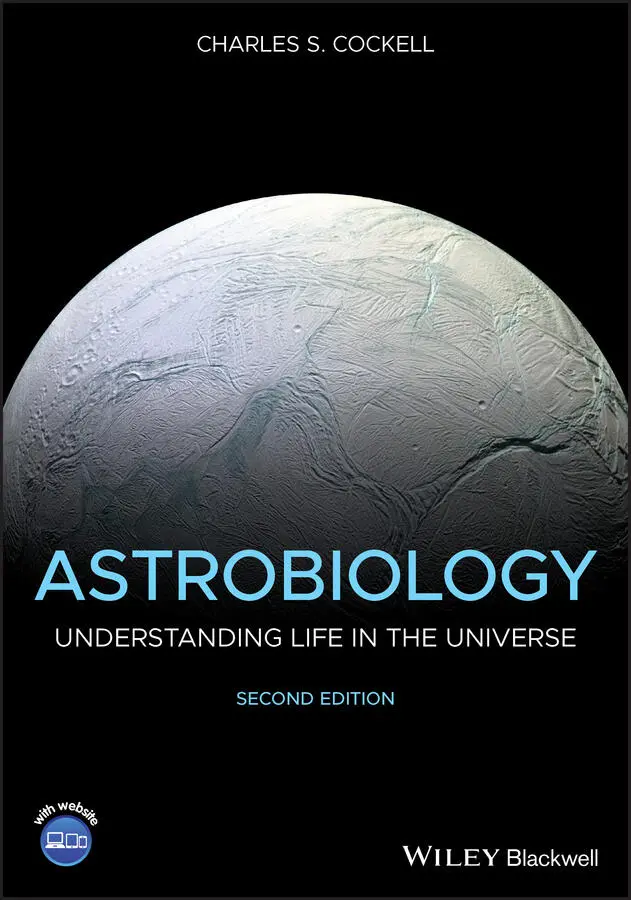
Charles S. Cockell - Astrobiology
Здесь есть возможность читать онлайн «Charles S. Cockell - Astrobiology» — ознакомительный отрывок электронной книги совершенно бесплатно, а после прочтения отрывка купить полную версию. В некоторых случаях можно слушать аудио, скачать через торрент в формате fb2 и присутствует краткое содержание. Жанр: unrecognised, на английском языке. Описание произведения, (предисловие) а так же отзывы посетителей доступны на портале библиотеки ЛибКат.
- Название:Astrobiology
- Автор:
- Жанр:
- Год:неизвестен
- ISBN:нет данных
- Рейтинг книги:3 / 5. Голосов: 1
-
Избранное:Добавить в избранное
- Отзывы:
-
Ваша оценка:
Astrobiology: краткое содержание, описание и аннотация
Предлагаем к чтению аннотацию, описание, краткое содержание или предисловие (зависит от того, что написал сам автор книги «Astrobiology»). Если вы не нашли необходимую информацию о книге — напишите в комментариях, мы постараемся отыскать её.
offers an introductory text that explores the structure of living things, the formation of the elements required for life in the Universe, the biological and geological history of the Earth, and the habitability of other planets. Written by a noted expert on the topic, the book examines many of the major conceptual foundations in astrobiology, which cover a diversity of traditional fields including chemistry, biology, geosciences, physics, and astronomy.
The book explores many profound questions such as: How did life originate on Earth? How has life persisted on Earth for over three billion years? Is there life elsewhere in the Universe? What is the future of life on Earth?
is centered on investigating the past and future of life on Earth by looking beyond Earth to get the answers. Astrobiology links the diverse scientific fields needed to understand life on our own planet and, potentially, life beyond. This new second edition:
Expands on information about the nature of astrobiology and why it is useful Contains a new chapter “What is Life?” that explores the history of attempts to understand life Contains 20% more material on the astrobiology of Mars, icy moons, the structure of life, and the habitability of planets New ‘Discussion Boxes’ to stimulate debate and thought about key questions in astrobiology New review and reflection questions for each chapter to aid learning New boxes describing the careers of astrobiologists and how they got into the subject Offers revised and updated information throughout to reflect the latest advances in the field Written for students of life sciences, physics, astronomy and related disciplines, the updated edition of
is an essential introductory text that includes recent advances to this dynamic field.
Astrobiology — читать онлайн ознакомительный отрывок
Ниже представлен текст книги, разбитый по страницам. Система сохранения места последней прочитанной страницы, позволяет с удобством читать онлайн бесплатно книгу «Astrobiology», без необходимости каждый раз заново искать на чём Вы остановились. Поставьте закладку, и сможете в любой момент перейти на страницу, на которой закончили чтение.
Интервал:
Закладка:
16 Stevenson, J., Lunine, J., and Clancy, P. (2015). Membrane alternatives in worlds without oxygen: creation of an azotosome. Science Advances 1: e1400067.
17 Walker, S.I., Kim, H., and Davies, P.C.W. (2016). The informational architecture of the cell. Philosophical Transactions of the Royal Society A: Mathematical, Physical and Engineering Sciences 374 article 0057, https://doi.org/10.1098/rsta.2015.0057.
18 Watson, J.D. and Crick, F.H.C. (1953). A structure for deoxyribose nucleic acid. Nature 171: 737–738.
19 Westheimer, F.H. (1987). Why nature chose phosphates. Science 235: 1173–1178.
5 The Cellular Structure of Life
Learning Outcomes
Understand the different types of cells found in life on Earth.
Understand the importance of compartmentalization in life.
Understand the structure of cell membranes and the different variations in cell membrane structure.
Understand the processes of genetic transcription and translation, and the principal molecules involved in these processes.
Know how the genetic code is used to assemble proteins and understand the meaning of the degeneracy of the genetic code.
Understand the difference between prokaryotic and eukaryotic cells.
Understand some of the differences between prokaryotic and eukaryotic cell replication.
Understand the complexity of modern-day prokaryotes and their ability to communicate, move, and form differentiated multicelled structures, and understand the significance of these features for astrobiology.
Describe the characteristics of viruses and prions.
5.1 From Molecules to Cells
We now have a good idea of how elements are assembled into atoms and how atoms form molecules and then the major classes of macromolecules from which life is constructed. The next stage of this journey must be to consider how these macromolecules are assembled into self-replicating living cells. From this point, we can go on to consider how these cells diversified into the array of life that we witness on Earth today, how this has changed over time, and whether this might have occurred, or be occurring, on other planetary bodies in the Universe. This chapter is concerned with understanding how macromolecules are assembled into the cells of life.
An understanding of cellular structure and the components of cells has application across diverse areas of astrobiology:
1 To investigate the origin of life, we need to know the minimum requirements for a reproducing cellular entity.
2 To be able to infer what the characteristics of the earliest types of cell were, we need to understand the structure of life today.
3 The search for life elsewhere in the Universe is strongly predicated on our knowledge of cellular structure. For example, if we want to look for remnant biological matter on Mars to test the hypothesis that the planet hosted life, we need to know what parts of cells might preserve well. That line of enquiry begins with an understanding of cellular structure.
4 From a less applied perspective, we could return to the question of whether the structure of biological material on Earth is universal. If biological evolution has occurred on another planet, would it produce the same sorts of structures we see in life on Earth? This question is difficult to address without another example of life to study, but we can only begin to embark on considering this question with a good knowledge of the structure of life on Earth.
From many perspectives, a grasp of cellular structure and how the individual components of cells come together to form a single cell is important. An understanding of cellular structure and its relevance to astrobiology is the focus of this chapter.
5.2 Types of Cells
Cells are the packages that hold life together. The term “cell” is derived from the Latin word, cella , which means “small room.” In biology, the cell refers to the structure that encloses the apparatus that allows for the growth and reproduction of organisms. Indeed, the compartmentalization of life's major biomolecules within cellular packages is so fundamental that some definitions of life have explicitly included compartmentalization or cellular structure as a feature of living things. Cells were first observed and described by polymath Robert Hooke (1636–1703) in his book Micrographia , in which he documented the structure of plant cells by observing thin slices of cork. He found them to look like honeycomb cells, an indication of compartmentalization.
Broadly, we can recognize two types of cells – prokaryotic and eukaryotic. Prokaryotic cells do not have a nucleus, hence their name, which derives from the two Greek words, pro (before) and karyon (nut or kernel – a reference to the nucleus in the biological context). Prokaryotes are single-celled organisms and include two major domainsof life: bacteriaand archaea. Domains are the highest hierarchy of life. The bacteria include many species of microorganisms that live in soils, in the oceans, in your gut, and in many other environments. Archaea is the domain that includes many of the species that live in extreme environments, for example high-temperature-loving microbes ( hyperthermophiles) that live in deep-sea hydrothermal vents, where hot water from the crust meets the deep ocean. However, the archaea also include many non-extremophile species that have important roles to play in natural environments, including soils, such as species that cycle nitrogen. We encounter both groups more as we proceed through the book. In prokaryotic cells, the DNA is free-floating in the cell fluid or cytoplasm.
By contrast, eukaryotic cells are cells with a nucleus that contains the DNA. They make up the structure of most multicellular organisms, including us, and some single-celled organisms like algae. Eukaryotic cells are usually larger (typically 10–100 μm) than prokaryotic cells (typically 1–10 μm).
Discussion Point: Must Life Be Cellular?
The cellular structure – essentially a small container that represents the smallest possible complete unit of a replicating, evolving life form, is a characteristic of life on Earth. However, is this compartmentalization universal? One feature of the cell is the accumulation of molecules at sufficiently high concentrations to carry out the diversity of reactions associated with life. Natural environments where water is available, such as lakes or the oceans, tend to dilute molecules. One could imagine a hypothetical scenario where cell contents became very concentrated. Consider a small pond in which lots of organic molecules and other ions and inorganic substances accumulate and that by chance they result in a primitive form of metabolism with reactions producing new compounds that are cycled in the pond. This “cell,” however, cannot go anywhere, and it cannot reproduce, since it is isolated in a small depression in the ground. Thus, we might suspect that for evolutionary biology to occur, for replicating, evolving life forms to be distributed across the surface of a planet, they must, in some way, be in containers or cells that can be dispersed to different environments and then selected for survival – to evolve. You might like to continue this discussion about whether cellularity is a fundamental and necessary characteristic of any form of replicating, evolving life particularly after you have read the sections on viruses and prions.
Prokaryotes were discovered in the seventeenth century by Dutch fabric maker, Antonie van Leeuwenhoek (1632–1723). Van Leeuwenhoek was keen to improve the quality of the cloth that he was selling, which enticed him to develop small microscopes to observe the fibers in his fabrics (Figure 5.1). As he was an inquisitive man, he used his new devices to examine samples of pond water. What he found were tiny creatures, which at the time he called “animalcules,” or little animals.
Читать дальшеИнтервал:
Закладка:
Похожие книги на «Astrobiology»
Представляем Вашему вниманию похожие книги на «Astrobiology» списком для выбора. Мы отобрали схожую по названию и смыслу литературу в надежде предоставить читателям больше вариантов отыскать новые, интересные, ещё непрочитанные произведения.










Обсуждение, отзывы о книге «Astrobiology» и просто собственные мнения читателей. Оставьте ваши комментарии, напишите, что Вы думаете о произведении, его смысле или главных героях. Укажите что конкретно понравилось, а что нет, и почему Вы так считаете.