Charles S. Cockell - Astrobiology
Здесь есть возможность читать онлайн «Charles S. Cockell - Astrobiology» — ознакомительный отрывок электронной книги совершенно бесплатно, а после прочтения отрывка купить полную версию. В некоторых случаях можно слушать аудио, скачать через торрент в формате fb2 и присутствует краткое содержание. Жанр: unrecognised, на английском языке. Описание произведения, (предисловие) а так же отзывы посетителей доступны на портале библиотеки ЛибКат.
- Название:Astrobiology
- Автор:
- Жанр:
- Год:неизвестен
- ISBN:нет данных
- Рейтинг книги:3 / 5. Голосов: 1
-
Избранное:Добавить в избранное
- Отзывы:
-
Ваша оценка:
Astrobiology: краткое содержание, описание и аннотация
Предлагаем к чтению аннотацию, описание, краткое содержание или предисловие (зависит от того, что написал сам автор книги «Astrobiology»). Если вы не нашли необходимую информацию о книге — напишите в комментариях, мы постараемся отыскать её.
offers an introductory text that explores the structure of living things, the formation of the elements required for life in the Universe, the biological and geological history of the Earth, and the habitability of other planets. Written by a noted expert on the topic, the book examines many of the major conceptual foundations in astrobiology, which cover a diversity of traditional fields including chemistry, biology, geosciences, physics, and astronomy.
The book explores many profound questions such as: How did life originate on Earth? How has life persisted on Earth for over three billion years? Is there life elsewhere in the Universe? What is the future of life on Earth?
is centered on investigating the past and future of life on Earth by looking beyond Earth to get the answers. Astrobiology links the diverse scientific fields needed to understand life on our own planet and, potentially, life beyond. This new second edition:
Expands on information about the nature of astrobiology and why it is useful Contains a new chapter “What is Life?” that explores the history of attempts to understand life Contains 20% more material on the astrobiology of Mars, icy moons, the structure of life, and the habitability of planets New ‘Discussion Boxes’ to stimulate debate and thought about key questions in astrobiology New review and reflection questions for each chapter to aid learning New boxes describing the careers of astrobiologists and how they got into the subject Offers revised and updated information throughout to reflect the latest advances in the field Written for students of life sciences, physics, astronomy and related disciplines, the updated edition of
is an essential introductory text that includes recent advances to this dynamic field.
Astrobiology — читать онлайн ознакомительный отрывок
Ниже представлен текст книги, разбитый по страницам. Система сохранения места последней прочитанной страницы, позволяет с удобством читать онлайн бесплатно книгу «Astrobiology», без необходимости каждый раз заново искать на чём Вы остановились. Поставьте закладку, и сможете в любой момент перейти на страницу, на которой закончили чтение.
Интервал:
Закладка:
Although silicon cannot easily form a six-membered ring structure like benzene, it can form a ring structure (siloxene) in which oxygen atoms hold together the silicon atoms. Cage-like molecular systems such as silsesquioxanes can be linked with a wide diversity of side groups to allow for a remarkable diversity of molecules (Figure 4.17) that have industrial uses from chemical catalysis to making light-emitting diodes.
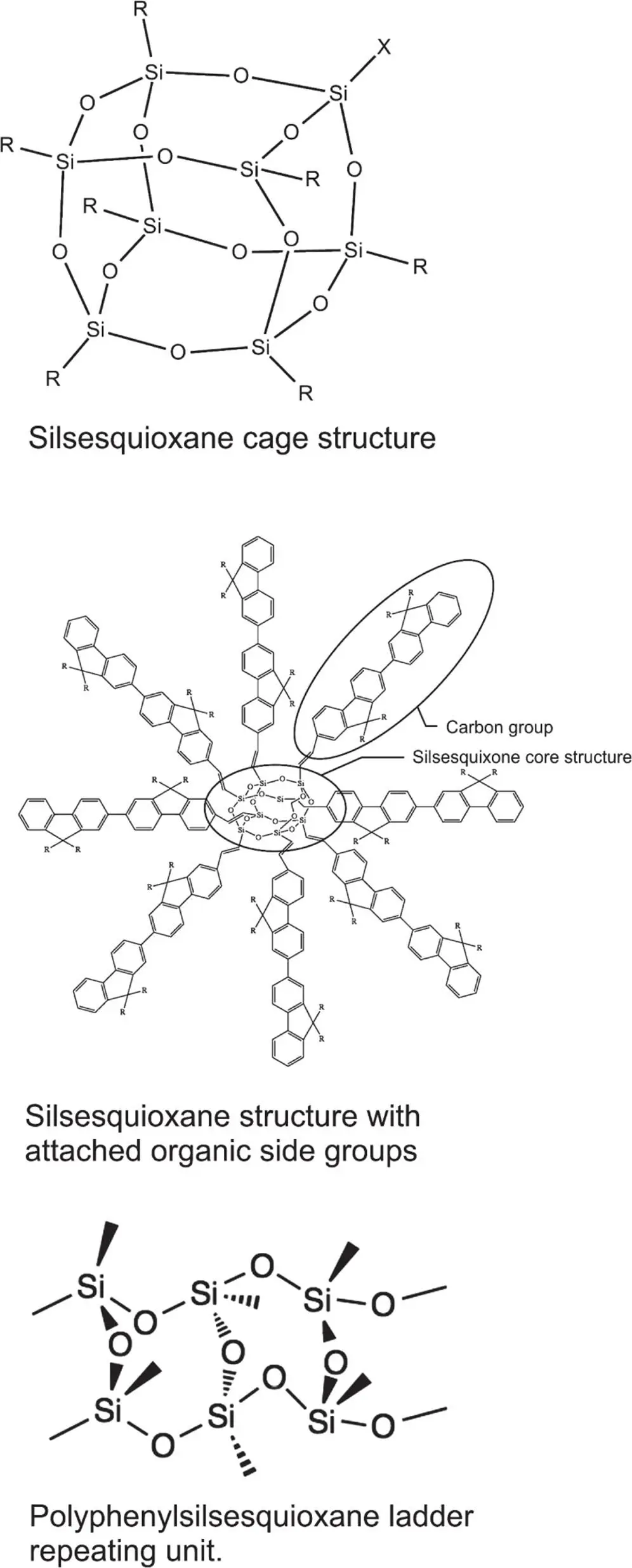
Figure 4.17 Silicon can form extraordinarily complex structures, such as these silsesquioxane structures.
Although there are similarities, carbon and silicon have some significant differences that affect compound formation. The larger radius of silicon compared to carbon accounts for its weaker bond strengths, which means that, despite some of the variety of complex compounds it can form, in general it less readily forms stable complex compounds. In particular, bond angles of silicon compounds are generally larger because of its larger size, meaning that silicon cannot form very stable molecules analogous to ring compounds in carbon biochemistry. Stable aromatic(ring) compounds are found throughout carbon biochemistry and give huge versatility to the complexity of compounds that can be assembled. Few silicon compounds contain double and triple bonds, which are common in carbon compounds and are found in many important compounds from lipids to nucleobases.
Perhaps one of the most significant limitations of silicon is its tendency to form inert structures with oxygen. Fully oxidized silicon is silica(SiO 2), a highly unreactive compound which makes up quartz and a wide variety of minerals. By contrast, carbon forms a double bond with oxygen to produce carbon dioxide, a gas which has a diversity of uses in biochemistry, not least as an easily accessible form of carbon for life, but also in energy-yielding reactions such as biological methane production ( methanogenesis). Indeed, in most settings under standard temperatures and pressures, silicon forms unreactive silicates, which on Earth are found in a wide diversity of different rock types (Figure 4.18).
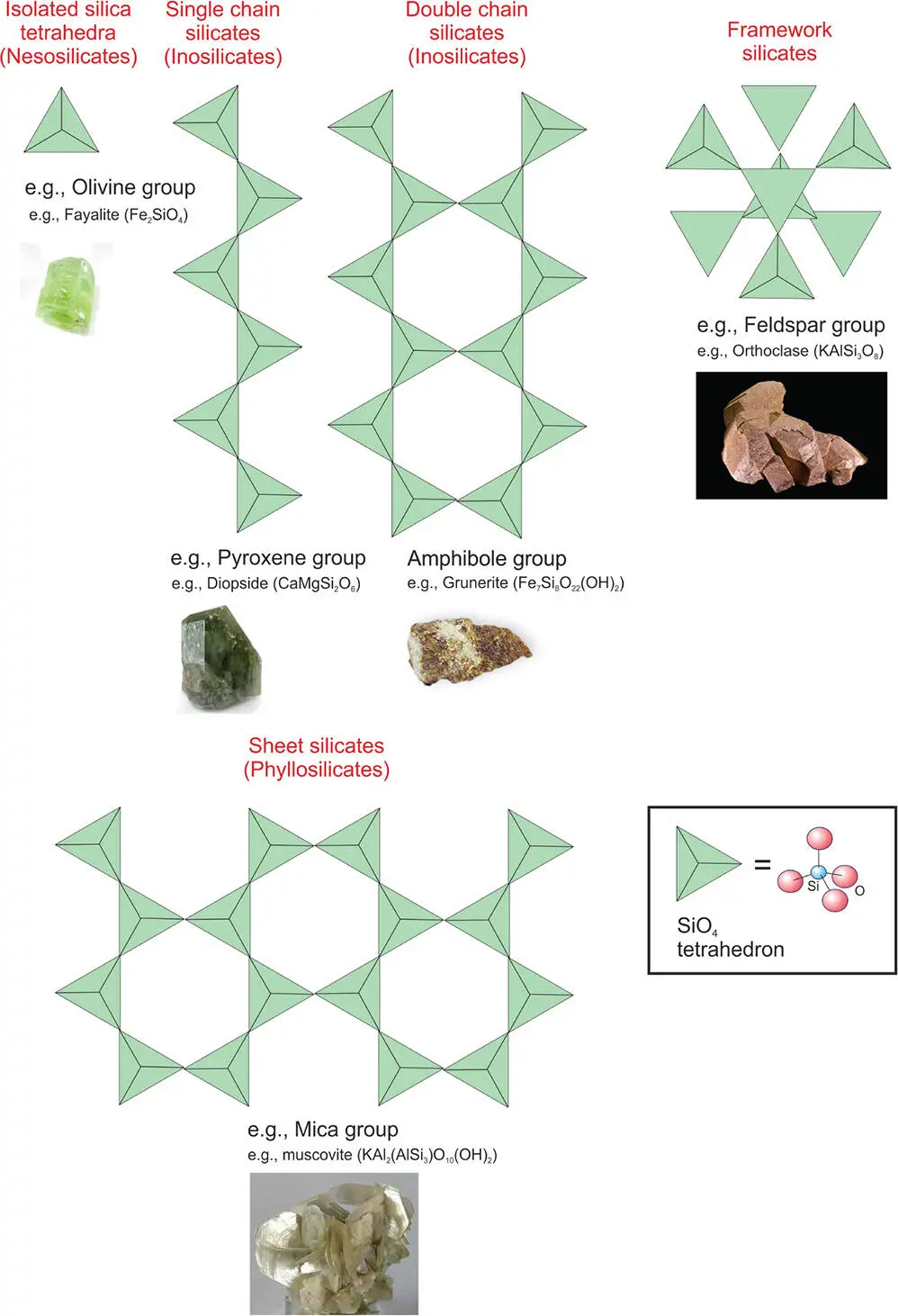
Figure 4.18 Silicate minerals. A variety of silicate structures formed when silicon binds to oxygen. These are the structures that make what we generally refer to as rocks and minerals. They comprise the core building block, a silica tetrahedron (SiO4).
The silicates are all formed from the silica tetrahedron as the unit building block. When on their own and gathered together into an assemblage with cations (such as iron or magnesium), they form minerals such as the olivineclass. When attached into a long chain, they form the pyroxeneclass. When these chains are themselves linked together to form double chain silicates, they form the amphiboleclass of minerals. When the chains are assembled into a large layer, they form the sheet silicates or phyllosilicates, which include clays found widely on Earth and the Martian surface and many other environments where silicates have interacted with water. Three-dimensional mineral structures form the framework silicates such as the feldspars. You can see examples of all of these in Figure 4.18. We return to minerals in Chapter 14. For now, it is enough to summarize by saying that the presence of oxygen, which is common in the Universe, tends to drive silicon chemistry toward silicates and away from a tendency to form the sorts of diverse silicon compounds that might be of interest to a biochemist.
Another way in which one can examine the suitability of silicon as a basis for life is to ask how biological evolution on Earth has used the element. We should remember that we live on a planet where there is a large quantity of silicon (28% by weight of the crust). If it is suitable as a building block for life, then perhaps observing what happens when terrestrial evolutionary processes are confronted with the element might tell us something about its potential? A number of organisms make substantial use of silicon. Sponges use silica particles, called spicules, which are structural units used to give rigor and shape to their bodies. In plants, phytoliths, which are small silica structures several tens of microns or more in size, are used as structural support materials. They may achieve several percent by weight of plant tissue. Diatoms, marine single-celled algae, construct frustules, which are cages made from silica. These examples serve to illustrate that life does use silicon. However, it is intriguing, and perhaps significant, that when it does evolve to use the element silicon, it does “rock-like” things with it, building silica support structures or cages.
No life form has yet been found that naturally replaces large numbers of carbon compounds in its biochemistry with silicon-based compounds. This argument may be tautologous in that we are discussing the use of silicon under Earth conditions by a carbon-based life, but it might also suggest that when reproducing, evolving entities stumble across silicon in the blind process of evolution, they find it most useful in building silica-derived structures similar to the non-biological tendency of silicon chemistry to make rocks. They tend not to use it in fabricating complex molecules from which the basic biochemistry of life is assembled.
Another chemistry involving silicon is a hybrid system with carbon. Silanes (Figure 4.19) are saturatedcompounds, analogous to the alkanesin carbon. For example, silane (SiH 4) is equivalent to methane (CH 4). They have the ability to form branched chains of molecules. By replacing the hydrogen atom in silanes with organic groups, organosilicon compounds can be fabricated. These molecules can be thermally stable and chemically inert. Although laboratory experiments can be performed to generate these compounds, rarely are they found in natural settings. If life was based on silanes and their derivatives, chemical reactions would probably have to occur at low temperatures or in an essentially oxygen- and water-free environment to prevent reactions of silanes, ultimately leading to reactions with oxygen and the production of inert silicon materials.
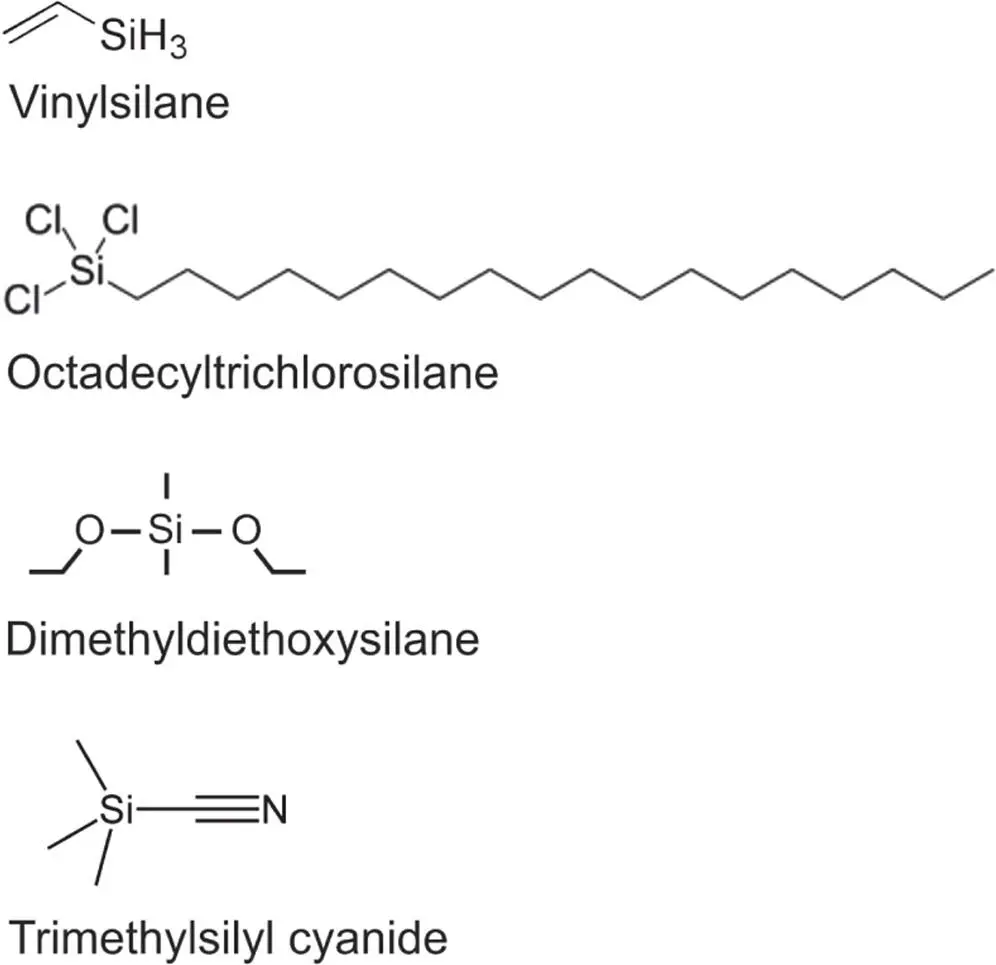
Figure 4.19 Hybrid silicon–carbon chemistries in life? Silanes can include hybrid molecules with organic groups.
Other speculations have considered silicate-based life forms at high temperatures when the melting of rocks increases their reactivity. Some people have discussed the possibility of “lavobes” and “magmobes,” organisms that inhabit molten rocks. Genetic information would be encoded within structural defects within the minerals. Although these ideas are intriguing, no evidence exists for them in the terrestrial rock record even though Earth has had abundant environments containing molten rocks throughout its history.
An examination of the Periodic Table does not suggest many other suitable elements that come close to silicon as plausible alternatives as a core building element for a diverse range of molecules.
We might look below silicon and carbon to germanium, the next element down in group 14 of the Periodic Table. It can form a set of three-dimensional molecules called germanates that have many similarities to the silicates, forming tetrahedral GeO 4arrangements. The element has a mass of 72 and is extremely rare in the Universe compared to less massive elements (the terrestrial abundance is about 1 ppm). Germanium, like silicon, lacks the capacity for the molecular diversity seen in carbon.
Читать дальшеИнтервал:
Закладка:
Похожие книги на «Astrobiology»
Представляем Вашему вниманию похожие книги на «Astrobiology» списком для выбора. Мы отобрали схожую по названию и смыслу литературу в надежде предоставить читателям больше вариантов отыскать новые, интересные, ещё непрочитанные произведения.







Обсуждение, отзывы о книге «Astrobiology» и просто собственные мнения читателей. Оставьте ваши комментарии, напишите, что Вы думаете о произведении, его смысле или главных героях. Укажите что конкретно понравилось, а что нет, и почему Вы так считаете.