Anthony Kelly - Crystallography and Crystal Defects
Здесь есть возможность читать онлайн «Anthony Kelly - Crystallography and Crystal Defects» — ознакомительный отрывок электронной книги совершенно бесплатно, а после прочтения отрывка купить полную версию. В некоторых случаях можно слушать аудио, скачать через торрент в формате fb2 и присутствует краткое содержание. Жанр: unrecognised, на английском языке. Описание произведения, (предисловие) а так же отзывы посетителей доступны на портале библиотеки ЛибКат.
- Название:Crystallography and Crystal Defects
- Автор:
- Жанр:
- Год:неизвестен
- ISBN:нет данных
- Рейтинг книги:3 / 5. Голосов: 1
-
Избранное:Добавить в избранное
- Отзывы:
-
Ваша оценка:
Crystallography and Crystal Defects: краткое содержание, описание и аннотация
Предлагаем к чтению аннотацию, описание, краткое содержание или предисловие (зависит от того, что написал сам автор книги «Crystallography and Crystal Defects»). Если вы не нашли необходимую информацию о книге — напишите в комментариях, мы постараемся отыскать её.
explains the modern concepts of crystallography in a clear, succinct manner and shows how to apply these concepts in the analyses of point, line and planar defects in crystalline materials.
Fully revised and updated, this book now includes:
Original source references to key crystallographic terms familiar to materials scientists Expanded discussion on the elasticity of cubic materials New content on texture that contains more detail on Euler angles, orientation distribution functions and an expanded discussion on examples of textures in engineering materials Additional content on dislocations in materials of symmetry lower than cubic An expanded discussion of twinning which includes the description and classification of growth twins The inclusion and explanation of results from atomistic modelling of twin boundaries Problem sets with new questions, detailed worked solutions, supplementary lecture material and online computer programs for crystallographic calculations. Written by authors with extensive lecturing experience at undergraduate level,
continues to take its place as the core text on the topic and provides the essential resource for students and researchers in metallurgy, materials science, physics, chemistry, electrical, civil and mechanical engineering.
Crystallography and Crystal Defects — читать онлайн ознакомительный отрывок
Ниже представлен текст книги, разбитый по страницам. Система сохранения места последней прочитанной страницы, позволяет с удобством читать онлайн бесплатно книгу «Crystallography and Crystal Defects», без необходимости каждый раз заново искать на чём Вы остановились. Поставьте закладку, и сможете в любой момент перейти на страницу, на которой закончили чтение.
Интервал:
Закладка:
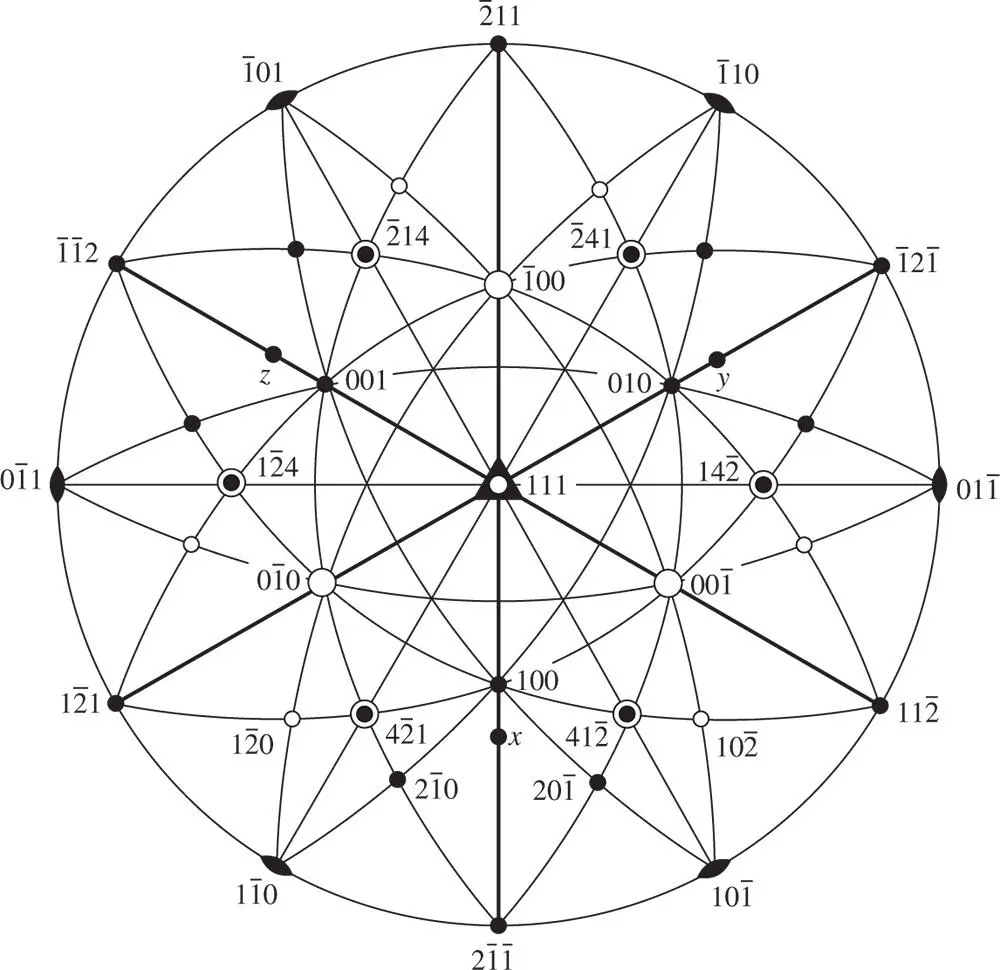
Figure 2.16A stereogram of a trigonal crystal of class  m with a rhombohedral unit cell. When poles in the upper and lower hemispheres coincide in projection, the indices shown refer to the poles in the upper hemisphere
In plotting a stereogram of a trigonal crystal with a rhombohedral unit cell from a given value of the angle α , it is useful to note that the angle γ between any of the crystal axes and the unique triad axis is given by:
(2.8) 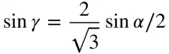
(see Problem 2.2).
For many purposes it is more convenient to use a hexagonal cell when dealing with trigonal crystals, irrespective of whether the lattice of the trigonal crystal is primitive hexagonal or rhombohedral. The shape of the cell chosen is the same as for hexagonal crystals (Figure 1.19j) and, since it is chosen without reference to the lattice, may or may not be primitive. The value c / a is characteristic of the substance.
A stereogram of a trigonal crystal of the point group  m with planes indexed according to the Miller–Bravais scheme is shown in Figure 2.17. This is the same crystal as that in Figure 2.16( c / a = 1.02). When using the hexagonal cell, the x ‐, y ‐ and u ‐axes are chosen parallel to the diads in
  m .
m .
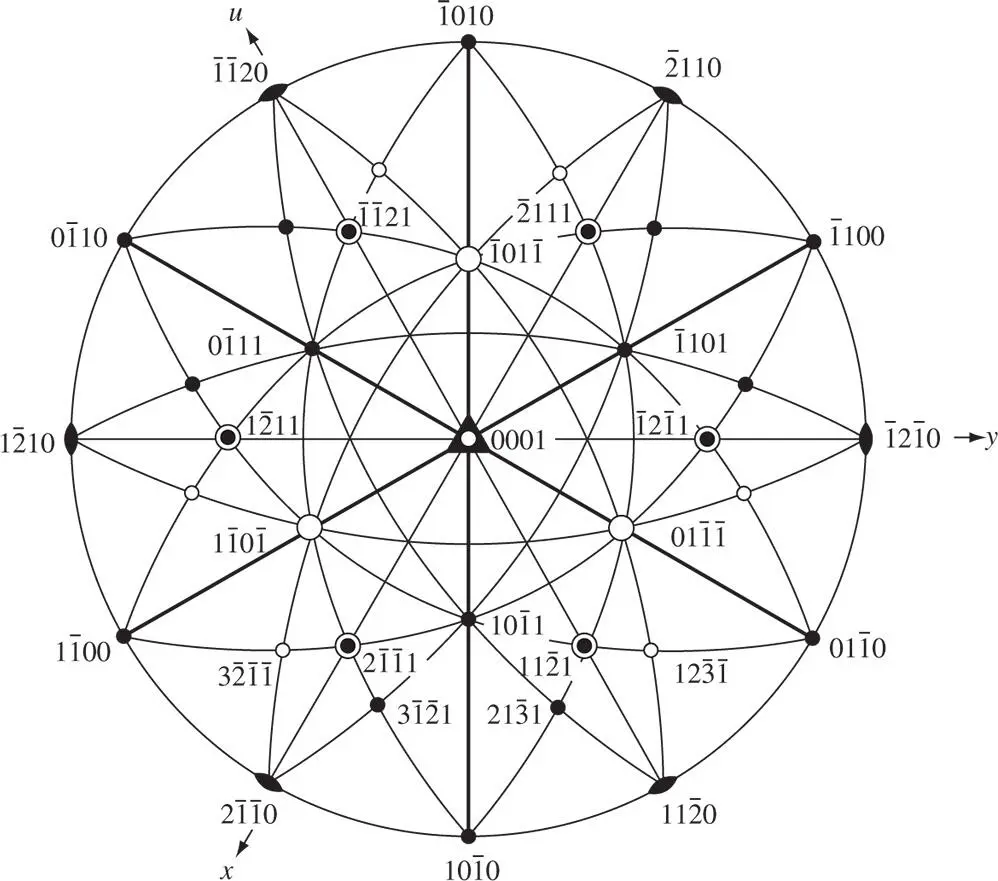
Figure 2.17The same crystal as in Figure 2.16indexed using a hexagonal cell. When poles in the upper and lower hemispheres superpose in projection, the indices refer to poles in the upper hemisphere
The relationship between the indices in the two stereograms can be easily worked out using the zone addition rule and the Weiss zone law, Eq. (1.6), from the orientation relationship of the rhombohedral and hexagonal cells. In Figures 2.16and 2.17this is (0001) || (111) 6and (10  1) || (100). The plane (10
  0) in Figure 2.17then has indices (2
  ) in Figure 2.16. The indices (2
  ) could be deduced by noting that the plane (2
  ) contains the [111] direction (and so the pole of (2
  ) must lie on the primitive if [111] is at the centre of the stereogram), is equally inclined to the y ‐ and z ‐axes, and lies in the zone containing (111) and (100). The plotting of a stereogram and the determination of axial ratios for a trigonal crystal referred to hexagonal axes then proceed as for the hexagonal system. 7
In the class  m , special forms lie (i) normal to the triad: {0001}, (ii) parallel to the triad: { hki 0}, (iii) normal to mirror planes: { h 0
  l }, and (iv) equally inclined to two diads { hh
  l }. The six faces in the form:{ h 0
  l }, make a rhombohedron; {10
  2}would be an example, consisting of the planes (10
  2), (
2), (  102), (0
  12), (
  01
01  ), (1
), (1  0
0  ), and (01
  ). This form is similar in appearance to {0 h
  l }, which is also a rhombohedron, rotated 60° with respect to the first one.
The relationship between { h 0  l } and {0 h
  l } (or, equivalently, {0 k
  l }) is shown in Figure 2.18. They are actually quite separate forms and each one is a special form. We therefore need to add {0 h
  l } to the list of special forms, in addition to { h 0
  l }. It is apparent from Figure 2.16that when using the rhombohedral cell the two forms {10
  1} and {01
  1} have different indices, since the face above (00
  ) in the projection in Figure 2.16would have indices (22
  ).
).
Интервал:
Закладка:
Похожие книги на «Crystallography and Crystal Defects»
Представляем Вашему вниманию похожие книги на «Crystallography and Crystal Defects» списком для выбора. Мы отобрали схожую по названию и смыслу литературу в надежде предоставить читателям больше вариантов отыскать новые, интересные, ещё непрочитанные произведения.












Обсуждение, отзывы о книге «Crystallography and Crystal Defects» и просто собственные мнения читателей. Оставьте ваши комментарии, напишите, что Вы думаете о произведении, его смысле или главных героях. Укажите что конкретно понравилось, а что нет, и почему Вы так считаете.