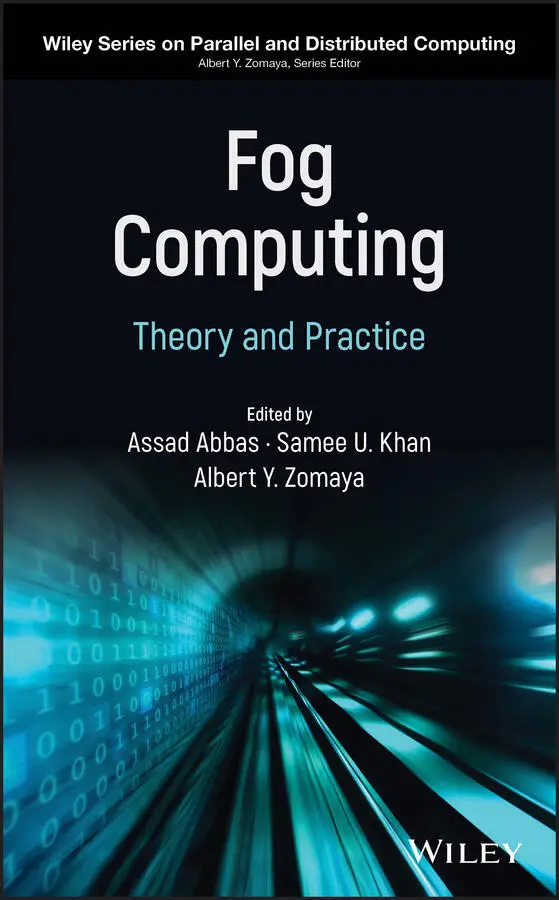
Fog Computing
Здесь есть возможность читать онлайн «Fog Computing» — ознакомительный отрывок электронной книги совершенно бесплатно, а после прочтения отрывка купить полную версию. В некоторых случаях можно слушать аудио, скачать через торрент в формате fb2 и присутствует краткое содержание. Жанр: unrecognised, на английском языке. Описание произведения, (предисловие) а так же отзывы посетителей доступны на портале библиотеки ЛибКат.
- Название:Fog Computing
- Автор:
- Жанр:
- Год:неизвестен
- ISBN:нет данных
- Рейтинг книги:5 / 5. Голосов: 1
-
Избранное:Добавить в избранное
- Отзывы:
-
Ваша оценка:
Fog Computing: краткое содержание, описание и аннотация
Предлагаем к чтению аннотацию, описание, краткое содержание или предисловие (зависит от того, что написал сам автор книги «Fog Computing»). Если вы не нашли необходимую информацию о книге — напишите в комментариях, мы постараемся отыскать её.
focuses on the technological aspects of employing fog computing in various application domains, such as smart healthcare, industrial process control and improvement, smart cities, and virtual learning environments. In addition, the Machine-to-Machine (M2M) communication methods for fog computing environments are covered in depth.
Presented in two parts—Fog Computing Systems and Architectures, and Fog Computing Techniques and Application—this book covers such important topics as energy efficiency and Quality of Service (QoS) issues, reliability and fault tolerance, load balancing, and scheduling in fog computing systems. It also devotes special attention to emerging trends and the industry needs associated with utilizing the mobile edge computing, Internet of Things (IoT), resource and pricing estimation, and virtualization in the fog environments.
Includes chapters on deep learning, mobile edge computing, smart grid, and intelligent transportation systems beyond the theoretical and foundational concepts Explores real-time traffic surveillance from video streams and interoperability of fog computing architectures Presents the latest research on data quality in the IoT, privacy, security, and trust issues in fog computing
provides a platform for researchers, practitioners, and graduate students from computer science, computer engineering, and various other disciplines to gain a deep understanding of fog computing.
Fog Computing — читать онлайн ознакомительный отрывок
Ниже представлен текст книги, разбитый по страницам. Система сохранения места последней прочитанной страницы, позволяет с удобством читать онлайн бесплатно книгу «Fog Computing», без необходимости каждый раз заново искать на чём Вы остановились. Поставьте закладку, и сможете в любой момент перейти на страницу, на которой закончили чтение.
Интервал:
Закладка:
60 60 Raza, U., Kulkarni, P., and Sooriyabandara, M. (2017). Low power wide area networks: an overview. IEEE Communication Surveys and Tutorials 19: 855–873.
61 61 Martin, B.A., Michaud, F., Banks, D. et al. (2017). Openfog security requirements and approaches. In: 2017 IEEE Fog World Congress (FWC), 1–6.
62 62 Sui, Y., Wang, X., Pengt, M., and An, N. (2017). Optimizing mobility and energy charging for mobile cloudlet. In: 2017 IEEE International Conference on Communications (ICC), 1–6. IEEE.
63 63 Tang, F., Fadlullah, Z.M., Mao, B. et al. (2018). On a novel adaptive UAV-mounted cloudlet-aided recommendation system for LBSNs. IEEE Transactions on Emerging Topics in Computing 7 (4): 565–577.
64 64 Truong-Huu, T., Tham, C.-K., and Niyato, D. (2014). To offload or to wait: An opportunistic offloading algorithm for parallel tasks in a mobile cloud. In: 2014 IEEE 6th International Conference on Cloud Computing Technology and Science (CloudCom), 182–189. IEEE.
65 65 Chang, C., Srirama, S.N., and Buyya, R. (2016). Mobile cloud business process management system for the Internet of Things: a survey. ACM Computing Surveys 49, pp. 70:1–70:42.
66 66 Li, M., Yu, F.R., Si, P. et al. (2018). Software-defined vehicular networks with caching and computing for delay-tolerant data traffic. In: 2018 IEEE International Conference on Communications (ICC), 1–6. IEEE.
67 67 Kumar, N., Rodrigues, J.J.P.C., Guizani, M. et al. (2018). Achieving energy efficiency and sustainability in edge/fog deployment. IEEE Communications Magazine 56: 20–21.
68 68 Ruan, Y., Durresi, A., and Uslu, S. (2018). Trust assessment for Internet of Things in multiaccess edge computing. In: 2018 IEEE 32nd International Conference on Advanced Information Networking and Applications (AINA), –1155, 1161. IEEE.
69 69 Wang, S., Xu, J., Zhang, N., and Liu, Y. (2018). A survey on service migration in mobile edge computing. IEEE Access 6: 23511–23528.
70 70 Zhang, P., Zhou, M., and Fortino, G. (2018). Security and trust issues in fog computing: a survey. Future Generation Computer Systems 88: 16–27.
71 71 Lipp, M., Schwarz, M., Gruss, D. et al. (2018). Meltdown: reading kernel memory from user space. In: 27th Security Symposium, 973–990.
72 72 Hussain, R., Son, J., Eun, H. et al. (2012). Rethinking vehicular communications: merging vanet with cloud computing. In: 2012 IEEE 4th International Conference on Cloud Computing Technology and Science (CloudCom), 606–609. IEEE.
73 73 Nobre, J.C., de Souza, A.M., Rosário, D. et al. (2019). Vehicular software-defined networking and fog computing: integration and design principles. Ad Hoc Networks 82: 172–181.
Note
1 1 www.docker.com.
2 Edge and Fog: A Survey, Use Cases, and Future Challenges
Cosmin Avasalcai, Ilir Murturi, and Schahram Dustdar
Distributed Systems Group, TU Wien, Vienna, Austria
2.1 Introduction
In the past couple of years, the cloud computing paradigm was at the center of the Internet of Things' (IoT) ever-growing network, where companies can move their control and computing capabilities, and store collected data in a medium with almost unlimited resources [1]. It was and continues to be the best solution to deploy demanding computational applications with the main focus on processing vast amounts of data. Data are generated from geo-distributed IoT devices, such as sensors, smartphones, laptops, and vehicles, just to name a few. However, today this paradigm is facing growing challenges in meeting the demanding constraints of new IoT applications.
With the rapid adoption of IoT devices, new use cases have emerged to improve our daily lives. Some of these new use cases are the smart city, smart home, smart grid, and smart manufacturing with the power of changing industries (i.e. healthcare, oil and gas, automotive, etc.) by improving the working environment and optimizing workflow. Since most of the use cases consist of multiple applications that require fast response time (i.e. real-time or near real-time) and improved privacy, most of the time the cloud fails to fulfill these requirements (i.e. network congestion and ensuring privacy).
To overcome these shortcomings, researchers have proposed two new paradigms, fog computing and edge computing, to enable more computational resources (i.e. storage, networking, and processing) closer to the edge of the network. Fog computing (FC) extends cloud capabilities closer to the end devices, such that a cloud-to-things continuum is obtained that decreases latency and network congestion while enforcing privacy by processing the data near the user [2]. On the same note, the edge computing vision is to migrate some computational resources from the cloud to the heterogeneous devices placed at the edge of the network [3].
Embracing the vision of these paradigms and focusing on the deployment of multiple applications in close proximity of users, researchers have suggested new fog/edge devices. Among these devices, the most notable are mini servers, such as cloudlets [4], portable edge computers [5], and edge-cloud [6], which enable an application to work in harsh environments; mobile edge computing (MEC) [7] and mobile cloud computing [8] improve user experience and enable higher computational applications to be deployed on smartphones by offloading parts of the application on the device locally.
Many surveys are found in the literature that describe each paradigm in detail and its challenges [3, 9, 10]. However, there is no paper that compares the two; most of the time the terms fog and edge are both used to describe the same IoT network. Generally speaking, the visions of the two paradigms overlap, aiming to make available more computational resources at the edge of the network. Hence, the most significant difference is given by the naming convention used to describe them. The aim of this chapter is to offer a detailed description of the two aforementioned paradigms, discussing their differences and similarities. Furthermore, we discuss their future challenges and argue if the different naming convention is still required.
The remainder of the chapter is structured as follows: Section 2.2defines the edge computing paradigm by describing its architectural features. Next, Section 2.3presents in detail the fog computing paradigm and describes two use cases by emphasizing the key features of this architecture. Section 2.4describes several illustrative use cases for both edge and fog computing. Section 2.5discusses the challenges that these paradigms must conquer to be fully adopted in our society. Finally, Section 2.6presents our final remarks on the comparison between fog and edge computing.
2.2 Edge Computing
As we explore new IoT applications and use cases, the consideration of proximity between edge nodes and the end-users is becoming increasingly obvious. The physical distance between the edge and the user affects highly end-to-end latency, privacy, network, and availability. Recently, this leads to a new paradigm allowing computation to be performed in close proximity of user and IoT devices (i.e. sensors and actuators). Edge computing [11] is a new paradigm aiming to provide storage and computing resources and act as an additional layer, composed of edge devices, between the end-user IoT device and the cloud layer. In edge computing, we define “edge” as any computing and network resources along the path between the initial source of data and destination storage of data (fog nodes, cloud data centers).

Figure 2.1 Edge computing solution using an IoT and edge devices [12].
Читать дальшеИнтервал:
Закладка:
Похожие книги на «Fog Computing»
Представляем Вашему вниманию похожие книги на «Fog Computing» списком для выбора. Мы отобрали схожую по названию и смыслу литературу в надежде предоставить читателям больше вариантов отыскать новые, интересные, ещё непрочитанные произведения.







Обсуждение, отзывы о книге «Fog Computing» и просто собственные мнения читателей. Оставьте ваши комментарии, напишите, что Вы думаете о произведении, его смысле или главных героях. Укажите что конкретно понравилось, а что нет, и почему Вы так считаете.