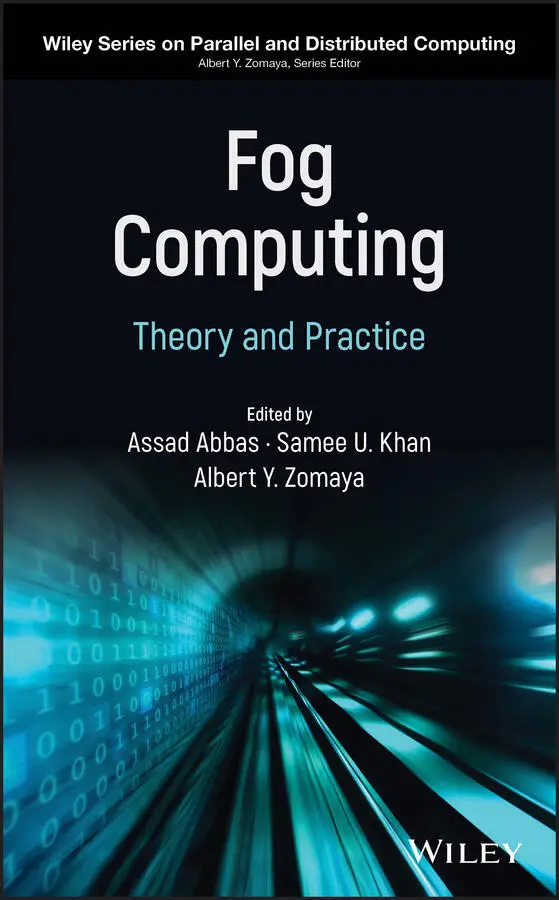
Fog Computing
Здесь есть возможность читать онлайн «Fog Computing» — ознакомительный отрывок электронной книги совершенно бесплатно, а после прочтения отрывка купить полную версию. В некоторых случаях можно слушать аудио, скачать через торрент в формате fb2 и присутствует краткое содержание. Жанр: unrecognised, на английском языке. Описание произведения, (предисловие) а так же отзывы посетителей доступны на портале библиотеки ЛибКат.
- Название:Fog Computing
- Автор:
- Жанр:
- Год:неизвестен
- ISBN:нет данных
- Рейтинг книги:5 / 5. Голосов: 1
-
Избранное:Добавить в избранное
- Отзывы:
-
Ваша оценка:
Fog Computing: краткое содержание, описание и аннотация
Предлагаем к чтению аннотацию, описание, краткое содержание или предисловие (зависит от того, что написал сам автор книги «Fog Computing»). Если вы не нашли необходимую информацию о книге — напишите в комментариях, мы постараемся отыскать её.
focuses on the technological aspects of employing fog computing in various application domains, such as smart healthcare, industrial process control and improvement, smart cities, and virtual learning environments. In addition, the Machine-to-Machine (M2M) communication methods for fog computing environments are covered in depth.
Presented in two parts—Fog Computing Systems and Architectures, and Fog Computing Techniques and Application—this book covers such important topics as energy efficiency and Quality of Service (QoS) issues, reliability and fault tolerance, load balancing, and scheduling in fog computing systems. It also devotes special attention to emerging trends and the industry needs associated with utilizing the mobile edge computing, Internet of Things (IoT), resource and pricing estimation, and virtualization in the fog environments.
Includes chapters on deep learning, mobile edge computing, smart grid, and intelligent transportation systems beyond the theoretical and foundational concepts Explores real-time traffic surveillance from video streams and interoperability of fog computing architectures Presents the latest research on data quality in the IoT, privacy, security, and trust issues in fog computing
provides a platform for researchers, practitioners, and graduate students from computer science, computer engineering, and various other disciplines to gain a deep understanding of fog computing.
Fog Computing — читать онлайн ознакомительный отрывок
Ниже представлен текст книги, разбитый по страницам. Система сохранения места последней прочитанной страницы, позволяет с удобством читать онлайн бесплатно книгу «Fog Computing», без необходимости каждый раз заново искать на чём Вы остановились. Поставьте закладку, и сможете в любой момент перейти на страницу, на которой закончили чтение.
Интервал:
Закладка:
1.6.5.3 Scheduling of Fog Applications
A few works have addressed fog application scheduling for hybrid MFC environments that consist of both iFog and mFog nodes. However, existing frameworks for mFog either designed for a specific purpose, such as for data routing in SDN [28], or for process/task distribution [20, 64], have not considered all the contextual factors (see Section 1.5.2) and the heterogeneity factors (see Section 1.5.1). Specifically, besides the movement of the entities, the tenants' application scheduling scheme should consider that the fog servers have the different computational and networking performance at different time slot due to the hardware specifications and the runtime context factors. In other words, developers need to have insight into the processing delay by considering all the factors toward proposing the optimal application scheduling scheme.
1.6.5.4 Scalable Resource Management of Fog Providers
In general, fog nodes have limited resources to serve tenants because they are fundamentally the independent network gateway devices that do not interconnect with one another in a short range like the server pools in the cloud. In other words, introducing computational scalability in MFC faces the network latency challenge. Commonly, providers of fog servers may manage multiple fog servers that are interconnected vertically within the hierarchy or are interconnected horizontally in a peer-to-peer manner. However, since the primary objective of fog servers in MFC is to serve the tenant-side clients, the distances between the fog servers are rarely within the range that is capable of achieving ultra-low latency. Therefore, the classic cloud-based scalability scheme is incompatible in MFC and hence, scalability becomes an unsolved challenge, especially for mFog environments. In order to address the challenge in scalability, the developers may consider developing a hybrid framework that integrates opportunistic computing, SDN, and context-aware software architecture toward enabling an adaptive fog service topology that can be orchestrating the fog servers in a highly dynamic manner.
1.7 Conclusion
Fog computing has appeared as a paradigm that extends Cloud computing and offers interesting and promising possibilities to overcome the limitations of the traditional environment. However, fog computing still faces a challenge with respect to mobility when the tasks come from ubiquitous mobile devices or applications in which the data sources are in constant movement. Therefore, this chapter pointins a spotlight on the development and advancement in the MFC and its related models. In this process, it reflects the areas where MFC is needed and has a very positive impact on enhancing the existing systems and opening new directions for evolving the environment, such as in the infrastructures, equipment and devices, land and marine vehicles, autonomous vehicles, etc. In addition, it investigates the communication technologies that have emerged or upgraded based on MFC with an emphasis on the added value that facilitated the process of solving some of the big challenges existing in the traditional design. Furthermore, the chapter also presents, in a comprehensive manner, the basics of nonfunctional requirement needed to achieve the basic QoS principles. Finally, it addresses the important open challenges that still need to be addressed in the new environment designed under the MFC framework.
Acknowledgment
The work is supported by the Estonian Centre of Excellence in IT (EXCITE), funded by the European Regional Development Fund.
References
1 1 Chang, C., Srirama, S.N., and Buyya, R. (2019). Internet of Things (IoT) and New Computing Paradigms, ch. 1, p. 1. Wiley.
2 2 Alam, K.M., Saini, M., and El Saddik, A. (2015). Toward social iInternet of vehicles: concept, architecture, and applications. IEEE Access 3: 343–357.
3 3 Gharibi, M., Boutaba, R., and Waslander, S.L. (2016). Internet of drones. IEEE Access 4: 1148–1162.
4 4 Al-Zaidi, R., Woods, J.C., Al-Khalidi, M., and Hu, H. (2018). Building novel VHF-based wireless sensor networks for the Internet of marine things. IEEE Sensors Journal 18 (5): 2131–2144.
5 5 Santagati, G.E. and Melodia, T. (2017). An implantable low-power ultrasonic platform for the Internet of medical things. In: INFOCOM 2017-IEEE Conference on Computer Communications, IEEE, –1, 9. IEEE.
6 6 Chang, C., Hadachi, A., Srirama, S.N., and Min, M. (2018). Mobile Big Data: Foundations, State of the Art, and Future Directions, 1–12. Cham: Springer International Publishing.
7 7 Chang, C., Srirama, S.N., and Mass, J. (2015). A middleware for discovering proximity-based service-oriented industrial Internet of Things. In: 2015 IEEE International Conference on Services Computing (SCC), 130–137. IEEE.
8 8 Satyanarayanan, M., Bahl, P., Cáceres, R., and Davies, N. (2009). The case for VM-based cloudlets in mobile computing. IEEE Pervasive Computing 4: 14–23.
9 9 ETSI (2017). ETSI and OpenFog Consortium collaborate on fog and edge applications. Berlin, Germany: MEC Congress https://www.etsi.org/newsroom/news/1216-2017-09-news-etsi-and-openfog-consortium-collaborate-on-fog-and-edge-applications.
10 10 M. Iorga, L. Feldman, R. Barton et al., Fog Computing Conceptual Model: Recommendations of the National Institute of Standards and Technology, Special Publication NIST SP 500-325, National Institute of Standards and Technology, March 2018.
11 11 Satyanarayanan, M. (2017). The emergence of edge computing. Computer 50 (1): 30–39.
12 12 Fahmy, H.M., El Ghany, M.A., and Baumann, G. (2018). Vehicle risk assessment and control for lane-keeping and collision avoidance at low-speed and high-speed scenarios. IEEE Transactions on Vehicular Technology 57 (6): 4805–4818.
13 13 Hafner, M.R., Cunningham, D., Caminiti, L., and Del Vecchio, D. (2013). Cooperative collision avoidance at intersections: algorithms and experiments. IEEE Transactions on Intelligent Transportation Systems 14 (3): 1162–1175.
14 14 Nguyen, V., Kim, O.T.T., Pham, C. et al. (2018). A survey on adaptive multichannel mac protocols in vanets using markov models. IEEE Access 6: 16493–16514.
15 15 Vinel, A., Lyamin, N., and Isachenkov, P. (2018). Modeling of V2V communications for C-ITS safety applications: a CPS perspective. IEEE Communications Letters 22 (8): 1600–1603.
16 16 Kalatzis, N., Avgeris, M., Dechouniotis, D. et al. (2018). Edge computing in IoT ecosystems for UAV-enabled early fire detection. In: 2018 IEEE International Conference on Smart Computing (SMARTCOMP), 106–114. IEEE.
17 17 Chang, C., Srirama, S.N., and Buyya, R. (2017). Indie fog: an efficient fog-computing infrastructure for the Internet of Things. Computer 50 (9): 92–98.
18 18 Soo, S., Chang, C., Loke, S.W., and Srirama, S.N. (2017). Proactive mobile fog computing using work stealing: data processing at the edge. International Journal of Mobile Computing and Multimedia Communications (IJMCMC) 8 (4): 1–19.
19 19 Soto, V., De Grande, R.E., and Boukerche, A. (2017). REPRO: time-constrained data retrieval for edge offloading in vehicular clouds. In: Proceedings of the 14th ACM Symposium on Performance Evaluation of Wireless Ad Hoc, Sensor, & Ubiquitous Networks, 47–54. ACM.
20 20 Zhu, C., Tao, J., Pastor, G. et al. (2018). Folo: latency and quality optimized task allocation in vehicular fog computing. IEEE Internet of Things Journal 6 (3): 4150–4161.
21 21 Yao, H., Bai, C., Zeng, D. et al. (2015). Migrate or not? Exploring virtual machine migration in roadside cloudlet-based vehicular cloud. Concurrency and Computation: Practice and Experience 27 (18): 5780–5792.
22 22 Cordeschi, N., Amendola, D., and Baccarelli, E. (2015). Reliable adaptive resource management for cognitive cloud vehicular networks. IEEE Transactions on Vehicular Technology 64 (6): 2528–2537.
Читать дальшеИнтервал:
Закладка:
Похожие книги на «Fog Computing»
Представляем Вашему вниманию похожие книги на «Fog Computing» списком для выбора. Мы отобрали схожую по названию и смыслу литературу в надежде предоставить читателям больше вариантов отыскать новые, интересные, ещё непрочитанные произведения.







Обсуждение, отзывы о книге «Fog Computing» и просто собственные мнения читателей. Оставьте ваши комментарии, напишите, что Вы думаете о произведении, его смысле или главных героях. Укажите что конкретно понравилось, а что нет, и почему Вы так считаете.