Fog Computing
Здесь есть возможность читать онлайн «Fog Computing» — ознакомительный отрывок электронной книги совершенно бесплатно, а после прочтения отрывка купить полную версию. В некоторых случаях можно слушать аудио, скачать через торрент в формате fb2 и присутствует краткое содержание. Жанр: unrecognised, на английском языке. Описание произведения, (предисловие) а так же отзывы посетителей доступны на портале библиотеки ЛибКат.
- Название:Fog Computing
- Автор:
- Жанр:
- Год:неизвестен
- ISBN:нет данных
- Рейтинг книги:5 / 5. Голосов: 1
-
Избранное:Добавить в избранное
- Отзывы:
-
Ваша оценка:
Fog Computing: краткое содержание, описание и аннотация
Предлагаем к чтению аннотацию, описание, краткое содержание или предисловие (зависит от того, что написал сам автор книги «Fog Computing»). Если вы не нашли необходимую информацию о книге — напишите в комментариях, мы постараемся отыскать её.
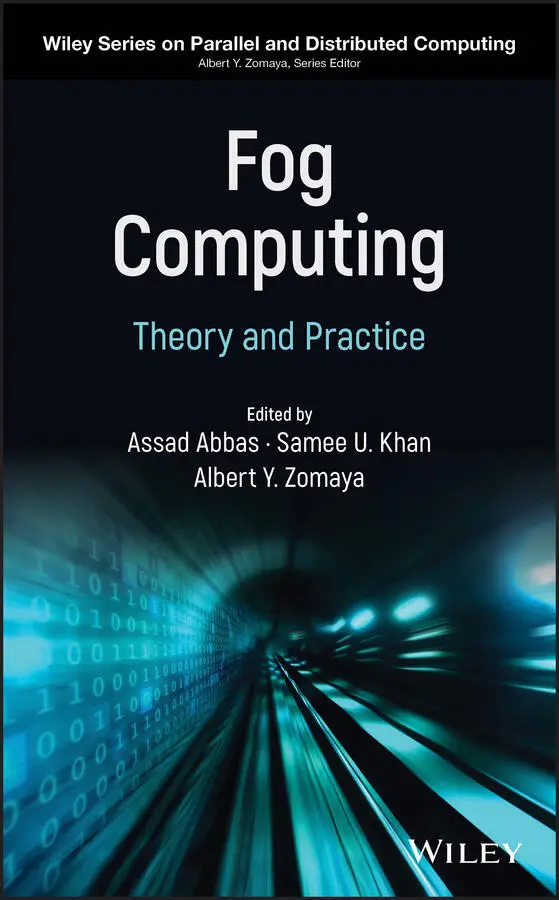
focuses on the technological aspects of employing fog computing in various application domains, such as smart healthcare, industrial process control and improvement, smart cities, and virtual learning environments. In addition, the Machine-to-Machine (M2M) communication methods for fog computing environments are covered in depth.
Presented in two parts—Fog Computing Systems and Architectures, and Fog Computing Techniques and Application—this book covers such important topics as energy efficiency and Quality of Service (QoS) issues, reliability and fault tolerance, load balancing, and scheduling in fog computing systems. It also devotes special attention to emerging trends and the industry needs associated with utilizing the mobile edge computing, Internet of Things (IoT), resource and pricing estimation, and virtualization in the fog environments.
Includes chapters on deep learning, mobile edge computing, smart grid, and intelligent transportation systems beyond the theoretical and foundational concepts Explores real-time traffic surveillance from video streams and interoperability of fog computing architectures Presents the latest research on data quality in the IoT, privacy, security, and trust issues in fog computing
provides a platform for researchers, practitioners, and graduate students from computer science, computer engineering, and various other disciplines to gain a deep understanding of fog computing.
Fog Computing — читать онлайн ознакомительный отрывок
Ниже представлен текст книги, разбитый по страницам. Система сохранения места последней прочитанной страницы, позволяет с удобством читать онлайн бесплатно книгу «Fog Computing», без необходимости каждый раз заново искать на чём Вы остановились. Поставьте закладку, и сможете в любой момент перейти на страницу, на которой закончили чтение.
Интервал:
Закладка:
1.6.1 Challenges in Land Vehicular Fog Computing
Introducing the cloud computing into VANET was redemption since it provided a solution to most challenges that traditional design of VANET faced, such as decreased flexibility, scalability, poor connectivity, and inadequate intelligence [72]. However, the new generation of VANET has introduced new requirement with respect to the high mobility, low latency, real-time applications, and reliable connectivity. For all these reasons, adding fog computing to the equation has emerged as a potential solution. Based on the existing research it seems that there are still some obstacles to be dealt with, for example, the management of fog server in geographically distributed fog nodes. The difficulty relies on the positioning of each edge server in a given area, which is important for fog approach and it considers many parameters, such as vehicles density, traffic status data, and processing load on the servers. Another challenge is related to management of neighboring fog servers with respect to communication and access, which can be affected by the environment. Finally, the assessment and handling dissemination of real-time critical message can be problematic, since design should be capable of distinguishing between a true or false event [73].
1.6.2 Challenges in Marine Fog Computing
Existing works [4, 28] have proposed the frameworks for improving the efficiency of the communication and for application management in the hybrid MFC environment that consist of both iFog and mFog nodes. Essentially, comparing to the UAV-Fog nodes and the UE-fog nodes, the Marine Fog nodes do not have the resource-constraint issue in terms of computation and data storage. However, because the operating marine environment lacks infrastructure, the communication between the Marine Fog nodes and the distant central cloud faces the latency issue derived from the limitation of the underline network topology and technology. For example, the bandwidth of the common VHF radio used in maritime communication can reach only 28.8 kbps and the range of the infrastructure-less 4G/5G LTE device-to-device communication is unable to fulfill the need of a marine environment. In order to overcome the fundamental communication issue, developers may consider integrating UAV-fog nodes [31] in which the system can deploy the UAV-fog nodes between vessels to form a mesh network toward dynamically supporting better bandwidth and more stable connection. However, UAVs have a limited available operation time slot because they are battery-powered. The system needs to introduce an adaptive scheduling scheme, physical location placement scheme. Further, the system needs to dynamically adjust the movement of the UAV-fog nodes based on the interconnected vessels in order to seamlessly maintain the mesh network.
1.6.3 Challenges in Unmanned Aerial Vehicular Fog Computing
Current works in UAV mFog [32, 52] were focusing on the underlying system design and communication mechanisms. Although UAV-Fog nodes have many potential applications due to the features in terms of fast deployment, scalability, flexibility, and cost-efficiency [31], integrating UAV-Fog nodes to pervasive computing systems or IoT systems raises many new challenges besides the underlying communication mechanisms. Specifically, existing works have not fully addressed the requirements for both tenant and provider. For example, although an existing work [63] has proposed schemes that enable UAV-Fog nodes to perform data-driven service handover, which transfers the client data from one UAV-Fog node to another, this scheme was designed for a domain-specific application in which the author assumes the system has preinstalled the application to all the UAV-Fog nodes and hence, at runtime, the UAV-Fog nodes need only to transfer the client data in order to support the mobility. On the other hand, considering the multitenancy fog service model, preinstalling applications to the UAV-Fog nodes for all the tenants will cause a high burden to the storage size, especially when the application involves large size files. Therefore, UAV-fog nodes require the mechanism that supports rapid and dynamic application management in terms of task allocation/placement and task migration.
1.6.4 Challenges in User Equipment-based Fog Computing
There exist a large number of frameworks designed for supporting mobile UE from iFog. However, existing works rarely address the challenges in UE-fog nodes. The use cases described in the previous section indicate that systems which integrate UE-fog nodes require a dynamic program deployment mechanism. For example, in the advanced crowd sensing use case, which utilize UE-fog nodes to provide the interpreted context information derived from the collected sensory data, the UE-fog nodes need to provide the corresponding service that allows the clients to deploy the program code of the context reasoning algorithm on the UE-fog nodes. Explicitly, considering the UE-fog nodes have constraint resources, they are unable to support the common VM or containers engine-based service for the dynamic program deployment. Instead, developers generally would develop the standalone solutions which leave the interoperability as an unsolved problem in UE-fog. In order to address such an issue, developers may consider integrating an open standard–based service interface or to develop a specific mobile fog node description language based on the extension of existing cloud service-based standard, such as OASIS Topology and Orchestration Specification for Cloud Applications (TOSCA).
1.6.5 General Challenges
1.6.5.1 Testbed Tool
The complexity of the MFC topology, which encompasses the hierarchical, vertical, and horizontal interconnections among the cloud, the iFog, the mFog, and the end-devices, has increased the challenges in system design and validation. Commonly, the developers of the distributed computing system, such as cloud services, pervasive services, or mobile services, have a broad range of simulation options (e.g. CloudSim [ http://www.cloudbus.org/cloudsim], the ONE simulator [ https://www.netlab.tkk.fi/tutkimus/dtn/theone], and iFogSim [ https://github.com/Cloudslab/iFogSim], etc.) to validate their system designs. However, existing simulation tools are insufficient to validate many MFC systems because they are unable to address all the elements of MFC. For example, although the cloud service–based simulation tools are capable of simulating the hardware heterogeneity, they do not include mobility-related factors. For another example, while the mobile service-based simulation tools are capable of simulating the movement of entities, they do not have corresponding mechanisms to simulate the complete MFC network that contains the hierarchical and the vertical interconnection among the entities. Finally, iFogSim is capable of simulating the stationary fog nodes but it does not provide the mechanism to simulate the mobile fog nodes. Consequently, integrating the existing tools to develop a comprehensive MFC testbed becomes a critical challenge.
1.6.5.2 Autonomous Runtime Adjustment and Rapid Redeployment
To achieve optimal operation in MFC, the system demands autonomous adjustment and rapid redeployment based on context-awareness and the real-time system process analysis. In particular, considering an MFC system with the large-scale deployment of mFog and iFog nodes, manned optimization becomes impractical and inefficient. In order to overcome such an issue, the system needs to introduce a certain level of self-aware mechanisms to the fog nodes. Specifically, at an early stage, the system manager can preconfigure the basic knowledge to the fog nodes that help the fog nodes to identify the situation at runtime and to adjust or to redeploy the fog service. While the system continuously operates, the fog nodes should support edge intelligence mechanism in which the fog nodes together with the back-end cloud can study the historical records of the operation in order to identify the weak parts and to perform adjustment and redeployment automatically. For example, by enabling edge intelligence on the UAV-Fog nodes, the UAV-Fog nodes are capable of learning when and where to adjust their location, when and where they should migrate or redeploy their services, or when they should reserve their computational resources in order to provide the best QoE to the tenant-side clients.
Читать дальшеИнтервал:
Закладка:
Похожие книги на «Fog Computing»
Представляем Вашему вниманию похожие книги на «Fog Computing» списком для выбора. Мы отобрали схожую по названию и смыслу литературу в надежде предоставить читателям больше вариантов отыскать новые, интересные, ещё непрочитанные произведения.








Обсуждение, отзывы о книге «Fog Computing» и просто собственные мнения читателей. Оставьте ваши комментарии, напишите, что Вы думаете о произведении, его смысле или главных героях. Укажите что конкретно понравилось, а что нет, и почему Вы так считаете.