Fog Computing
Здесь есть возможность читать онлайн «Fog Computing» — ознакомительный отрывок электронной книги совершенно бесплатно, а после прочтения отрывка купить полную версию. В некоторых случаях можно слушать аудио, скачать через торрент в формате fb2 и присутствует краткое содержание. Жанр: unrecognised, на английском языке. Описание произведения, (предисловие) а так же отзывы посетителей доступны на портале библиотеки ЛибКат.
- Название:Fog Computing
- Автор:
- Жанр:
- Год:неизвестен
- ISBN:нет данных
- Рейтинг книги:5 / 5. Голосов: 1
-
Избранное:Добавить в избранное
- Отзывы:
-
Ваша оценка:
Fog Computing: краткое содержание, описание и аннотация
Предлагаем к чтению аннотацию, описание, краткое содержание или предисловие (зависит от того, что написал сам автор книги «Fog Computing»). Если вы не нашли необходимую информацию о книге — напишите в комментариях, мы постараемся отыскать её.
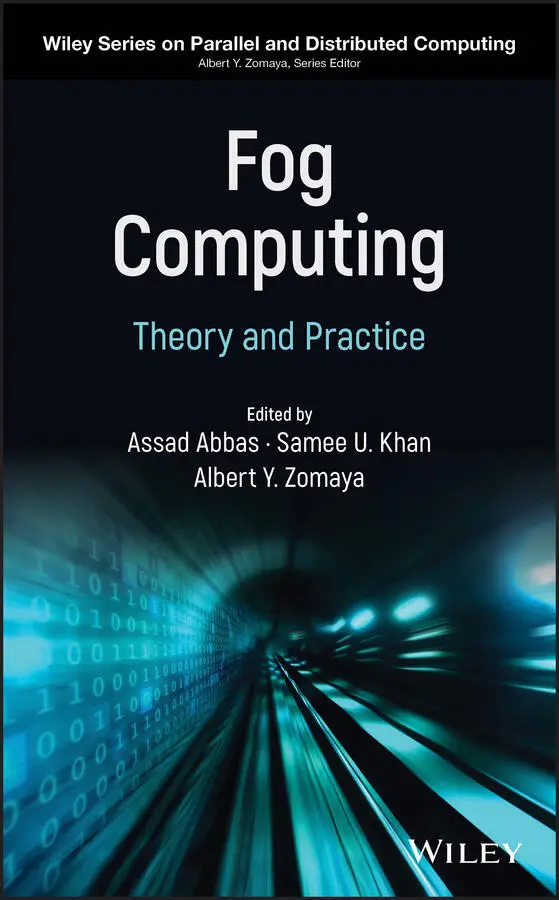
focuses on the technological aspects of employing fog computing in various application domains, such as smart healthcare, industrial process control and improvement, smart cities, and virtual learning environments. In addition, the Machine-to-Machine (M2M) communication methods for fog computing environments are covered in depth.
Presented in two parts—Fog Computing Systems and Architectures, and Fog Computing Techniques and Application—this book covers such important topics as energy efficiency and Quality of Service (QoS) issues, reliability and fault tolerance, load balancing, and scheduling in fog computing systems. It also devotes special attention to emerging trends and the industry needs associated with utilizing the mobile edge computing, Internet of Things (IoT), resource and pricing estimation, and virtualization in the fog environments.
Includes chapters on deep learning, mobile edge computing, smart grid, and intelligent transportation systems beyond the theoretical and foundational concepts Explores real-time traffic surveillance from video streams and interoperability of fog computing architectures Presents the latest research on data quality in the IoT, privacy, security, and trust issues in fog computing
provides a platform for researchers, practitioners, and graduate students from computer science, computer engineering, and various other disciplines to gain a deep understanding of fog computing.
Fog Computing — читать онлайн ознакомительный отрывок
Ниже представлен текст книги, разбитый по страницам. Система сохранения места последней прочитанной страницы, позволяет с удобством читать онлайн бесплатно книгу «Fog Computing», без необходимости каждый раз заново искать на чём Вы остановились. Поставьте закладку, и сможете в любой момент перейти на страницу, на которой закончили чтение.
Интервал:
Закладка:
23 23 Chen, Y.-A., Walters, J.P., and Crago, S.P. (2017). Load balancing for minimizing deadline misses and total runtime for connected car systems in fog computing. In: 2017 IEEE International Symposium on Parallel and Distributed Processing with Applications and 2017 IEEE International Conference on Ubiquitous Computing and Communications (ISPA/IUCC), 683–690. IEEE.
24 24 Fan, X., He, X., Puthal, D. et al. (2018). CTOM: collaborative task offloading mechanism for mobile cloudlet networks. In: 2018 IEEE International Conference on Communications (ICC), 1–6. IEEE.
25 25 Marshall, W.E. and Dumbaugh, E. (2018). Revisiting the relationship between traffic congestion and the economy: a longitudinal examination of us metropolitan areas. Transportation: 1–40.
26 26 Wang, C., Li, Y., Jin, D., and Chen, S. (2016). On the serviceability of mobile vehicular cloudlets in a large-scale urban environment. IEEE Transactions on Intelligent Transportation Systems 17 (10): 2960–2970.
27 27 Wang, Z., Zhong, Z., Zhao, D., and Ni, M. (2018). Vehicle-based cloudlet relaying for mobile computation offloading. IEEE Transactions on Vehicular Technology 67 (11): 11181–11191.
28 28 Yang, T., Cui, Z., Wang, R. et al. (2018). A multivessels cooperation scheduling for networked maritime fog-ran architecture leveraging SDN. Peer-to-Peer Networking and Applications 11 (4): 808–820.
29 29 R. Sosa, R. Sucasas, A. Queralt et al., Towards an open, secure, decentralized and coordinated fog-to-cloud management ecosystem, D5.1 mF2C reference architecture (integration IT-1), mF2C Consortium, 2018.
30 30 Xu, G., Shen, W., and Wang, X. (2014). Applications of wireless sensor networks in marine environment monitoring: a survey. Sensors 14 (9): 16932–16954.
31 31 Mohamed, N., Al-Jaroodi, J., Jawhar, I. et al. (2017). UAV fog: a UAV-based fog computing for Internet of Things. In: 2017 IEEE SmartWorld, Ubiquitous Intelligence & Computing, Advanced & Trusted Computed, Scalable Computing & Communications, Cloud & Big Data Computing, Internet of People and Smart City Innovation (SmartWorld/SCALCOM/UIC/ATC/CBDCom/IOP/SCI), 1–8. IEEE.
32 32 Radu, D., Cretu, A., Parrein, B. et al. (2018). Flying ad hoc network for emergency applications connected to a fog system. In: International Conference on Emerging Internetworking, Data & Web Technologies, 675–686. Springer.
33 33 451 Research, “Size and impact of fog computing market,” OpenFog Consortium, 2017.
34 34 Puliafito, C., Mingozzi, E., and Anastasi, G. (2017). Fog computing for the Internet of mobile things: issues and challenges. In: 2017 IEEE International Conference on Smart Computing (SMARTCOMP), 1–6. IEEE.
35 35 Silva, P.M.P., Rodrigues, J., Silva, J. et al. (2017). Using edge-clouds to reduce load on traditional Wi-Fi infrastructures and improve quality of experience. In: 2017 IEEE 1st International Conference on Fog and Edge Computing (ICFEC), 61–67. IEEE.
36 36 Chang, C. and Srirama, S.N. (2018). Providing context as a service using service-oriented mobile indie fog and opportunistic computing. In: European Conference on Software Architecture, –219, 235. Springer.
37 37 Siddiqui, F., Zeadally, S., and Salah, K. (2015). Gigabit wireless networking with ieee 802.11 ac: technical overview and challenges. Journal of Networks 10 (3): 164.
38 38 Rejiba, Z., Masip-Bruin, X., Jurnet, A. et al. (2018). F2C-aware: enabling discovery in Wi-Fi-powered fog-to-cloud (F2C) systems. In: 2018 6th IEEE International Conference on Mobile Cloud Computing, Services, and Engineering (MobileCloud), 113–116. IEEE.
39 39 Chowdhury, M., Steinbach, E., Kellerer, W., and Maier, M. (2018). Context-aware task migration for HART-centric collaboration over FiWi based tactile internet infrastructures. IEEE Transactions on Parallel and Distributed Systems 29 (6): 1231–1246.
40 40 Enayet, A., Razzaque, M.A., Hassan, M.M. et al. (2018). A mobility-aware optimal resource allocation architecture for big data task execution on mobile cloud in smart cities. IEEE Communications Magazine 56 (2): 110–117.
41 41 Taleb, T., Dutta, S., Ksentini, A. et al. (2017). Mobile edge computing potential in making cities smarter. IEEE Communications Magazine 55: 38–43.
42 42 Akter, M., Zohra, F.T., and Das, A.K. (2017). Q-MAC: QoS and mobility aware optimal resource allocation for dynamic application offloading in mobile cloud computing. In: International Conference on Electrical, Computer and Communication Engineering (ECCE), 803–808. IEEE.
43 43 Lei, L. (2016). Stochastic modeling of device-to-device communications for intelligent transportation systems. In: 2016 23rd International Conference on Telecommunications (ICT), 1–5. IEEE.
44 44 ITUR, Requirements related to technical performance for IMT-advanced radio interface(s), Report M.2134, International Telecommunications Union, 2008.
45 45 ITUR, Minimum requirements related to technical performance for IMT 2020 radio interface(s), Report M.2410, International Telecommunications Union, 2017 (22nd February Draft).
46 46 IMT vision – framework and overall objectives of the future development of IMT for 2020 and beyond, Recommendation ITU-R M.2083-0, pp. 2083–2090, International Telecommunications Union, 2015.
47 47 Dong, P., Zheng, T., Yu, S. et al. (2017). Enhancing vehicular communication using 5g-enabled smart collaborative networking. IEEE Wireless Communications 24: 72–79.
48 48 Yu, F., Chen, H., and Xu, J. (2018). DMPO: dynamic mobility-aware partial offloading in mobile edge computing. Future Generation Computer Systems 89: 722–735.
49 49 Wang, Z., Zhao, Z., Min, G. et al. (2018). User mobility aware task assignment for mobile edge computing. Future Generation Computer Systems 85: 1–8.
50 50 Nasrin, W. and Xie, J. (2018). SharedMEC: sharing clouds to support user mobility in mobile edge computing. In: 2018 IEEE International Conference on Communications (ICC), 1–6. IEEE.
51 51 Yang, J., Wen, J., Jiang, B. et al. (2018). Marine depth mapping algorithm based on the edge computing in Internet of Things. Journal of Parallel and Distributed Computing 114: 95–103.
52 52 Jeong, S., Simeone, O., and Kang, J. (2018). Mobile edge computing via a UAV-mounted cloudlet: optimization of bit allocation and path planning. IEEE Transactions on Vehicular Technology 67 (3): 2049–2063.
53 53 Salem, A., Salonidis, T., Desai, N., and Nadeem, T. (2017). Kinaara: distributed discovery and allocation of mobile edge resources. In: 2017 IEEE 14th International Conference on Mobile Ad Hoc and Sensor Systems (MASS), 153–161. IEEE.
54 54 Liyanage, M., Chang, C., and Srirama, S.N. (2018). Adaptive mobile web server framework for mist computing in the Internet of Things. International Journal of Pervasive Computing and Communications.
55 55 Sucipto, K., Chatzopoulos, D., Kosta±, S., and Hui, P. (2017). Keep your nice friends close, but your rich friends closer — computation offloading using nfc. In: IEEE INFOCOM 2017 IEEE Conference on Computer Communications, 1–9.
56 56 Characteristics of VHF radio systems and equipment for the exchange of data and electronic mail in the maritime mobile service RR appendix 18 channels, Recommendation M.1842-1, International Telecommunication Union, 2008.
57 57 Al-Zaidi, R., Woods, J., Al-Khalidi, M. et al. (2017). Next generation marine data networks in an iot environment. In: 2017 Second International Conference on Fog and Mobile Edge Computing (FMEC), 50–55. IEEE.
58 58 Manoufali, M., Alshaer, H., Kong, P.-Y., and Jimaa, S. (2013). Technologies and networks supporting maritime wireless mesh communications. In: Wireless and Mobile Networking Conference (WMNC), 2013 6th Joint IFIP, 1–8. IEEE.
59 59 Bardram, A.V.T., Larsen, M.D., Malarski, K.M. et al. (2018). Lorawan capacity simulation and field test in a harbour environment. In: 2018 Third International Conference on Fog and Mobile Edge Computing (FMEC), 193–198.
Читать дальшеИнтервал:
Закладка:
Похожие книги на «Fog Computing»
Представляем Вашему вниманию похожие книги на «Fog Computing» списком для выбора. Мы отобрали схожую по названию и смыслу литературу в надежде предоставить читателям больше вариантов отыскать новые, интересные, ещё непрочитанные произведения.







Обсуждение, отзывы о книге «Fog Computing» и просто собственные мнения читателей. Оставьте ваши комментарии, напишите, что Вы думаете о произведении, его смысле или главных героях. Укажите что конкретно понравилось, а что нет, и почему Вы так считаете.