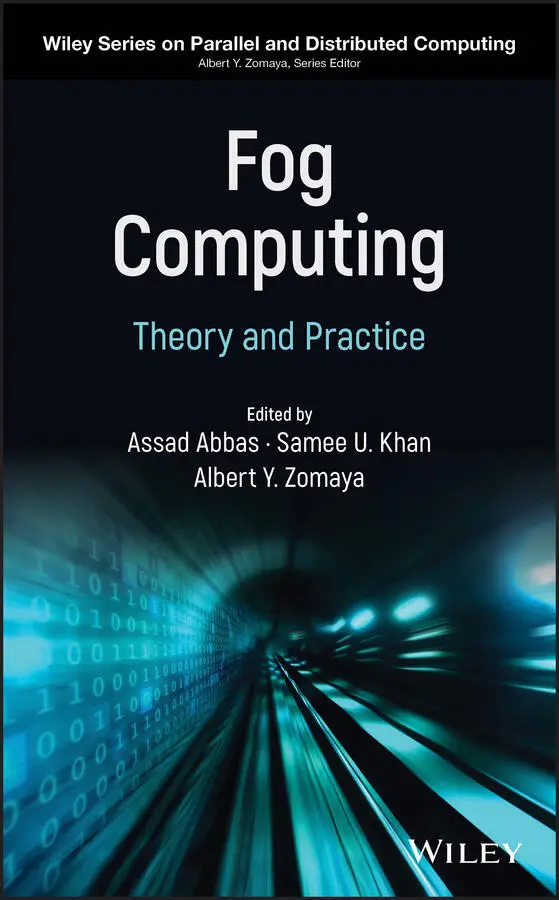
Fog Computing
Здесь есть возможность читать онлайн «Fog Computing» — ознакомительный отрывок электронной книги совершенно бесплатно, а после прочтения отрывка купить полную версию. В некоторых случаях можно слушать аудио, скачать через торрент в формате fb2 и присутствует краткое содержание. Жанр: unrecognised, на английском языке. Описание произведения, (предисловие) а так же отзывы посетителей доступны на портале библиотеки ЛибКат.
- Название:Fog Computing
- Автор:
- Жанр:
- Год:неизвестен
- ISBN:нет данных
- Рейтинг книги:5 / 5. Голосов: 1
-
Избранное:Добавить в избранное
- Отзывы:
-
Ваша оценка:
Fog Computing: краткое содержание, описание и аннотация
Предлагаем к чтению аннотацию, описание, краткое содержание или предисловие (зависит от того, что написал сам автор книги «Fog Computing»). Если вы не нашли необходимую информацию о книге — напишите в комментариях, мы постараемся отыскать её.
focuses on the technological aspects of employing fog computing in various application domains, such as smart healthcare, industrial process control and improvement, smart cities, and virtual learning environments. In addition, the Machine-to-Machine (M2M) communication methods for fog computing environments are covered in depth.
Presented in two parts—Fog Computing Systems and Architectures, and Fog Computing Techniques and Application—this book covers such important topics as energy efficiency and Quality of Service (QoS) issues, reliability and fault tolerance, load balancing, and scheduling in fog computing systems. It also devotes special attention to emerging trends and the industry needs associated with utilizing the mobile edge computing, Internet of Things (IoT), resource and pricing estimation, and virtualization in the fog environments.
Includes chapters on deep learning, mobile edge computing, smart grid, and intelligent transportation systems beyond the theoretical and foundational concepts Explores real-time traffic surveillance from video streams and interoperability of fog computing architectures Presents the latest research on data quality in the IoT, privacy, security, and trust issues in fog computing
provides a platform for researchers, practitioners, and graduate students from computer science, computer engineering, and various other disciplines to gain a deep understanding of fog computing.
Fog Computing — читать онлайн ознакомительный отрывок
Ниже представлен текст книги, разбитый по страницам. Система сохранения места последней прочитанной страницы, позволяет с удобством читать онлайн бесплатно книгу «Fog Computing», без необходимости каждый раз заново искать на чём Вы остановились. Поставьте закладку, и сможете в любой момент перейти на страницу, на которой закончили чтение.
Интервал:
Закладка:
Table of Contents
1 Cover
2 List of Contributors
3 Acronyms
4 Part I: Fog Computing Systems and Architectures Part I Fog Computing Systems and Architectures
1 Mobile Fog Computing 1 Mobile Fog Computing Chii Chang, Amnir Hadachi, Jakob Mass, and Satish Narayana Srirama Institute of Computer Science, University of Tartu, Estonia
1.1 Introduction 1.2 Mobile Fog Computing and Related Models 1.3 The Needs of Mobile Fog Computing 1.4 Communication Technologies 1.5 Nonfunctional Requirements 1.6 Open Challenges 1.7 Conclusion Acknowledgment References 2 Edge and Fog: A Survey, Use Cases, and Future Challenges 2.1 Introduction 2.2 Edge Computing 2.3 Fog Computing 2.4 Fog and Edge Illustrative Use Cases 2.5 Future Challenges 2.6 Conclusion Acknowledgment References 3 Deep Learning in the Era of Edge Computing: Challenges and Opportunities 3.1 Introduction 3.2 Challenges and Opportunities 3.3 Concluding Remarks References 4 Caching, Security, and Mobility in Content-centric Networking 4.1 Introduction 4.2 Caching and Fog Computing 4.3 Mobility Management in CCN 4.4 Security in Content-centric Networks 4.5 Caching 4.6 Conclusions References 5 Security and Privacy Issues in Fog Computing 5.1 Introduction 5.2 Trust in IoT 5.3 Authentication 5.4 Authorization 5.5 Privacy 5.6 Web Semantics and Trust Management for Fog Computing 5.7 Discussion 5.8 Conclusion References 6 How Fog Computing Can Support Latency/Reliability-sensitive IoT Applications: An Overview and a Taxonomy of State-of-the-art Solutions 6.1 Introduction 6.2 Fog Computing for IoT: Definition and Requirements 6.3 Fog Computing: Architectural Model 6.4 Fog Computing for IoT: A Taxonomy 6.5 Comparisons of Surveyed Solutions 6.6 Challenges and Recommended Research Directions 6.7 Concluding Remarks References 7 Harnessing the Computing Continuum for Programming Our World 7.1 Introduction and Overview 7.2 Research Philosophy 7.3 A Goal-oriented Approach to Programming the Computing Continuum 7.4 Summary References 8 Fog Computing for Energy Harvesting-enabled Internet of Things 8.1 Introduction 8.2 System Model 8.3 Tradeoffs in EH Fog Systems 8.4 Future Research Challenges Acknowledgment References 9 Optimizing Energy Efficiency of Wearable Sensors Using Fog-assisted Control 9.1 Introduction 9.2 Background 9.3 Related Topics 9.4 Design Challenges 9.5 IoT System Architecture 9.6 Fog-assisted Runtime Energy Management in Wearable Sensors 9.7 Conclusions Acknowledgment References 10 Latency Minimization Through Optimal Data Placement in Fog Networks 10.1 Introduction 10.2 Related Work 10.3 Problem Statement 10.4 Delay Minimization Without Replication 10.5 Delay Minimization with Replication 10.6 Performance Evaluation 10.7 Conclusion Acknowledgement References 11 Modeling and Simulation of Distributed Fog Environment Using FogNetSim++ 11.1 Introduction 11.2 Modeling and Simulation 11.3 FogNetSim++: Architecture 11.4 FogNetSim++: Installation and Environment Setup 11.5 Conclusion References
5 Part II: Fog Computing Techniques and Applications 12 Distributed Machine Learning for IoT Applications in the Fog 12.1 Introduction 12.2 Challenges in Data Processing for IoT 12.3 Computational Intelligence and Fog Computing 12.4 Challenges for Running Machine Learning on Fog Devices 12.5 Approaches to Distribute Intelligence on Fog Devices 12.6 Final Remarks Acknowledgments References 13 Fog Computing-Based Communication Systems for Modern Smart Grids 13.1 Introduction 13.2 An Overview of Communication Technologies in Smart Grid 13.3 Distribution Management System (DMS) Based on Fog/Cloud Computing 13.4 Real-time Simulation of the Proposed Feeder-based Communication Scheme Using MATLAB and ThingSpeak 13.5 Conclusion References 14 An Estimation of Distribution Algorithm to Optimize the Utility of Task Scheduling Under Fog Computing Systems 14.1 Introduction 14.2 Estimation of Distribution Algorithm 14.3 Related Work 14.4 Problem Statement 14.5 Details of Proposed Algorithm 14.6 Simulation 14.7 Conclusion References 15 Reliable and Power-Efficient Machine Learning in Wearable Sensors 15.1 Introduction 15.2 Preliminaries and Related Work 15.3 System Architecture and Methods 15.4 Data Collection and Experimental Procedures 15.5 Results 15.6 Discussion and Future Work 15.7 Summary References 16 Insights into Software-Defined Networking and Applications in Fog Computing 16.1 Introduction 16.2 OpenFlow Protocol 16.3 SDN-Based Research Works 16.4 SDN in Fog Computing 16.5 SDN in Wireless Mesh Networks 16.6 SDN in Wireless Sensor Networks 16.7 Conclusion References 17 Time-Critical Fog Computing for Vehicular Networks 17.1 Introduction 17.2 Applications and Timeliness Guarantees and Perturbations 17.3 Coping with Perturbation to Meet Timeliness Guarantees 17.4 Research Gaps and Future Research Directions 17.5 Conclusion References 18 A Reliable and Efficient Fog-Based Architecture for Autonomous Vehicular Networks 18.1 Introduction 18.2 Proposed Methodology 18.3 Hypothesis Formulation 18.4 Simulation Design 18.5 Conclusions References 19 Fog Computing to Enable Geospatial Video Analytics for Disaster-incident Situational Awareness 19.1 Introduction 19.2 Computer Vision Application Case Studies and FCC Motivation 19.3 Geospatial Video Analytics Data Collection Using Edge Routing 19.4 Fog/Cloud Data Processing for Geospatial Video Analytics Consumption 19.5 Concluding Remarks References 20 An Insight into 5G Networks with Fog Computing 20.1 Introduction 20.2 Vision of 5G 20.3 Fog Computing with 5G Networks 20.4 Architecture of 5G 20.5 Technology and Methodology for 5G 20.6 Applications 20.7 Challenges 20.8 Conclusion References 21 Fog Computing for Bioinformatics Applications 21.1 Introduction 21.2 Cloud Computing 21.3 Cloud Computing Applications in Bioinformatics 21.4 Fog Computing 21.5 Fog Computing for Bioinformatics Applications 21.6 Conclusion References
6 Index
7 End User License Agreement
List of Tables
1 Chapter 2 Table 2.1 Threat model for fog and edge computing [21].
2 Chapter 3 Table 3.1 Memory and computational expensiveness of some of the most commonly...
3 Chapter 4 Table 4.1 Caching schemes comparison.Table 4.2 Objectives-based comparison.
4 Chapter 5Table 5.1 State of the art research work timeline.Table 5.2 Authentication grid.Table 5.3 Authorization requirements in the Internet of Things.Table 5.4 Privacy requirements in the light of Internet of Things.
5 Chapter 6Table 6.1 Comparison between surveyed communication approaches.Table 6.2 Comparison between surveyed security and privacy approaches.Table 6.3 Comparison of the surveyed solution related to the Internet of Thin...Table 6.4 Comparison of the surveyed solution related to the data quality lay...Table 6.5 Comparison of the surveyed solution related to the cloudification l...Table 6.6 Comparison of the surveyed solution related to the analytics and de...
6 Chapter 7Table 7.1 Exemplar continuum computing science applications.Table 7.2 Twister2 components and status.
7 Chapter 10Table 10.1 Summary of symbols.
8 Chapter 12Table 12.1 Comparison of machine learningtechnologies [14].Table 12.2 Execution time (ms) for running DL models in three hardware platfo...Table 12.3 Classification of smart IoT devices according to their capacities ...
9 Chapter 13Table 13.1 Comparison of communication technologies for the SG [10–13].
10 Chapter 14Table 14.1 Simulation environmental parameters.Table 14.2 Comparison results of utility between heuristic and uEDA.
11 Chapter 15Table 15.1 Extracted features from sensor signals.Table 15.2 Energy consumption of various configurations, where computation is...Table 15.3 Accuracy of sensor localization.Table 15.4 The comparison between the accuracy of the regression on different...Table 15.5 Leave-one-subject-out cross validation test.Table 15.6 R 2values from linear regression on MET vs Ankle and Hip Accelerometer...Table 15.7 Comparing R 2values and error of linear regression on MET vs Ankle ...
Читать дальшеИнтервал:
Закладка:
Похожие книги на «Fog Computing»
Представляем Вашему вниманию похожие книги на «Fog Computing» списком для выбора. Мы отобрали схожую по названию и смыслу литературу в надежде предоставить читателям больше вариантов отыскать новые, интересные, ещё непрочитанные произведения.






Обсуждение, отзывы о книге «Fog Computing» и просто собственные мнения читателей. Оставьте ваши комментарии, напишите, что Вы думаете о произведении, его смысле или главных героях. Укажите что конкретно понравилось, а что нет, и почему Вы так считаете.