Fog Computing
Здесь есть возможность читать онлайн «Fog Computing» — ознакомительный отрывок электронной книги совершенно бесплатно, а после прочтения отрывка купить полную версию. В некоторых случаях можно слушать аудио, скачать через торрент в формате fb2 и присутствует краткое содержание. Жанр: unrecognised, на английском языке. Описание произведения, (предисловие) а так же отзывы посетителей доступны на портале библиотеки ЛибКат.
- Название:Fog Computing
- Автор:
- Жанр:
- Год:неизвестен
- ISBN:нет данных
- Рейтинг книги:5 / 5. Голосов: 1
-
Избранное:Добавить в избранное
- Отзывы:
-
Ваша оценка:
Fog Computing: краткое содержание, описание и аннотация
Предлагаем к чтению аннотацию, описание, краткое содержание или предисловие (зависит от того, что написал сам автор книги «Fog Computing»). Если вы не нашли необходимую информацию о книге — напишите в комментариях, мы постараемся отыскать её.
focuses on the technological aspects of employing fog computing in various application domains, such as smart healthcare, industrial process control and improvement, smart cities, and virtual learning environments. In addition, the Machine-to-Machine (M2M) communication methods for fog computing environments are covered in depth.
Presented in two parts—Fog Computing Systems and Architectures, and Fog Computing Techniques and Application—this book covers such important topics as energy efficiency and Quality of Service (QoS) issues, reliability and fault tolerance, load balancing, and scheduling in fog computing systems. It also devotes special attention to emerging trends and the industry needs associated with utilizing the mobile edge computing, Internet of Things (IoT), resource and pricing estimation, and virtualization in the fog environments.
Includes chapters on deep learning, mobile edge computing, smart grid, and intelligent transportation systems beyond the theoretical and foundational concepts Explores real-time traffic surveillance from video streams and interoperability of fog computing architectures Presents the latest research on data quality in the IoT, privacy, security, and trust issues in fog computing
provides a platform for researchers, practitioners, and graduate students from computer science, computer engineering, and various other disciplines to gain a deep understanding of fog computing.
Fog Computing — читать онлайн ознакомительный отрывок
Ниже представлен текст книги, разбитый по страницам. Система сохранения места последней прочитанной страницы, позволяет с удобством читать онлайн бесплатно книгу «Fog Computing», без необходимости каждый раз заново искать на чём Вы остановились. Поставьте закладку, и сможете в любой момент перейти на страницу, на которой закончили чтение.
Интервал:
Закладка:
1.3.1.4 Mobile Ambient Assisted Living
Today's UE devices, such as smartphones, have numerous inbuilt sensor components. For example, the modern mobile operating systems (e.g. Android OS) have provided numerous software components that are capable of integrating both internal and external sensors to support mobile Ambient Assisted Living (AAL) applications such as real-time health monitoring and observing the surrounding environments of the user to avoid dangers. Fundamentally, classic mobile AAL applications rely on the distant cloud to process the sensory data in order to identify situations. However, such an approach is often unable to provide rapid response due to communication latency issues. Therefore, utilizing proximal fog service derived either from the MEC-supported cellular base station or individual or small business-provided Indie Fog [17] has become an ideal solution to enhance the agility of mobile AAL applications [18].
1.3.2 Land Vehicular Fog
The development of vehicular networking has improved safety and control on the roads. Especially, LV-Fog nodes have emerged as a solution to introduce computational power and reliable connectivity to transportation systems at the level of Vehicle-to-Infrastructure (V2I), V2V, and Vehicle-to-Device (V2D) communications [19]. These networks are shaped around moving vehicles, pedestrians equipped with mobile devices, and road network infrastructure units. Further, these aspects have facilitated the introduction of real-time situational/context awareness by allowing the vehicle to collect or process data about their surroundings and share these insights with the central traffic control management units or other vehicles and devices in a cooperative manner.
To perform such activities, there is a need for adequate computing resources at the edge for performing time-critical and data-intensive jobs [20] and face all the challenges related to data collection and dissemination, data storage, mobility-influenced changing network structure, resource management, energy, and data analysis [21, 22].
Most of the techniques proposed to solve these challenges are focusing on merging the computation power between vehicular cloud and vehicular networks [19]. This combination allows usage of both vehicles' OBUs and RSUs as communication entities. Another side that has been investigated is the issues related to latency and quality optimization of the tasks in the Vehicular Fog Computing (VFC) [20], and it was formulated by presenting the task as a bi-objective minimization problem, where the trade-off is preserved between the latency and quality loss. Furthermore, handling the mobility complexity that massively affects the network structure is addressed by using mobility patterns of the moving vehicles and devices to perform a periodic load balancing in the fog servers [23] or distance-based forwarding (DBF) protocol [19]. The energy management and computational power for data analysis are controlled by distributing the load among the network entities to make use of all the available resources based on CR-based access protocol [22].
Moreover, the design of the Media Access Control (MAC) layer protocol in the vehicular networks is essential for improving the network performance, especially in V2V communication. V2V enables cooperative tasks among the vehicles and introduces cooperative communication, such as:
Dynamic fog service for next generation mobile applications. The emergence of new mobile applications, such as augmented reality (AR) and virtual reality, have brought a new level of experience that is greedy for more computational power. However, the traditional approach of a distant cloud-driver is incapable of achieving with good performance due to latency. Therefore, introducing Metropolitan vehicle-based cloudlet, which is a form of mobile fog node model, solves the latency issue by dynamically placing the fog at the areas with high demand. Furthermore, by adopting a collaborative task offloading mechanism, the vehicle-based mobile fog nodes are capable of effectively distributing the processes across all the participative nodes, based on their encounter conditions [24].
Federated intelligent transportation. Traffic jams start to have a considerable negative impact by wasting time, fuel, capital, and polluting the environment due to the nonstop increase in the number of vehicles on the roads [25]. Fortunately, cloud-driven smart vehicles have emerged as a facilitator to overcome the problem. The solution resides in considering the serviceability level of mobile vehicular cloudlets (MVCs), which are a form of the mobile fog node model, based on the real-world large-scale traces of mobility of urban vehicles collected by onboard computers. Based on the peer-to-peer communication network, vehicles can further improve the traffic experience by exchanging real-time information and providing assistance to the manned or unmanned vehicles [26].
Vehicular opportunistic computation offloading. Public transportation service vehicles, such as buses and trams, which commonly have fixed routes and time schedules, can be the mobile fog nodes for the other mobile application devices inside the proximal encountered vehicles that need to execute time-sensitive and computation-intensive tasks, such as augmented reality (AR) processes used for the advanced driver assistance systems and applications [27].
1.3.3 Marine Fog
Integrating IoT to existing legacy marine systems can provide rapid information exchange. Initially, classic marine communication systems utilize VHF radio to obtain ship identification, ship location, position, destination, moving speed, and so forth. Unfortunately, VHF can provide only 9.6 kbps, which is insufficient to provide marine sensory data streaming [28]. Alternatively, ships can utilize the new satellite Internet to deliver their data, which is capable of achieving 432 kbps. However, satellite communication is not affordable for small and medium-size businesses since a simple voice service can cost USD $13.75 per minute [28]. In order to overcome the issue, researchers have introduced fog computing and networking-integrated marine communication systems for the Internet of marine t hings (IoMaT) [4]. Here, we term such a fog computing model Marine Fog.
By integrating a virtualization or containerization technology-based fog server with onboard equipment, vessels are capable of realizing a software-defined network (SDN) that allows the vessels to (re)configure a message routing path dynamically. Afterwards, by utilizing Marine Fog–based SDN mechanism, vessels can easily establish an ad hoc–based DTN, which caches data at the onboard Marine Fog node until the vessel encounters the next Marine Fog node, for delivering sensory data from the data source to the base stations toward relaying the data to the cloud. Moreover, an advanced Marine Fog node within the network may also perform data preprocessing in order to further reduce the transmission latency [29] ( Figure 1.2).
Existing wireless sensor network (WSN) architecture in marine monitoring uses sea buoys as sink nodes, capable of communicating with nearby sensor nodes (other buoys, vessels) directly (e.g. using ZigBee), as well as via the cellular Internet network [30]. By introducing the previously mentioned virtualization, the WSN architecture could be extended to be used in Marine Fog. However, this approach amplifies the need for energy-harvesting technology at the buoys.
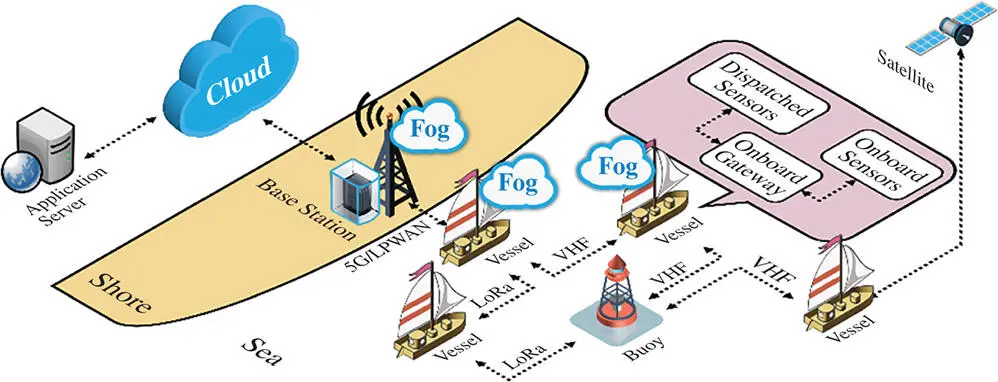
Figure 1.2 Maritime fog computing examples.
1.3.4 Unmanned Aerial Vehicular Fog
Интервал:
Закладка:
Похожие книги на «Fog Computing»
Представляем Вашему вниманию похожие книги на «Fog Computing» списком для выбора. Мы отобрали схожую по названию и смыслу литературу в надежде предоставить читателям больше вариантов отыскать новые, интересные, ещё непрочитанные произведения.






Обсуждение, отзывы о книге «Fog Computing» и просто собственные мнения читателей. Оставьте ваши комментарии, напишите, что Вы думаете о произведении, его смысле или главных героях. Укажите что конкретно понравилось, а что нет, и почему Вы так считаете.