Fog Computing
Здесь есть возможность читать онлайн «Fog Computing» — ознакомительный отрывок электронной книги совершенно бесплатно, а после прочтения отрывка купить полную версию. В некоторых случаях можно слушать аудио, скачать через торрент в формате fb2 и присутствует краткое содержание. Жанр: unrecognised, на английском языке. Описание произведения, (предисловие) а так же отзывы посетителей доступны на портале библиотеки ЛибКат.
- Название:Fog Computing
- Автор:
- Жанр:
- Год:неизвестен
- ISBN:нет данных
- Рейтинг книги:5 / 5. Голосов: 1
-
Избранное:Добавить в избранное
- Отзывы:
-
Ваша оценка:
Fog Computing: краткое содержание, описание и аннотация
Предлагаем к чтению аннотацию, описание, краткое содержание или предисловие (зависит от того, что написал сам автор книги «Fog Computing»). Если вы не нашли необходимую информацию о книге — напишите в комментариях, мы постараемся отыскать её.
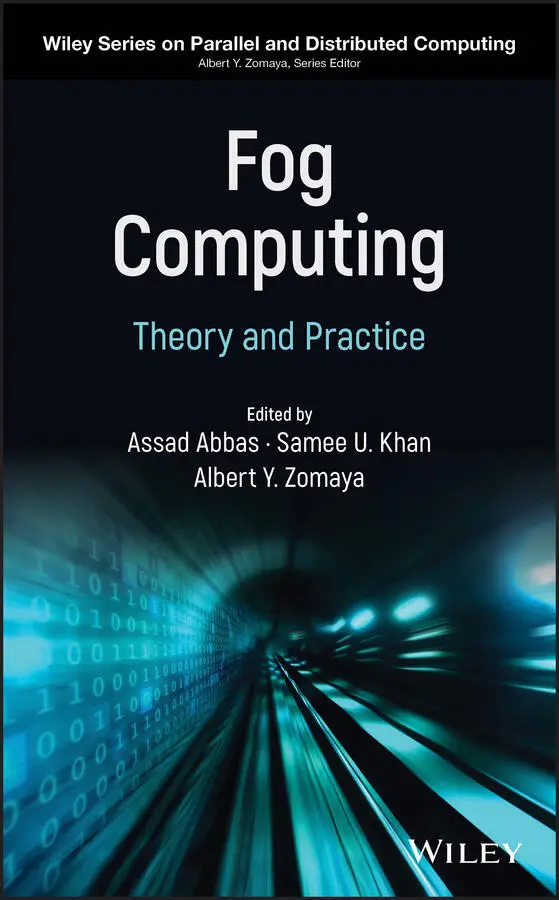
focuses on the technological aspects of employing fog computing in various application domains, such as smart healthcare, industrial process control and improvement, smart cities, and virtual learning environments. In addition, the Machine-to-Machine (M2M) communication methods for fog computing environments are covered in depth.
Presented in two parts—Fog Computing Systems and Architectures, and Fog Computing Techniques and Application—this book covers such important topics as energy efficiency and Quality of Service (QoS) issues, reliability and fault tolerance, load balancing, and scheduling in fog computing systems. It also devotes special attention to emerging trends and the industry needs associated with utilizing the mobile edge computing, Internet of Things (IoT), resource and pricing estimation, and virtualization in the fog environments.
Includes chapters on deep learning, mobile edge computing, smart grid, and intelligent transportation systems beyond the theoretical and foundational concepts Explores real-time traffic surveillance from video streams and interoperability of fog computing architectures Presents the latest research on data quality in the IoT, privacy, security, and trust issues in fog computing
provides a platform for researchers, practitioners, and graduate students from computer science, computer engineering, and various other disciplines to gain a deep understanding of fog computing.
Fog Computing — читать онлайн ознакомительный отрывок
Ниже представлен текст книги, разбитый по страницам. Система сохранения места последней прочитанной страницы, позволяет с удобством читать онлайн бесплатно книгу «Fog Computing», без необходимости каждый раз заново искать на чём Вы остановились. Поставьте закладку, и сможете в любой момент перейти на страницу, на которой закончили чтение.
Интервал:
Закладка:
12 Chapter 16Table 16.1 Comparison between centralized and distributed controller.
13 Chapter 17Table 17.1 Benchmarking of application classes.
14 Chapter 18Table 18.1 Results of the latency in the both architectures.Table 18.2 Log-transformed data for latency.Table 18.3 Results of the network usage in the both architectures.Table 18.4 Log-transformed data for network usage.
15 Chapter 20Table 20.1 Comparison of wireless technologies.Table 20.2 5G protocol stack.Table 20.3 Challenges of 5G.Table 20.4 Research projects on 5G.
16 Chapter 21Table 21.1 A summary of existing cloud computing based major bioinformatics a...Table 21.2 Comparison between the cloud computing and fog computing paradigms...
List of Illustrations
1 Chapter 1 Figure 1.1 Land-vehicular fog computing examples. ( See color plate section f ... Figure 1.2 Maritime fog computing examples. Figure 1.3 UAV fog computing examples. Figure 1.4 UE fog computing examples. ( See color plate section for the color ... Figure 1.5 A taxonomy of non-functional requirements of mobile fog computing... Figure 1.6 Fog infrastructure service provider, fog service tenant, and tena... Figure 1.7 The three types of end-to-end networking.
2 Chapter 2 Figure 2.1 Edge computing solution using an IoT and edge devices [12]. Figure 2.2 An overview of edge computing architecture [16]. ( See color plate ... Figure 2.3 Fog computing a bridge between cloud and edge [20]. Figure 2.4 Fog computing architecture [10]. ( See color plate section for the ... Figure 2.5 A wearable ECG sensor. Figure 2.6 Structure of edgeOS in the smart home environment [3]. Figure 2.7 Smart Traffic light system. Figure 2.8 Smart pipeline monitoring system architecture.
3 Chapter 3 Figure 3.1 Illustration of differences between training and test images of t... Figure 3.2 Illustration of data sharing mechanism. Figure 3.3 Illustration of intermediate results of a DNN model. The size of ...
4 Chapter 4 Figure 4.1 CCN router components. Figure 4.2 Tunnel-based redirection (TBR) scheme.
5 Chapter 5Figure 5.1 Fog computing enabled smart cities. ( See color plate section for ...Figure 5.2 A generic fog enabled IoT environment. ( See color plate section f ...Figure 5.3 Internet of Things security phenomenon.Figure 5.4 Layered depiction of components of trust.Figure 5.5 Detailed taxonomy of threats.Figure 5.6 Semantic web technology stack by Tim Berners-Lee 2000 (http://w3c...Figure 5.7 With the appropriate sensors and wireless technology, several wir...Figure 5.8 Authentication methods taxonomy.Figure 5.9 Authorization frameworks and models.Figure 5.10 Taxonomy of the frameworks and models used for privacy.
6 Chapter 6Figure 6.1 Cloud-fog-IoT architecture. ( See color plate section for the colo ...Figure 6.2 Our proposed architecture for cloud-fog-IoT integration.Figure 6.3 Taxonomy for the classification of the communication layer.Figure 6.4 Taxonomy for the classification of the security and privacy layer...Figure 6.5 Taxonomy for the classification of the Internet of Things layer....Figure 6.6 Taxonomy for the classification of the data quality layer.Figure 6.7 Taxonomy for the classification of the cloudification layer.Figure 6.8 Taxonomy for the classification of the analytics and decision-mak...
7 Chapter 7Figure 7.1 The Computing Continuum: Cyberinfrastructure that spans every sca...Figure 7.2 Continuum Computing Research Areas: A pictorial depiction of the ...Figure 7.3 Continuum mapping and execution: Research is needed to explore te...
8 Chapter 8Figure 8.1 Fog system.Figure 8.2 Energy receiver.Figure 8.3 Time slot.
9 Chapter 9Figure 9.1 PPG sensors consisting of two light sources and one light sensor....Figure 9.2 Power spectral density (PSD) of one-minute PPG signal.Figure 9.3 PPG waveforms and the four features extracted for SpO 2calculatio...Figure 9.4 IoT system architecture.Figure 9.5 The high level system architecture.Figure 9.6 Modeling accuracy of measurements (e.g. ɛ( X , U )) in PP...Figure 9.7 Optimization algorithm implementation.Figure 9.8 Markov chain of battery states during charging and discharging.Figure 9.9 Markov chain of activities of an individual during one period.Figure 9.10 Markov chain of joint battery and activity states during period ...Figure 9.11 24-hour health monitoring of a healthy person. (a) User's activi...Figure 9.12 Average probability of error as a function of energy consumption...
10 Chapter 10Figure 10.1 An illustration of a typical fog network.Figure 10.2 An illustration of the problem's challenges.Figure 10.3 An illustration of the min-cost transformation.Figure 10.4 An illustration of latency updating procedure: (a) demand collec...Figure 10.5 The dynamic programming in the line topology.Figure 10.6 An illustration of the greedy algorithm: (a) greedy, (b) optimal...Figure 10.7 Server distribution.Figure 10.8 Latency-distance mapping: (a) greedy, (b) optimal.Figure 10.9 Performance comparison without data replication.Figure 10.10 Performance comparison with data replication.
11 Chapter 11Figure 11.1 A comparison of different simulators for fog computing environme...Figure 11.2 FogNetSim++ high-level architecture.Figure 11.3 FogNetSim++: Graphical user interface, showing static, mobile, a...Figure 11.4 FogNetSim++: showing the handover features managed through singl...Figure 11.5 FogNetSim++: Internal structure of broker node.Figure 11.6 GUI – Sample fog simulation.
12 Chapter 12Figure 12.1 Three-tier architecture for IoT (a) and two-tier cloud assisted ...Figure 12.2 IoT Data Challenges in three dimensions: generation, transmissio...Figure 12.3 A multilayer feed-forward neural network.Figure 12.4 Traditional machine learning (a) and deep learning (b) approache...Figure 12.5 Typical CNN architecture [25].Figure 12.6 OpenMV, a machine vision kit for IoT developers.Figure 12.7 NCS based on Intel Movidius Myriad 2 Vision Processing Unit (VPU...Figure 12.8 Fog topology with devices grouped by levels.Figure 12.9 Multilevel data fusion for video processing.
13 Chapter 13Figure 13.1 Comparison between the Smart Grid and the traditional grid.Figure 13.2 Time triggering of the major functions used in DMS.Figure 13.3 Feeder-based communication scheme for DMS using fog/cloud comput...Figure 13.4 Simplified communication scheme connecting MATLAB/Simulink and T...Figure 13.5 Distribution feeder topology with ThingSpeak channel assignments...Figure 13.6 Simulation test 1 – Three-phase tripping of network branch 571–6...Figure 13.7 Three-phase voltage profile of distribution feeder downstream fr...Figure 13.8 Simulation test 2 – “Heavy” loading of the distribution feeder, ...Figure 13.9 Three-phase voltage profile of distribution feeder downstream fr...
14 Chapter 14Figure 14.1 Our proposed three-tier IoT system architecture.Figure 14.2 Line chat with average value markers of different CCR values.Figure 14.3 100% stack column chat of different CCR values.
15 Chapter 15Figure 15.1 The process of developing location-independent MET estimation mo...Figure 15.2 The result of the cross-correlation function on magnitude (a) an...Figure 15.3 Three smart phones are placed on three different locations of ea...Figure 15.4 Performance comparison of the proposed transfer learning approac...Figure 15.5 Performance comparison of the proposed transfer learning approac...
16 Chapter 16Figure 16.1 Architecture of software-defined network (SDN). ( See color plate ...Figure 16.2 An OpenFlow switch communicate with controller over a secure con...Figure 16.3 Architecture of SDN-based wireless mesh network.Figure 16.4 Architecture of SDN-enabled wireless sensor network.
17 Chapter 17Figure 17.1 Fog computing for vehicular applications.Figure 17.2 Obstacle detection as an example of delay-critical application s...Figure 17.3 Timeliness perturbations.Figure 17.4 Coping with perturbation in DCVF.
Читать дальшеИнтервал:
Закладка:
Похожие книги на «Fog Computing»
Представляем Вашему вниманию похожие книги на «Fog Computing» списком для выбора. Мы отобрали схожую по названию и смыслу литературу в надежде предоставить читателям больше вариантов отыскать новые, интересные, ещё непрочитанные произведения.









Обсуждение, отзывы о книге «Fog Computing» и просто собственные мнения читателей. Оставьте ваши комментарии, напишите, что Вы думаете о произведении, его смысле или главных героях. Укажите что конкретно понравилось, а что нет, и почему Вы так считаете.