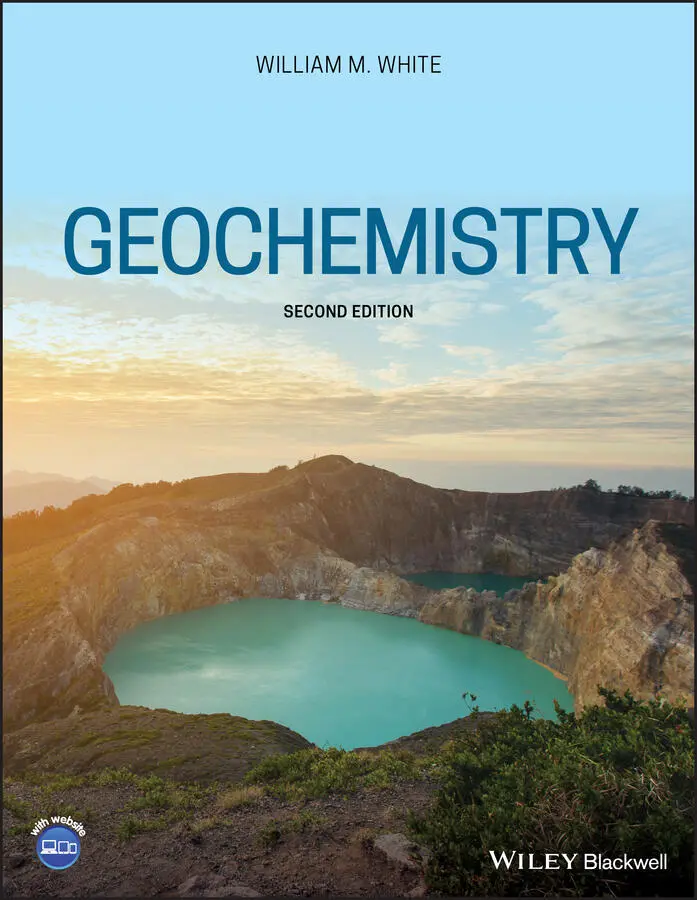
William M. White - Geochemistry
Здесь есть возможность читать онлайн «William M. White - Geochemistry» — ознакомительный отрывок электронной книги совершенно бесплатно, а после прочтения отрывка купить полную версию. В некоторых случаях можно слушать аудио, скачать через торрент в формате fb2 и присутствует краткое содержание. Жанр: unrecognised, на английском языке. Описание произведения, (предисловие) а так же отзывы посетителей доступны на портале библиотеки ЛибКат.
- Название:Geochemistry
- Автор:
- Жанр:
- Год:неизвестен
- ISBN:нет данных
- Рейтинг книги:5 / 5. Голосов: 1
-
Избранное:Добавить в избранное
- Отзывы:
-
Ваша оценка:
Geochemistry: краткое содержание, описание и аннотация
Предлагаем к чтению аннотацию, описание, краткое содержание или предисловие (зависит от того, что написал сам автор книги «Geochemistry»). Если вы не нашли необходимую информацию о книге — напишите в комментариях, мы постараемся отыскать её.
, undergraduate and graduate students will find each of the core principles of geochemistry covered. From defining key principles and methods to examining Earth’s core composition and exploring organic chemistry and fossil fuels, this definitive edition encompasses all the information needed for a solid foundation in the earth sciences for beginners and beyond.
For researchers and applied scientists, this book will act as a useful reference on fundamental theories of geochemistry, applications, and environmental sciences. The new edition includes new chapters on the geochemistry of the Earth’s surface (the “critical zone”), marine geochemistry, and applied geochemistry as it relates to environmental applications and geochemical exploration.
● A review of the fundamentals of geochemical thermodynamics and kinetics, trace element and organic geochemistry
● An introduction to radiogenic and stable isotope geochemistry and applications such as geologic time, ancient climates, and diets of prehistoric people
● Formation of the Earth and composition and origins of the core, the mantle, and the crust
● New chapters that cover soils and streams, the oceans, and geochemistry applied to the environment and mineral exploration
In this foundational look at geochemistry, new learners and professionals will find the answer to the essential principles and techniques of the science behind the Earth and its environs.
Geochemistry — читать онлайн ознакомительный отрывок
Ниже представлен текст книги, разбитый по страницам. Система сохранения места последней прочитанной страницы, позволяет с удобством читать онлайн бесплатно книгу «Geochemistry», без необходимости каждый раз заново искать на чём Вы остановились. Поставьте закладку, и сможете в любой момент перейти на страницу, на которой закончили чтение.
Интервал:
Закладка:
2 Complete the proof that V is a state variable by showing that for an ideal gas:
3 A quartz crystal has a volume of 7.5 ml at 298 K and 0.1 MPa. What is the volume of the crystal at 840K and 12.3 MPa ifα = 1.4654 × 10⁻⁵ K−1 and β = 2.276 × 10⁻¹¹ Pa−1 and α and β are independent of T and P.α = 1.4310 × 10⁻⁵ K−1 + 1.1587 × 10⁻⁹ K−2T β = 1.8553 × 10⁻¹¹Pa−1 + 7.9453 × 10⁻⁸ Pa−1
4 One mole of an ideal gas is allowed to expand against a piston at constant temperature of 0°C. The initial pressure is 1 MPa and the final pressure is 0.04 MPa. Assuming the reaction is reversible,What is the work done by the gas during the expansion?What is the change in the internal energy and enthalpy of the gas?How much heat is gained/lost during the expansion?
5 A typical eruption temperature of basaltic lava is about 1200°C. Assuming that basaltic magma travels from its source region in the mantle quickly enough so that negligible heat is lost to wall rocks, calculate the temperature of the magma at a depth of 40 km. The density of basaltic magma at 1200°C is 2610 kg/m3; the coefficient of thermal expansion is about 1 × 10⁻⁴/K. Assume a heat capacity of 850 J/kg-K and that pressure is related to depth as 1 km = 33 MPa (surface pressure is 0.1 MPa.).(HINT: “Negligible heat loss” means the system may be treated as adiabatic.)
6 Show that the Cp of an ideal monatomic gas is 5/2 R.
7 Show that:
8 Show that for a reversible process:(2.73) (Hint: Begin with the statement of the first law ( eqn. 2.58), make use of the Maxwell relations, and your proof in problem 7.)
9 Imagine that there are 30 units of energy to distribute among three copper blocks.If the energy is distributed completely randomly, what is the probability of the first block having all the energy?If n1 is the number of units of energy of the first block, construct a graph (a histogram) showing the probability of a given value of n1 occurring as a function of n1.(HINT: Use eqn. 2.37, but modify it for the case where there are three blocks.)
10 Consider a box partitioned into equal volumes, with the left half containing 1 mole of Ne and the right half containing 1 mole of He. When the partition is removed, the gases mix. Show, using a classical thermodynamic approach (i.e., macroscopic), that the entropy change of this process is . Assume that He and Ne are ideal gases and that temperature is constant.
11 Find expressions for Cp and Cv for a van der Waals gas.
12 Show that β (the compressibility, defined in eqn. 2.12) of an ideal gas is equal to 1/P.
13 Show that Hint: Start with equations 2.47and 2.36a using the approximation that .
14 Show that Hint: Begin with equation 2.63and express dU as a function of temperature and volume change.
15 Helium at 298K and 1 atm has . Assume He is an ideal gas.Calculate V, H, G, α, β, Cp, Cv, for He at 298K and 1 atm.What are the values for these functions at 600K and 100 atm?What is the entropy at 600 K and 100 atm?
16 Using the enthalpies of formation given in Table 2.02, find ΔH in Joules for the reaction:
17 Using the data in Table 2.2, calculate the enthalpy and entropy change of diopside as it is heated at constant pressure from 600 K to 1000 K.
18 Calculate the total enthalpy upon heating of 100g of quartz from 25° C to 900° C. Quartz undergoes a phase transition from α-quartz to β-quartz at 575° C. The enthalpy of this phase transition is . Use the Maier−Kelly heat capacity data in Table 2.2.
19 Calcite and aragonite are two forms of CaCO3 that differ only their crystal lattice structure. The reaction between them is thus simply:Using the data in Table 2.2,Determine which of these forms is stable at the surface of the earth (25° C and 0.1 MPa).Which form is favored by increasing temperature?Which form is favored by increasing pressure?
20 Use the data in Table 2.2to determine the pressure at which calcite and aragonite are in equilibrium at 300°C.
21 Suppose you found kyanite and andalusite coexisting in the same rock, that you had reason to believe this was an equilibrium assemblage, and that you could independently determine the temperature of equilibrium to be 400°C. Use the data in Table 2.2to determine the pressure at which this rock equilibrated.
NOTES
1 *Frenchman Joseph Gay-Lussac (1778–1850) established this law based on the earlier work of Englishman Robert Boyle and Frenchman Edme Mariotte.
2 †We will generally refer to it merely as the gas constant.
3 ‡Named for Lord Kelvin. Born William Thomson in Scotland in 1824, he was appointed professor at Glasgow University at the age of 22. Among his many contributions to physics and thermodynamics was the concept of absolute temperature. He died in 1907.
4 §This may seem intuitively obvious to us, but it was not to James Joule (1818–1889), English brewer and physicist, who postulated it on the basis of experimental results. It was not obvious to his contemporaries either. His presentation of the idea of equivalence of heat and work to the British Association in 1843 was received with “entire incredulity” and “general silence”. The Royal Society rejected his paper on the subject a year later. If you think about it a bit, it is not so obvious – in fact, there is no good reason why heat and work should be equivalent. This law is simply an empirical observation. The proof is a negative one: experience has found no contradiction of it. German physician Julius Mayer (1814–1878) formulated the idea of conservation of energy in 1842, but his writing attracted little attention. It was Joule's experiments with heat and work that conclusively established the principle of conservation of energy. By 1850, the idea of conservation of energy began to take hold among physicists, thanks to Joule's persistence and the support of a brilliant young physicist named William Thomson (later Lord Kelvin), who also had been initially skeptical.
5 *The pascal, the SI unit of pressure, is equal to 1 kg/m-s2. Thus if pressure is measured in MPa (megapascals, 1 atm ≈ 1 bar ≈ 0.1 MPa) and volume in cc (= 10−6 m−3), the product of pressure times volume will be in Joules. This is rather convenient. It is named for French mathematician and physicist Blaise Pascal (1623–1662). Among his many contributions was the demonstration that atmospheric pressure was lower atop the Puy de Dome volcano than in the town of Clermont-Ferrand below it.
6 †Rudolf Clausius (1822–1888), a physicist at the Prussian military engineering academy in Berlin, formulated what we now refer to as the second law and the concept of entropy in a paper published in 1850. Similar ideas were published a year later by William Thomson (Lord Kelvin), who is responsible for the word entropy. Clausius was a theorist who deserves much of the credit for founding what we now call thermodynamics (he was responsible for, among many other things, the virial equation for gases). However, a case can be made that Sadi Carnot (1796–1832) should be given the credit. Carnot was a Parisian military officer (the son of a general in the French revolutionary army) interested in the efficiency of steam engines. The question of credit hinges on whether he was referring to what we now call entropy when he used the word calorique.
7 ‡This is the equation when there are two possible outcomes. A more general form for a situation where there are m possible outcomes (e.g., copper blocks) would be:(2.36a) where there are n1 outcomes of the first kind (i.e., objects assigned to the first block), n2 outcomes of the second, etc. and N = ∑ni (i.e., N objects to be distributed).
8 †In Microsoft Excel™, you can use the BINOMDIST function to compute the outcome of this equation, which makes computing graphs such as Figure 2.8much easier. In MATLAB™, you can compute the distribution using the probability distribution command: pd=makedist (‘Binomial’,N,p), where N is the number of trials (e) and p is the probability of success (p). A plot similar to Figure 2.8a can be created using the Probability Distribution Function App with the distool command.
Читать дальшеИнтервал:
Закладка:
Похожие книги на «Geochemistry»
Представляем Вашему вниманию похожие книги на «Geochemistry» списком для выбора. Мы отобрали схожую по названию и смыслу литературу в надежде предоставить читателям больше вариантов отыскать новые, интересные, ещё непрочитанные произведения.












Обсуждение, отзывы о книге «Geochemistry» и просто собственные мнения читателей. Оставьте ваши комментарии, напишите, что Вы думаете о произведении, его смысле или главных героях. Укажите что конкретно понравилось, а что нет, и почему Вы так считаете.