Howdunit
Здесь есть возможность читать онлайн «Howdunit» — ознакомительный отрывок электронной книги совершенно бесплатно, а после прочтения отрывка купить полную версию. В некоторых случаях можно слушать аудио, скачать через торрент в формате fb2 и присутствует краткое содержание. Жанр: unrecognised, на английском языке. Описание произведения, (предисловие) а так же отзывы посетителей доступны на портале библиотеки ЛибКат.
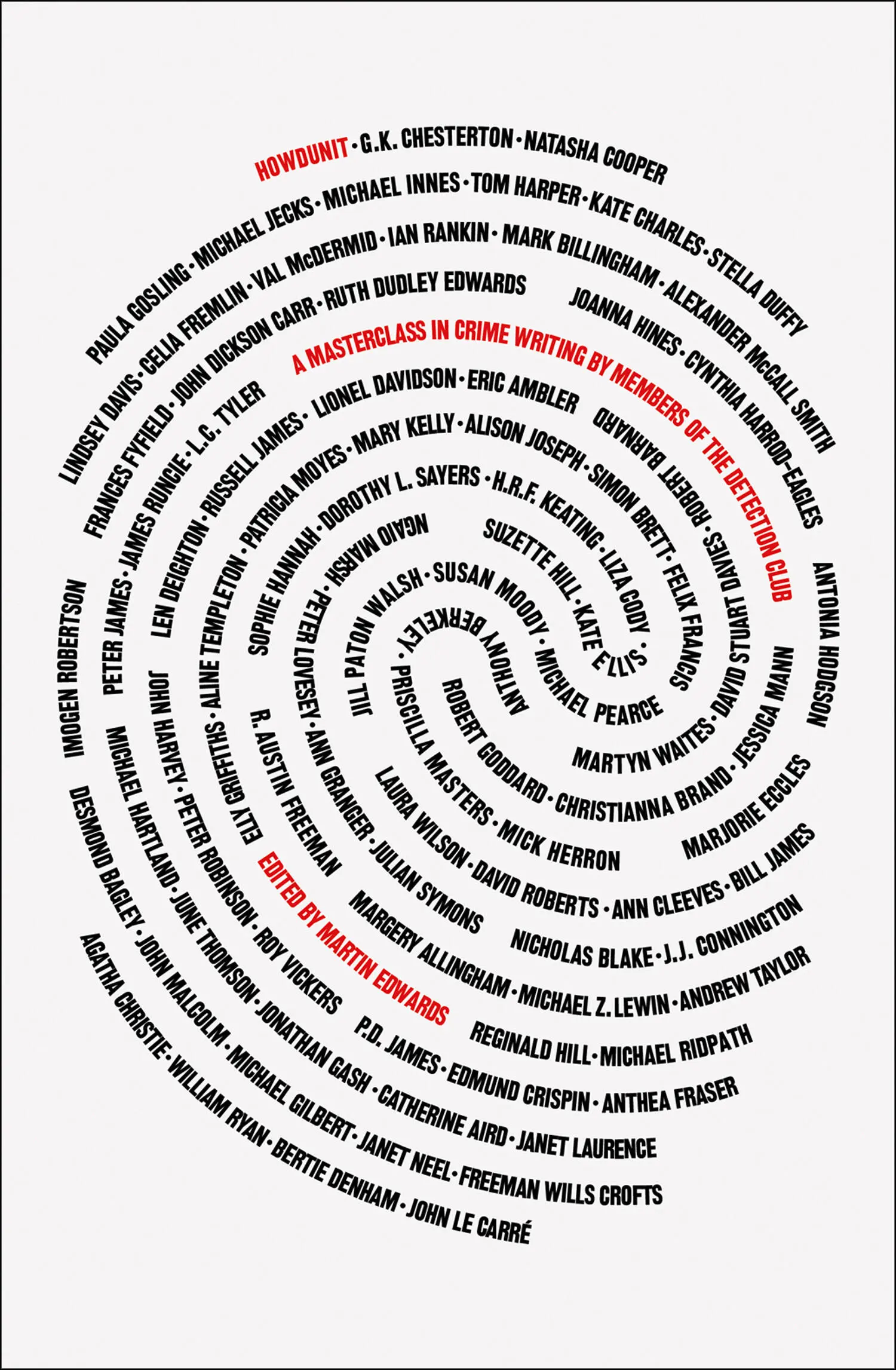
- Название:Howdunit
- Автор:
- Жанр:
- Год:неизвестен
- ISBN:нет данных
- Рейтинг книги:5 / 5. Голосов: 1
-
Избранное:Добавить в избранное
- Отзывы:
-
Ваша оценка:
Howdunit: краткое содержание, описание и аннотация
Предлагаем к чтению аннотацию, описание, краткое содержание или предисловие (зависит от того, что написал сам автор книги «Howdunit»). Если вы не нашли необходимую информацию о книге — напишите в комментариях, мы постараемся отыскать её.
Howdunit — читать онлайн ознакомительный отрывок
Ниже представлен текст книги, разбитый по страницам. Система сохранения места последней прочитанной страницы, позволяет с удобством читать онлайн бесплатно книгу «Howdunit», без необходимости каждый раз заново искать на чём Вы остановились. Поставьте закладку, и сможете в любой момент перейти на страницу, на которой закончили чтение.
Интервал:
Закладка:
Lastly, our idea may be simply to place the action in a definite setting, such as a mining setting, or a golf or fishing setting, or to lay our scenes in a certain place: a bus or an office, an opium den or Canterbury Cathedral.
We may of course build our book on some idea which does not fall under one of these heads. For instance, Dr Austin Freeman’s book, The Red Thumb Mark , was probably built on the idea that a fingerprint is not necessarily convincing evidence.
This then is the first stage in our work: getting the idea to start on. Our second stage is more difficult: we have to build up the plot on our idea.
We do this in a very simple, but very tedious way: we ask ourselves innumerable questions and think out the answers. One question invariably leads to another, and as we go on our plot gradually takes shape.

Nicholas Blake – the poet Cecil Day-Lewis – began writing ingenious Golden Age puzzles to earn some extra cash in the 1930s, but as time passed became increasingly ambitious as a detective novelist. Introducing an omnibus edition of his finest stories, he explained their diverse origins. Unluckily for him, one clever idea had already occurred to another crime writer, who later became a colleague in the Detection Club.
Sources of Inspiration
Nicholas Blake
Imagination at full stretch: emotional involvement … During the Thirties, I saw my little son narrowly missed by a road hog. Suppose he had been killed, and the police were unable to trace the hit-and-run driver? Such was the germ of The Beast Must Die . I tried to imagine myself into the mind of a man – a widower whose only child had been killed like this: how would he find the culprit, and how might he set about destroying him? Revenge, incidentally, seems to be the motive in quite a few of my detection novels, though I am not an overly vindictive person. Perhaps, if I had lived in the early seventeenth century, I would have turned out revenge dramas after the Jacobean pattern. But the point is that, if The Beast Must Die has a sharper edge than most of my thrillers, it is because it sprang from that initial involvement of my emotions, and because I was enabled thus to take the hero’s plight at a more serious imaginative level. This book has the one first-rate plot I have ever invented – a plot, by the way, which was no great shakes till, halfway through the book, I suddenly saw how the hero could use his diary.
The plot of A Tangled Web , on the other hand, was given to me gratis – by ‘The Case of the Hooded Man’, as Sir Patrick Hastings called it in his Memoirs, the first case in which that celebrated KC led for the defence. At Eastbourne early this century a policeman was shot by a burglar – a clergyman’s son who bore the most remarkable resemblance, in temperament and actions, to Hornung’s ‘Raffles’. Sir Patrick was chiefly concerned, in his book, with the legal aspects of the case. So I could exercise all my imagination in reconstructing the character of this young burglar, of his beautiful and innocent mistress, and of the ‘friend’ who proved to be their downfall – a man who, even through Sir Patrick’s factual account, shines out luridly as the nearest thing to Iago I have ever heard about in real life. My emotions, even at the distance of 45 years, became thoroughly involved with the burglar’s girl as I interpreted her. After the book was finished, inquiries among retired policemen who had taken part in the case discovered that several things I had imagined about the Iago character, though not mentioned at the trial, were in fact true.
The germ of A Penknife in my Heart was also given me. A friend suggested a story in which two men, previously unknown to each other and both needing to get rid of certain human encumbrances, meet by chance and decide to swap victims. Neither my friend nor I had read Patricia Highsmith’s Strangers on a Train , or seen the film Hitchcock made of it. Later, I found that Miss Highsmith’s treatment was entirely different from mine; but its starting-point was identical – and, horror of horrors, I had given two of my characters the same Christian names as she had used for two of hers. The plot of A Penknife in my Heart is the most ‘fictional’ of the three presented here, and the most diagrammatic. To put flesh on it, I had to work myself into the minds of two very different men – a coarse brute and a weaker, more sensitive character, plunge as deep as I could into their weird relationship, and be each of them as he made his murder-attempt (upon a complete stranger), and live with them through the aftermath. It needed a pretty strenuous stretching of the invention.
Even before the plot is constructed in detail (or not constructed, in the case of authors like Eric Ambler, who regard writing a crime story as a voyage of discovery) there comes another question. Which type of crime fiction to choose? How to put it all together? Anthea Fraser and Ann Granger, two highly experienced novelists who both worked in other genres before specializing in crime fiction, describe their personal approaches.
Making Choices
Anthea Fraser
Crime writing is a broad church, offering a choice of police procedural, supernatural, hard-boiled, ‘noir’, psychological or romantic suspense, espionage, thrillers or whodunits, though sometimes the sub-genres can blur at the edges and overlap. I came to crime writing myself by way of paranormal books, which were enjoying a vogue at the time. When public interest started to wane, my agent asked if I’d like to change genre, and realizing there’d been a crime in each of the paranormals, I found I’d already made my choice.
It’s important to remember that although you’ll be writing over a period of months, the reader might take only a few days to read the entire book, so the same ‘tone of voice’ should be kept throughout. Sometimes I can tell where I’ve stopped for the day by a very slight but noticeable change of style, so I always begin by rereading (and heavily editing) what I wrote the previous day to ensure it flows without a break.
The main aim, of course, is to grab the reader’s attention from page one, and there are various devices to achieve this. You could start with a prologue covering an event that, unknown to the characters, has already happened. Or begin with an explosive incident that hasn’t yet happened, but which the reader is awaiting with trepidation until it occurs later in the book . Or you could have a catalytic event taking place in ‘real time’ which is the actual starting point of the story – such as the discovery of a dead body.
Conflict is, of course, a necessary component to a good story, whether between lovers, police colleagues or family members, and can pave the way to any number of situations, often resulting in murder. However the maxim ‘Write about what you know’ just isn’t possible when you’re dealing with murder, and anyway, what price imagination? I turn it round to ‘Know about what you write’, and try to make sure I check my facts – thoroughly – easy these days with the internet. When writing a police procedural, however, there really is no substitute for personal contact with a friendly officer who is prepared to answer any number of queries you might raise. What’s more, they seem to enjoy it, and I used to send my contact a copy of each book to thank him for ‘helping with my enquiries’!
Читать дальшеИнтервал:
Закладка:
Похожие книги на «Howdunit»
Представляем Вашему вниманию похожие книги на «Howdunit» списком для выбора. Мы отобрали схожую по названию и смыслу литературу в надежде предоставить читателям больше вариантов отыскать новые, интересные, ещё непрочитанные произведения.


Обсуждение, отзывы о книге «Howdunit» и просто собственные мнения читателей. Оставьте ваши комментарии, напишите, что Вы думаете о произведении, его смысле или главных героях. Укажите что конкретно понравилось, а что нет, и почему Вы так считаете.