Michael Begon - Ecology
Здесь есть возможность читать онлайн «Michael Begon - Ecology» — ознакомительный отрывок электронной книги совершенно бесплатно, а после прочтения отрывка купить полную версию. В некоторых случаях можно слушать аудио, скачать через торрент в формате fb2 и присутствует краткое содержание. Жанр: unrecognised, на английском языке. Описание произведения, (предисловие) а так же отзывы посетителей доступны на портале библиотеки ЛибКат.
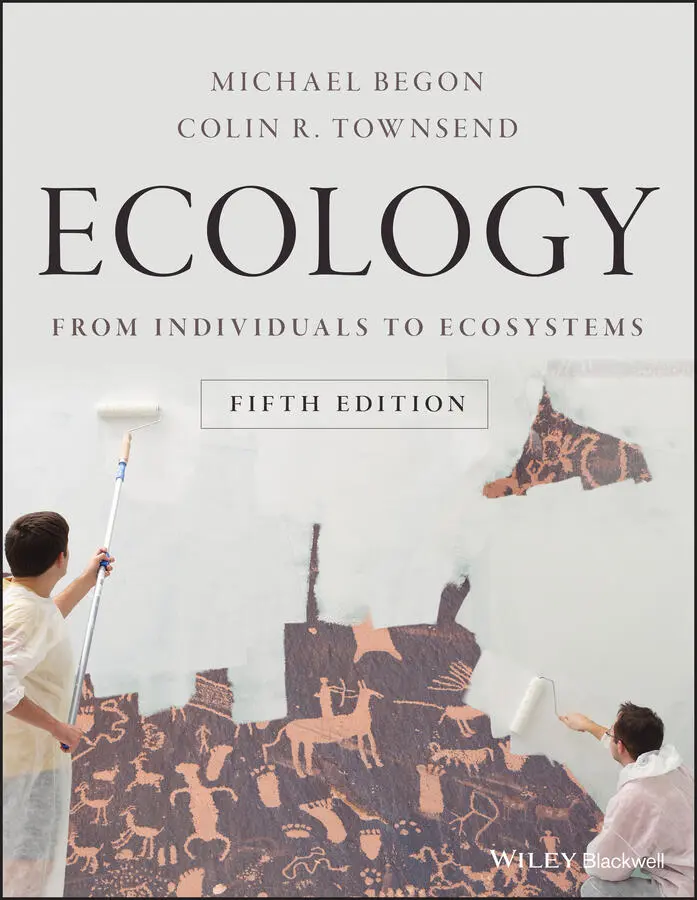
- Название:Ecology
- Автор:
- Жанр:
- Год:неизвестен
- ISBN:нет данных
- Рейтинг книги:5 / 5. Голосов: 1
-
Избранное:Добавить в избранное
- Отзывы:
-
Ваша оценка:
Ecology: краткое содержание, описание и аннотация
Предлагаем к чтению аннотацию, описание, краткое содержание или предисловие (зависит от того, что написал сам автор книги «Ecology»). Если вы не нашли необходимую информацию о книге — напишите в комментариях, мы постараемся отыскать её.
– now in full colour – offers students and practitioners a review of the ecological sciences.
The previous editions of this book earned the authors the prestigious ‘Exceptional Life-time Achievement Award’ of the British Ecological Society – the aim for the fifth edition is not only to maintain standards but indeed to enhance its coverage of Ecology.
In the first edition, 34 years ago, it seemed acceptable for ecologists to hold a comfortable, objective, not to say aloof position, from which the ecological communities around us were simply material for which we sought a scientific understanding. Now, we must accept the immediacy of the many environmental problems that threaten us and the responsibility of ecologists to play their full part in addressing these problems. This fifth edition addresses this challenge, with several chapters devoted entirely to applied topics, and examples of how ecological principles have been applied to problems facing us highlighted throughout the remaining nineteen chapters.
Nonetheless, the authors remain wedded to the belief that environmental action can only ever be as sound as the ecological principles on which it is based. Hence, while trying harder than ever to help improve preparedness for addressing the environmental problems of the years ahead, the book remains, in its essence, an exposition of the
of ecology. This new edition incorporates the results from more than a thousand recent studies into a fully up-to-date text.
Written for students of ecology, researchers and practitioners, the fifth edition of
is anessential reference to all aspects of ecology and addresses environmental problems of the future.
Ecology — читать онлайн ознакомительный отрывок
Ниже представлен текст книги, разбитый по страницам. Система сохранения места последней прочитанной страницы, позволяет с удобством читать онлайн бесплатно книгу «Ecology», без необходимости каждый раз заново искать на чём Вы остановились. Поставьте закладку, и сможете в любой момент перейти на страницу, на которой закончили чтение.
Интервал:
Закладка:
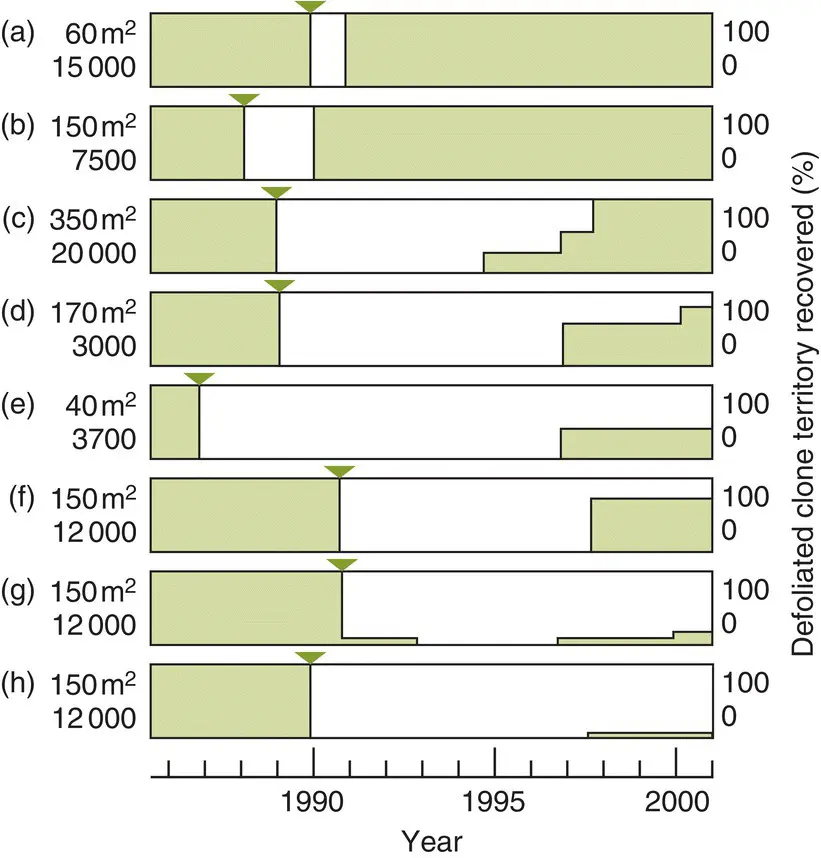
Figure 4.8 Dormancy in goldenrods is enforced by defoliation.The histories of eight Missouri goldenrod ( Solidago missouriensis ) clones (rows a–h). Each clone’s predefoliation area (m 2) and estimated number of ramets is given on the left. The panels show a 15‐year record of the presence (shading) and absence of ramets in each clone’s territory. The arrowheads show the beginning of dormancy, initiated by eruption of the beetle Trirhabda canadensis and defoliation. Reoccupation of entire or major segments of the original clone’s territory by postdormancy ramets is expressed as the percentage of the original clone’s territory.
Source : After Morrow & Olfelt (2003).
Most of the species of plants with seeds that persist for long in the soil are annuals and biennials, and they are mainly weedy species – opportunists waiting (literally) for an opening. They largely lack features that will disperse them extensively in space. The seeds of trees, by contrast, usually have a very short expectation of life in the soil, and many are extremely difficult to store artificially for more than one year. The seeds of many tropical trees are particularly short‐lived: a matter of weeks or even days. Amongst trees, the most striking longevity is seen in those that retain the seeds in cones or pods on the tree until they are released after fire (many species of Eucalyptus and Pinus ). This phenomenon of serotiny protects the seeds against risks on the ground until fire creates an environment suitable for their rapid establishment.
4.6 Monitoring birth and death: life tables, survivorships curves and fecundity schedules
We turn now to look in more detail at the patterns of birth and death in a variety of life cycles, and at how these patterns are quantified. Often, in order to monitor and examine changing patterns of mortality with age or stage, a life table may be drawn up. This allows a survivorship curve to be constructed, which traces the decline in numbers, over time, of a group of newly born or newly emerged individuals or modules. It can also be thought of as a plot of the probability, for a representative newly born individual, of surviving to various ages. Patterns of birth amongst individuals of different ages are often monitored at the same time as life tables are constructed. These patterns are displayed in age‐specific fecundity schedules .
The underlying principles are explained in Figure 4.9. There, a population is portrayed as a series of diagonal lines, each line representing the life ‘track’ of an individual. As time passes, each individual ages (moves from bottom‐left to top‐right along its track) and eventually dies (the dot at the end of the track). Here, individuals are classified by their age. In other cases it may be more appropriate to split the life of each individual into different developmental stages.

Figure 4.9 Derivation of cohort and static life tables.See text for details.
Time is divided into successive periods: t 0, t 1, etc. In the present case, three individuals were born (started their life track) prior to the time period t 0, four during t 0, and three during t 1. To construct a cohort life table, we direct our attention to a particular cohort and monitor what happens to them subsequently. Here we focus on those born during t 0. The life table is constructed by noting the number surviving to the start of each time period. So, four were there at the beginning of t 1, two of the four survived to the beginning of t 2; only one of these was alive at the beginning of t 3; and none survived to the start of t 4. The first data column of a cohort life table for these individuals would thus comprise the series of declining numbers in the cohort: 4, 2, 1, 0.
A different approach is necessary when we cannot follow cohorts but we know the ages of all the individuals in a population (perhaps from some clue such as the condition of the teeth in a species of deer). We can then, as the figure shows, direct our attention to the whole population during a single period (in this case, t 1) and note the numbers of survivors of different ages in the population. These may be thought of as entries in a life table if we assume that rates of birth and death are, and have previously been, constant – a very big assumption. What results is called a static life table. Here, of the 11 individuals alive during t 1, five were actually born during t 1and are hence in the youngest age group, four were born in the previous time interval, two in the interval before that, and none in the interval before that. The first data column of the static life table thus comprises the series 5, 4, 2, 0. This amounts to saying that over these time intervals, a typical cohort will have started with five and declined over successive time intervals to four, then two, then zero.
4.6.1 Cohort life tables
To monitor and quantify survival, we may follow the fate of individuals from the same cohort within a population: that is, all individuals born within a particular period. The life table then records the survivorship of the members of the cohort over time ( Figure 4.9). The most straightforward life table to construct is a cohort life table for an annual species. Putting to one side the caveats raised above, annual life cycles take approximately 12 months or rather less to complete ( Figure 4.6b, c). Usually, every individual in a population breeds during one particular season of the year, but then dies before the same season in the next year. Generations are therefore said to be discrete, and each cohort is distinguishable from every other; the only overlap of generations is between breeding adults and their offspring during and immediately after the breeding season.
an annual life table for a plant
Two very simple life tables, for inland and coastal subspecies of the annual plant Gilia capitata , growing in California, USA are shown in Table 4.1. Initial cohorts of around 750 seeds were followed from seed germination to the death of the last adult.
Table 4.1 Two cohort life tables for the annual plant Gilia capitata.One is for the ‘inland’ subspecies, G. capitata capitata , and one for the ‘coastal’ subspecies, G. capitata chamissonis , growing at an inland site in Napa County, California, USA and being easily distinguishable morphologically, despite being cross‐fertile. Cohorts of seeds were planted at the beginning of the season in 1993 and the life cycle divided simply into seeds, plants that emerged from those seeds, and emerged plants that went on to flower. Other column entries are explained in the text. Source : After Nagy & Rice (1997).
| Stage (x) | Number alive at the start of each age class ax | Proportion of original cohort surviving to the start of each age class lx | dx | qx | log ax | log lx | kx | Number of female young produced by each age class Fx | Number of female young produced per surviving individual in each age class mx | Number of female young produced per original individual in each age class lxmx |
|---|---|---|---|---|---|---|---|---|---|---|
| Inland subspecies: | ||||||||||
| Seed (0) | 746 | 1.00 | 0.66 | 0.66 | 2.87 | 0.00 | 0.47 | 0 | 0 | 0 |
| Emergence (1) | 254 | 0.34 | 0.25 | 0.74 | 2.40 | –0.47 | 0.59 | 0 | 0 | 0 |
| Flowering (2) | 66 | 0.09 | 1.82 | –1.05 | 28,552 | 432.61 | 38.29 | |||
| Coastal subspecies: | ||||||||||
| Seed (0) | 754 | 1.00 | 0.73 | 0.73 | 2.88 | 0.00 | 0.57 | 0 | 0 | 0 |
| Emergence (1) | 204 | 0.27 | 0.25 | 0.91 | 2.31 | –0.57 | 1.03 | 0 | 0 | 0 |
| Flowering (2) | 19 | 0.03 | 1.28 | –1.60 | 8645 | 455.00 | 11.47 |
a cohort life table for marmots
Читать дальшеИнтервал:
Закладка:
Похожие книги на «Ecology»
Представляем Вашему вниманию похожие книги на «Ecology» списком для выбора. Мы отобрали схожую по названию и смыслу литературу в надежде предоставить читателям больше вариантов отыскать новые, интересные, ещё непрочитанные произведения.







Обсуждение, отзывы о книге «Ecology» и просто собственные мнения читателей. Оставьте ваши комментарии, напишите, что Вы думаете о произведении, его смысле или главных героях. Укажите что конкретно понравилось, а что нет, и почему Вы так считаете.