Alain Lempereur - Mediation
Здесь есть возможность читать онлайн «Alain Lempereur - Mediation» — ознакомительный отрывок электронной книги совершенно бесплатно, а после прочтения отрывка купить полную версию. В некоторых случаях можно слушать аудио, скачать через торрент в формате fb2 и присутствует краткое содержание. Жанр: unrecognised, на английском языке. Описание произведения, (предисловие) а так же отзывы посетителей доступны на портале библиотеки ЛибКат.
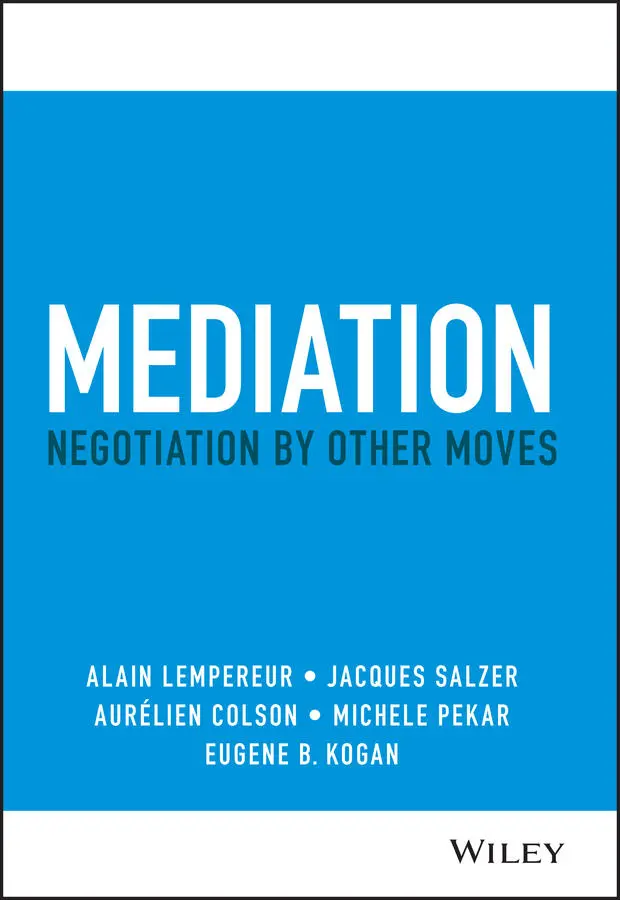
- Название:Mediation
- Автор:
- Жанр:
- Год:неизвестен
- ISBN:нет данных
- Рейтинг книги:3 / 5. Голосов: 1
-
Избранное:Добавить в избранное
- Отзывы:
-
Ваша оценка:
Mediation: краткое содержание, описание и аннотация
Предлагаем к чтению аннотацию, описание, краткое содержание или предисловие (зависит от того, что написал сам автор книги «Mediation»). Если вы не нашли необходимую информацию о книге — напишите в комментариях, мы постараемся отыскать её.
Mediation: Negotiation by Other Moves Models and principles from various domains of mediation: family, business & labor, public affairs, international relations A mediation framework to prepare for mediation and to run its process smoothly A step-by-step approach to a mediation session, from the opening until a possible settlement, via the various phases of problem solving Mediation traps and how to avoid them—for mediators and parties alike Ethics of mediation and questions of responsibility
is essential reading for anyone who wishes to develop a pragmatic approach to mediation.
Mediation — читать онлайн ознакомительный отрывок
Ниже представлен текст книги, разбитый по страницам. Система сохранения места последней прочитанной страницы, позволяет с удобством читать онлайн бесплатно книгу «Mediation», без необходимости каждый раз заново искать на чём Вы остановились. Поставьте закладку, и сможете в любой момент перейти на страницу, на которой закончили чтение.
Интервал:
Закладка:
TABLE 1.5
| What about the time factor? | |
|---|---|
| A unique encounter . | Several successive meetings . |
| Brevity of meeting – For example, 1.5 to 4 hours in criminal or family mediation. | “Marathon” meeting – Mediation proceeds continuously over a weekend, a few days, or even weeks. For example, a dispute between banks in different countries – brought to court for two years – was resolved within a week by intensive mediation. |
| Short in total – Mediation focuses on a meeting of a few hours. | Long‐lasting in total – Mediation spans several days, even months or even years. |
| Where? | |
| In a “neutral” space – A place equidistant between the parties, the premises of a mediation center or a town hall. | At the place of the dispute, or on the premises of one party with the agreement of the other – For example, on the construction site where the damage occurred. |
| Agreement and post‐mediation | |
| With suggestions for solutions from the parties . | With suggestions for solutions from mediators . |
| With a final written agreement – Written by the parties themselves, or their lawyers, or mediators, or a combination of the above. This written agreement can be approved by a court to ensure enforceability. | With a final oral agreement . |
| With the existence of a follow‐up – Verification with mediators of the next steps of implementation and completion of the agreement. | Without follow‐up – Follow‐up is left to the parties themselves. |
| With post‐mediation debrief – The mediation, once completed, is the subject of an analysis of practices, and of exchange between mediators. | Without post‐mediation debrief – Without organized exchanges of reflection between peers on past mediations. |
Of course, a given mediation can simultaneously combine a set of elements taken from both columns of the tables above. This diversity is further increased if we look at the variety of mediation sequences, an aspect covered in greater detail in Chapters 5to 7. This sequence varies, depending on the number of parties, the habits and training of the mediators, the technical nature of the case, the refusal of one of the parties to physically meet the other, the tensions between the parties, etc. Finally, this variety also contributes to the irreducible diversity of personalities: no mediator is like another, depending on their training, their specialization in this or that sector, their past experiences, their personal qualities, openness and attentiveness, authority, or objectivity. Mediation is a deeply human process with many variations (Fiutak 2009).
Conclusion: An Overflow of Methods or a Lack Thereof?
Mediation illustrates the 2000 European Union motto: “United in Diversity ” (In Varietate Concordia) . Behind a constant – the desire to contribute to the peaceful resolution of conflicts between parties, based on their acceptance of an approach characterized by its dynamism and plasticity – appears the variability of practices. However, this mediation effervescence should not obscure several risks.
The first risk is the trivialization of mediation, of its use in any situation, leading to some mediation mania . It is useful to identify precisely when and why to engage in a mediation process, or otherwise rely on other intervention mechanisms. This refers to the relevance of mediation, and its application criteria, which is treated in Chapter 2.
Aboard an airplane, a pointless mediation
The use of micro‐mediation can reflect the growing difficulty of fellow human beings to communicate directly with each other in order to settle small disputes. On planes, when a passenger was annoyed by a neighbor (conventionally, the knee kick in the seat, or the backrest too tilted during a meal), the matter would be settled directly with the fellow traveler. Airline companies have noted the increasing propensity of passengers to ask for help from flight attendants, rather than attempt a direct resolution of their conflict by relying on the elementary rules of civil request by conversation.
A corollary to the previous one, the second risk is the absence of methods: whether they may be ignorant of the existence of methods, or, on the contrary, disturbed by the apparent relativism that draws from a diversity of possible methods, would‐be mediators might rely on their own instincts only. This risk concerns each of us when we are called upon to take on the role of informal mediators. But the other models – institutional mediators and ad hoc mediators – are not immune to this pitfall either.
Moreover, a third risk is unsuitable methods; i.e. mediators apply patterns and reflexes inherited from their previous professional experience in other functions. This is the case, in particular, of the institutional and ad hoc mediators, who find themselves minutely supervised when planning the mediation but in the end are left fairly on their own during the actual mediation process.
Even mediation professionals may lack methods
Criminal mediators, sometimes chosen from among former judges or police commissioners, might see mediation as a subset of a criminal lawsuit, without necessarily reaping all the potential of a more methodical approach including gaining a mutual understanding of the causes that led to a criminal offense.
Some mediators, who are often efficient in the search for solutions, seem less focused on the reconciliation between people. In this case, it is a question of working, also, if necessary, on the relationship on top of the concrete problem at stake.
A mediation process entails its own methodological requirements. To ignore them, or to apply inadequate ones that are fundamentally foreign to it, is to risk the failure of mediation, or in any case to deprive oneself of assets in favor of the resolution of the conflict.
Hence this book: it is not about proposing the method – as if only one method exists – but rather about synthesizing methods, drawing from enough sources and tempered by enough experiences to be applied flexibly to most contexts. It is not a question here of limiting oneself to a single model, but of being inspired by several, to unfold an approach that allows each mediator to find their own ways of engaging in mediation. In doing so, we will try to bring as much to experienced mediators – who are sometimes so comfortable employing a single method that they end up ignoring others that may be useful – as to beginners – who venture in this delicate path with, depending on their personalities, either the misleading feeling of knowing it all or the paralyzing impression of not knowing anything.
To structure this method, mediators and parties in conflict can rely on what we call the Seven Pillars of Mediation, which we will develop in the following chapters.
The Seven Pillars of Mediation
1 Solicit the Parties permanently so that they take ownership of the resolution mechanism, by mobilizing active communication between them and seeking progressively some mutual recognition.
2 Secure Principles, that is to say the “rules of engagement,” which will allow everyone to stay on course with problem‐solving.
3 Sequence Phases in this process, with various stages, from the establishment of mediation to, if possible, an agreement.
4 Seize the Problem, and its various data, by an in‐depth analysis of its dimensions.
Читать дальшеИнтервал:
Закладка:
Похожие книги на «Mediation»
Представляем Вашему вниманию похожие книги на «Mediation» списком для выбора. Мы отобрали схожую по названию и смыслу литературу в надежде предоставить читателям больше вариантов отыскать новые, интересные, ещё непрочитанные произведения.




Обсуждение, отзывы о книге «Mediation» и просто собственные мнения читателей. Оставьте ваши комментарии, напишите, что Вы думаете о произведении, его смысле или главных героях. Укажите что конкретно понравилось, а что нет, и почему Вы так считаете.