Patrick Muldowney - Gauge Integral Structures for Stochastic Calculus and Quantum Electrodynamics
Здесь есть возможность читать онлайн «Patrick Muldowney - Gauge Integral Structures for Stochastic Calculus and Quantum Electrodynamics» — ознакомительный отрывок электронной книги совершенно бесплатно, а после прочтения отрывка купить полную версию. В некоторых случаях можно слушать аудио, скачать через торрент в формате fb2 и присутствует краткое содержание. Жанр: unrecognised, на английском языке. Описание произведения, (предисловие) а так же отзывы посетителей доступны на портале библиотеки ЛибКат.
- Название:Gauge Integral Structures for Stochastic Calculus and Quantum Electrodynamics
- Автор:
- Жанр:
- Год:неизвестен
- ISBN:нет данных
- Рейтинг книги:3 / 5. Голосов: 1
-
Избранное:Добавить в избранное
- Отзывы:
-
Ваша оценка:
Gauge Integral Structures for Stochastic Calculus and Quantum Electrodynamics: краткое содержание, описание и аннотация
Предлагаем к чтению аннотацию, описание, краткое содержание или предисловие (зависит от того, что написал сам автор книги «Gauge Integral Structures for Stochastic Calculus and Quantum Electrodynamics»). Если вы не нашли необходимую информацию о книге — напишите в комментариях, мы постараемся отыскать её.
, left off,
introduces readers to particular problems of integration in the probability-like theory of quantum mechanics. Written as a motivational explanation of the key points of the underlying mathematical theory, and including ample illustrations of the calculus, this book relies heavily on the mathematical theory set out in the author’s previous work. That said, this work stands alone and does not require a reading of
in order to be understandable.
Gauge Integral Structures for Stochastic Calculus and Quantum Electrodynamics Stochastic calculus, including discussions of random variation, integration and probability, and stochastic processes. Field theory, including discussions of gauges for product spaces and quantum electrodynamics. Robust and thorough appendices, examples, illustrations, and introductions for each of the concepts discussed within. An introduction to basic gauge integral theory. The methods employed in this book show, for instance, that it is no longer necessary to resort to unreliable «Black Box» theory in financial calculus; that full mathematical rigor can now be combined with clarity and simplicity. Perfect for students and academics with even a passing interest in the application of the gauge integral technique pioneered by R. Henstock and J. Kurzweil,
is an illuminating and insightful exploration of the complex mathematical topics contained within.
Gauge Integral Structures for Stochastic Calculus and Quantum Electrodynamics — читать онлайн ознакомительный отрывок
Ниже представлен текст книги, разбитый по страницам. Система сохранения места последней прочитанной страницы, позволяет с удобством читать онлайн бесплатно книгу «Gauge Integral Structures for Stochastic Calculus and Quantum Electrodynamics», без необходимости каждый раз заново искать на чём Вы остановились. Поставьте закладку, и сможете в любой момент перейти на страницу, на которой закончили чтение.
Интервал:
Закладка:
Let  represent sample values (or potential occurrences) of the random variables
  . For any given j , i can have value

so  is the set of permutations, with repetition, of the numbers
  taken n at a time.
The ideas in I1, I2, I3, I4) suggest the following sample values for the stochastic integral 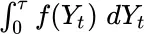 (or “
(or “ 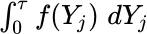 ”):
”):
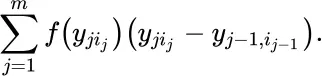
The subscript  labels the random variability in this calculation, and demonstrates that this version of the stochastic integral can take
  possible values; though not all of the possible values are necessarily distinct.
For further simplification, take  and
and  ; so, at each of times
  (
( 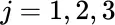 ), the random variable
  can take one of two possible values,
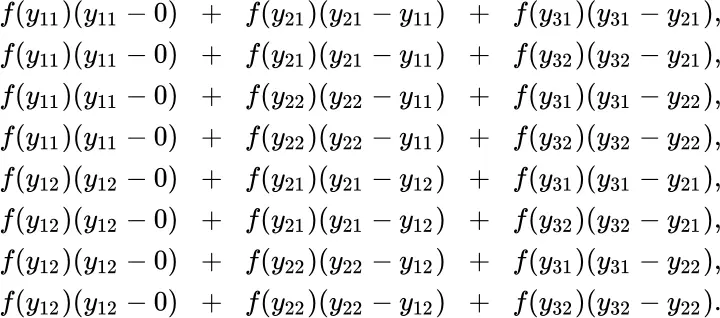
  . Then, by enumerating the permutations with repetition of
  things taken
  at a time , the 8 possible sample values of the stochastic integral
 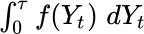 are:
are:
Now suppose that the deterministic function f is exponentiation to the power of 2 (so 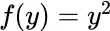 ); and suppose the random variable
  (or
(or  above) has sample values
  and
and  with equal probabilities
  . Calculating each of the above expressions, the 8 sample evaluations of the stochastic integral
  are, respectively,

each having equal probability; so the distinct sample values of the random variable X are  ,
,  with equal probabilities
  . Thus it happens, in this case, that the stochastic integral has the same sample space
  , and the same probabilities, as each of the random variables
  .
.
This example gets round the technical problem of measurability by discretizing the domains  and
and  , and using only function
  , which are step functions in respect of their dependence on t and
  .
.
Интервал:
Закладка:
Похожие книги на «Gauge Integral Structures for Stochastic Calculus and Quantum Electrodynamics»
Представляем Вашему вниманию похожие книги на «Gauge Integral Structures for Stochastic Calculus and Quantum Electrodynamics» списком для выбора. Мы отобрали схожую по названию и смыслу литературу в надежде предоставить читателям больше вариантов отыскать новые, интересные, ещё непрочитанные произведения.











Обсуждение, отзывы о книге «Gauge Integral Structures for Stochastic Calculus and Quantum Electrodynamics» и просто собственные мнения читателей. Оставьте ваши комментарии, напишите, что Вы думаете о произведении, его смысле или главных героях. Укажите что конкретно понравилось, а что нет, и почему Вы так считаете.