Bioethics
Здесь есть возможность читать онлайн «Bioethics» — ознакомительный отрывок электронной книги совершенно бесплатно, а после прочтения отрывка купить полную версию. В некоторых случаях можно слушать аудио, скачать через торрент в формате fb2 и присутствует краткое содержание. Жанр: unrecognised, на английском языке. Описание произведения, (предисловие) а так же отзывы посетителей доступны на портале библиотеки ЛибКат.
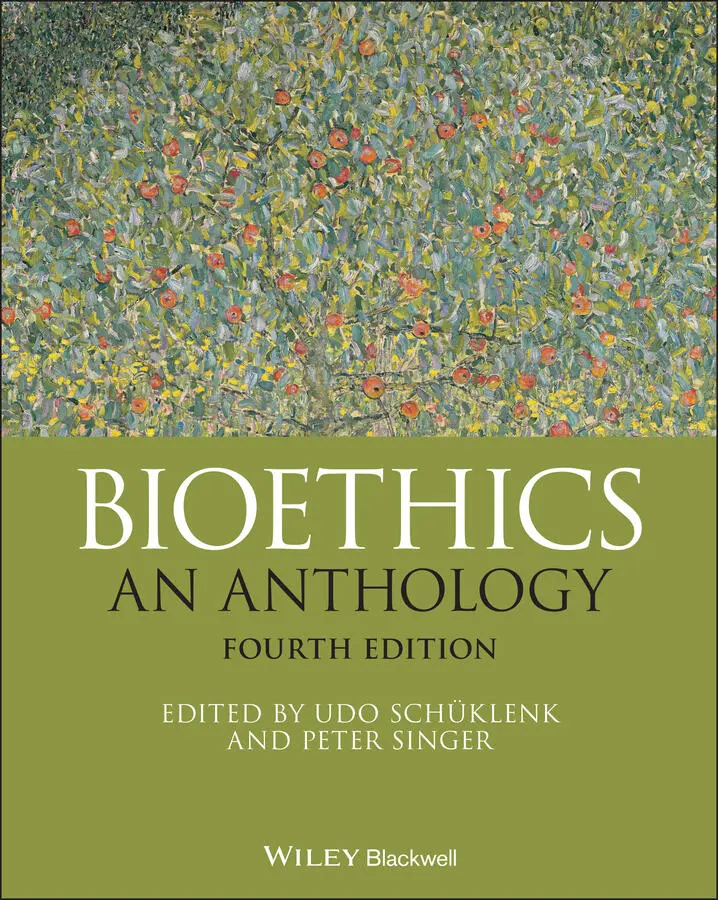
- Название:Bioethics
- Автор:
- Жанр:
- Год:неизвестен
- ISBN:нет данных
- Рейтинг книги:4 / 5. Голосов: 1
-
Избранное:Добавить в избранное
- Отзывы:
-
Ваша оценка:
Bioethics: краткое содержание, описание и аннотация
Предлагаем к чтению аннотацию, описание, краткое содержание или предисловие (зависит от того, что написал сам автор книги «Bioethics»). Если вы не нашли необходимую информацию о книге — напишите в комментариях, мы постараемся отыскать её.
For more than two decades,
has been widely regarded as the definitive single-volume compendium of seminal readings on both traditional and cutting-edge ethical issues in biology and medicine. Acclaimed for its scope and depth of coverage, this landmark work brings together compelling writings by internationally-renowned bioethicist to help readers develop a thorough understanding of the central ideas, critical issues, and current debate in the field.
Now fully revised and updated, the fourth edition contains a wealth of new content on ethical questions and controversies related to the COVID-19 pandemic, advances in CRISPR gene editing technology, physician-assisted death, public health and vaccinations, transgender children, medical aid in dying, the morality of ending the lives of newborns, and much more. Throughout the new edition, carefully selected essays explore a wide range of topics and offer diverse perspectives that underscore the interdisciplinary nature of bioethical study. Edited by two of the field’s most respected scholars, Covers an unparalleled range of thematically-organized topics in a single volume Discusses recent high-profile cases, debates, and ethical issues Features three brand-new sections: Conscientious Objection, Academic Freedom and Research, and Disability Contains new essays on topics such as brain death, life and death decisions for the critically ill, experiments on humans and animals, neuroethics, and the use of drugs to ease the pain of unrequited love Includes a detailed index that allows the reader to easily find terms and topics of interest
remains a must-have resource for all students, lecturers, and researchers studying the ethical implications of the health-related life sciences, and an invaluable reference for doctors, nurses, and other professionals working in health care and the biomedical sciences.
Bioethics — читать онлайн ознакомительный отрывок
Ниже представлен текст книги, разбитый по страницам. Система сохранения места последней прочитанной страницы, позволяет с удобством читать онлайн бесплатно книгу «Bioethics», без необходимости каждый раз заново искать на чём Вы остановились. Поставьте закладку, и сможете в любой момент перейти на страницу, на которой закончили чтение.
Интервал:
Закладка:
To evaluate this argument, one needs to consider what type of conclusion one might draw as a result of observing the earlier life of someone with the same genetic makeup as oneself. Suppose that one had observed someone striving very hard, over a long stretch of time, to achieve some goal and failing to get anywhere near it. Perhaps the earlier, genetically identical individual wanted to be the first person to run the marathon in under two hours, and after several years of intense and well‐designed training, attention to diet, etc., never got below two and a half hours. Surely one would then be justified in viewing that particular goal as not really open to one. But would that knowledge be a bad thing, as Jonas seems to be suggesting? Would not such knowledge, on the contrary, be valuable, by making it easier to choose goals that one could successfully pursue?
A very different possibility is that, observing the life of the genetically identical individual, one concludes that no life significantly different from that life could really be open to one. Then one would certainly feel that one's life was constrained to a very unwelcome extent. That conclusion, however, would be one that is unsupported by the evidence; indeed, one that there is excellent evidence against.
First of all, although identical twins can be very similar in some striking ways, they can also have lives that are quite different. Secondly, as Pinker points out (1997, 35), one’s genes do not contain sufficient information to fix the wiring in one’s brain, and the differences may be very important with regard to the traits one develops. Thirdly, as was noted earlier, it is a well‐established scientific fact that the traits of identical twins display a correlation of only about 50%, so the scope for a different life is very significant – even more so with clones than with identical twins, given that a clone develops inside a different womb, and then is raised by a different family, and belongs to a different peer group. The belief that the course of a clone’s life would be seriously constrained is, therefore, not a defensible belief.
In conclusion, then, it seems that this second argument for the view that cloning with the goal of producing persons is intrinsically wrong is unsound.
3.1.3 Causing psychological distress
This objection is closely related to the two preceding, violation‐of‐rights objections, as the idea is that, even if cloning does not violate a person's right to be a unique individual, or to have a unique genetic makeup, or to have an open and unconstrained future, nevertheless, people who are clones may feel that their uniqueness is compromised, or that their future is constrained, and this may cause substantial psychological harm.
There is, however, a good reason for viewing this objection as unsound. It emerges once one reflects upon the beliefs in question – namely, the belief that one's uniqueness is compromised by the existence of a clone, or the belief that one's future is constrained if one has knowledge of the existence of a clone. Both beliefs are, as we have seen, false. In addition, however, it also seems plausible that those beliefs would be, in general, irrational, since it is hard to see what grounds one could have for accepting either belief, other than something like genetic determinism – against which, as we have seen, there is conclusive evidence. If, however, the psychological distress would necessarily be due to irrational beliefs, the solution is readily at hand: if cloning that produces persons were allowed, society would need to act to ensure that cloned individuals did not acquire an irrational belief in genetic determinism, thereby preventing the distress that might otherwise arise from a false and irrational belief.
Notice, too, what would happen if cloning became a familiar occurrence, and suppose that society had somehow failed to ensure that John, who is a clone, did not acquire the false beliefs in question, and that John has come to feel that he is no longer a unique individual, or that his future is constrained. If Mary is also a clone, she may point out to John that she is different from the person with whom she is genetically identical, and that she has not been constrained by the way the other person lived her life. Would John still persist in his irrational belief? That does not seem likely. Accordingly, distress that might arise in such a case seems unlikely to persist for any significant length of time.
3.1.4 Failing to treat individuals as ends in themselves
A fourth objection applies, not to the cloning of persons in general, but to certain cases – such as where parents clone a child who is suffering from some life‐threatening condition in order to produce another child who can save the first child's life – and the contention is that such cases involve a failure to treat individuals as ends in themselves. Thus Philip Kitcher, referring to such cases, says that “a lingering concern remains,” and he goes on to ask whether such scenarios “can be reconciled with Kant's injunction to 'treat humanity, whether in your own person or in the person of another, always at the same time as an end and never simply as a means’” (1997, 61).
What is one to say about this objection? In thinking about it, it seems important to specify what sacrifices the child being produced will have to make to save his or her sibling. Kitcher, in his formulation, assumes that it will be a kidney transplant, which is a very significant sacrifice indeed, since it may have unhappy consequences for that person in the future. Consequently, I think that Kitcher’s case seriously clouds one’s thinking about this general type of case. Let us suppose, instead, then – as in the non‐cloning case to be mentioned later – that the cloned child will instead be the source for a bone marrow transfer that will save the life of a sibling who would otherwise die from leukemia.
In such a case, would there be a violation of Kant's injunction? There could be – if the parents abandoned, or did not really care for the one child, once he or she had provided bone marrow to save the life of the other child. This, however, would surely be a very unlikely occurrence. After all, the history of the human race is the history of largely unplanned children, often born into situations where the parents are anything but well off, and yet typically those children are deeply loved by their parents.
In short, though this type of case is by hypothesis one where the parents have a child with a goal in mind that, in itself, has nothing to do with the well‐being of that child, this is no reason for supposing that they are therefore likely to treat that child merely as a means, and not also as an end in itself. Indeed, surely there is good reason to think, on the contrary, that such a child will be raised in no less loving a way than is normally the case.
3.1.5 Interfering with personal autonomy
The final objection – also advanced by Philip Kitcher – is as follows: “If the cloning of human beings is undertaken in the hope of generating a particular kind of person, then cloning is morally repugnant. The repugnance arises not because cloning involves biological tinkering but because it interferes with human autonomy” (1997, 61).
What is one to say about this objection? First, notice that where one's goal is to produce “a particular kind of person,” what one is sometimes aiming at is simply a person who will have certain potentialities . Parents might, for example, want to have children who would be capable of enjoying intellectual pursuits, or who could enjoy classical music, or the playing of instruments, or who could, if they so chose, excel at various physical activities, such as golf or skiing. The parents would not be forcing the children to engage in such pursuits, so it is hard to see how cloning that is directed at such goals need involve any interference with human autonomy.
Читать дальшеИнтервал:
Закладка:
Похожие книги на «Bioethics»
Представляем Вашему вниманию похожие книги на «Bioethics» списком для выбора. Мы отобрали схожую по названию и смыслу литературу в надежде предоставить читателям больше вариантов отыскать новые, интересные, ещё непрочитанные произведения.

Обсуждение, отзывы о книге «Bioethics» и просто собственные мнения читателей. Оставьте ваши комментарии, напишите, что Вы думаете о произведении, его смысле или главных героях. Укажите что конкретно понравилось, а что нет, и почему Вы так считаете.