Bioethics
Здесь есть возможность читать онлайн «Bioethics» — ознакомительный отрывок электронной книги совершенно бесплатно, а после прочтения отрывка купить полную версию. В некоторых случаях можно слушать аудио, скачать через торрент в формате fb2 и присутствует краткое содержание. Жанр: unrecognised, на английском языке. Описание произведения, (предисловие) а так же отзывы посетителей доступны на портале библиотеки ЛибКат.
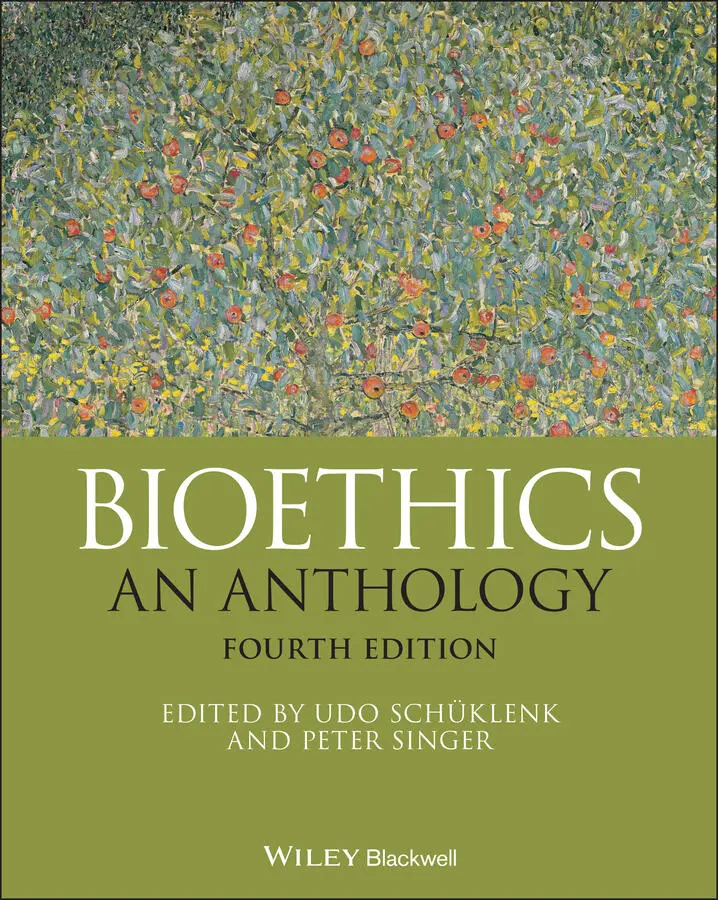
- Название:Bioethics
- Автор:
- Жанр:
- Год:неизвестен
- ISBN:нет данных
- Рейтинг книги:4 / 5. Голосов: 1
-
Избранное:Добавить в избранное
- Отзывы:
-
Ваша оценка:
Bioethics: краткое содержание, описание и аннотация
Предлагаем к чтению аннотацию, описание, краткое содержание или предисловие (зависит от того, что написал сам автор книги «Bioethics»). Если вы не нашли необходимую информацию о книге — напишите в комментариях, мы постараемся отыскать её.
For more than two decades,
has been widely regarded as the definitive single-volume compendium of seminal readings on both traditional and cutting-edge ethical issues in biology and medicine. Acclaimed for its scope and depth of coverage, this landmark work brings together compelling writings by internationally-renowned bioethicist to help readers develop a thorough understanding of the central ideas, critical issues, and current debate in the field.
Now fully revised and updated, the fourth edition contains a wealth of new content on ethical questions and controversies related to the COVID-19 pandemic, advances in CRISPR gene editing technology, physician-assisted death, public health and vaccinations, transgender children, medical aid in dying, the morality of ending the lives of newborns, and much more. Throughout the new edition, carefully selected essays explore a wide range of topics and offer diverse perspectives that underscore the interdisciplinary nature of bioethical study. Edited by two of the field’s most respected scholars, Covers an unparalleled range of thematically-organized topics in a single volume Discusses recent high-profile cases, debates, and ethical issues Features three brand-new sections: Conscientious Objection, Academic Freedom and Research, and Disability Contains new essays on topics such as brain death, life and death decisions for the critically ill, experiments on humans and animals, neuroethics, and the use of drugs to ease the pain of unrequited love Includes a detailed index that allows the reader to easily find terms and topics of interest
remains a must-have resource for all students, lecturers, and researchers studying the ethical implications of the health-related life sciences, and an invaluable reference for doctors, nurses, and other professionals working in health care and the biomedical sciences.
Bioethics — читать онлайн ознакомительный отрывок
Ниже представлен текст книги, разбитый по страницам. Система сохранения места последней прочитанной страницы, позволяет с удобством читать онлайн бесплатно книгу «Bioethics», без необходимости каждый раз заново искать на чём Вы остановились. Поставьте закладку, и сможете в любой момент перейти на страницу, на которой закончили чтение.
Интервал:
Закладка:
However, one can also offer positive arguments against the claim. One can appeal, for example, to intuitions that one has upon reflection. Thus, one can consider the case of identical twins, and ask oneself whether, upon reflection, one thinks that it would be prima facie wrong to reproduce if one somehow knew that doing so would result in identical twins. I think it would be surprising if many people felt that this was so.
Another way of approaching the issue is by appealing to some plausible general theory of rights. Thus, for example, I am inclined to think that rights exist where there are serious, self‐regarding interests that deserve to be protected. If some such view is correct, one can then approach the question of whether persons have a right to a genetically unique nature by asking whether there is some serious, self‐regarding interest that would be impaired if one were a clone. An initial reason for thinking that this is not so is that the existence of the person from whom one was cloned does not seem to impinge upon one in the way in which being injured, or being prevented from performing some action that harms no one, do: the existence of the other person might well have no impact at all upon one's life.
A second way of thinking about the question of whether there is a right to a genetically unique nature is to consider a scenario in which individuals with the same genetic makeup are very common indeed, and to consider whether such a world would, for example, be inferior to the present world. Imagine, for example, that it is the year 4004 BC, and God is contemplating creating human beings. He has already considered the idea of letting humans come into being via evolution, but has rejected that on the grounds that a lottery approach in such a vital matter as bringing humans into existence seems inappropriate. He also considered creating an original human pair that were genetically distinct, and who would then give rise to humans who would be genetically quite diverse. Upon reflection, however, that idea also seemed flawed, since the random shuffling and mutation of genes would result in individuals who might be physically impaired, or disposed to unpleasant diseases, such as cancer, that would cause them enormous suffering, and lead to premature deaths. In the end, accordingly, the creator decides upon a genetic constitution that is almost the same for everyone, which will not lead to serious physical handicaps and diseases, and which will allow an individual, who makes wise choices, to grow in body, mind and character. God then creates one person with that genetic makeup – call her Eve – and a second individual – Adam – where their only difference is that Adam has an X chromosome, and a funky Y chromosome, whereas Eve has two X chromosomes. The upshot will then be that any descendent of Adam and Eve will be genetically identical either to Adam or to Eve. That genetic endowment leaves scope, however, for development in different directions, depending upon the choices that individuals freely make.
How would such a world compare with the actual world? One way of thinking about that is by using a variation on an idea introduced by John Rawls in his 1971 book A Theory of Justice . Rawls' suggestion was that a just society would be one that it would be rational to choose if one were choosing a society in which to live behind a veil of ignorance, so that one did not know what position one would occupy in that society, or what one’s abilities would be. Now apply this idea instead to possible worlds, and consider whether, if one were choosing from behind a Rawlsian veil of ignorance, it would be rational to prefer the actual world, or the alternative world just described.
That is not, perhaps, an easy question, but clearly there would be some significant pluses associated with the alternative world. First, unlike the actual world, one would be assured of a genetic makeup that would not give rise to various unwelcome and life‐shortening diseases, or to other debilitating conditions such as depression, schizophrenia, etc. Secondly, inherited traits would be distributed in a completely equitable fashion, so no one would start out, as in the actual world, severely disadvantaged, and facing an enormous uphill battle. Thirdly, aside from the differences between men and women, everyone would be physically the same, so people would differ only with regard to the interests they had chosen to pursue, the beliefs they had formed, and the traits of character they had developed based on choices they had made. There would seem, in short, to be some serious reasons for preferring the alternative world over the actual world.
The third advantage just mentioned points, however, to an obvious practical drawback of the alternative world: knowing who was who would be a rather more difficult matter than in the actual world. However, that problem could be dealt with by variants on the above scenario. One variant, for example, would involve having identity of genetic makeup except with regard to the genes that determine the appearance of one’s face and hair. Then one could identify individuals in the way one typically does in the actual world.
Given that change, the alternative world would not be one where, gender aside, individuals would be identical with respect to genetic makeup. Nevertheless, if this other alternative world would be preferable to the actual world, I think that it still provides an argument against the claim that individuals have a right to a unique genetic makeup. For, first of all, the preferability of this other alternative world strongly suggests that genetic difference, rather than being desirable in itself, is valuable only to the extent that it is needed to facilitate the easy identification of people. Secondly, is it plausible to hold that while genetic uniqueness is crucial, an extremely high degree of genetic similarity would not be troubling? For in the alternative world in question, the degree of genetic similarity between any two individuals would be extraordinarily high. Thirdly, the alternative world is one where the initial structure of one's brain is absolutely the same in all individuals. But, then, can one plausibly hold that genetic uniqueness is morally crucial, while conceding that a world in which individuals do not differ from one another with regard to the initial nature of their brains might be better than the actual world? That seems to me implausible.
The upshot is that I think that the three ways mentioned in which the alternative world would be better than the actual world are good grounds for concluding that, all things considered, the alternative world would be better than the actual world. If so, there is good reason to reject the view that genetic uniqueness is morally significant.
3.1.2 The “Open Future” Argument
Brock mentions a second argument for the view that cloning aimed at producing persons is intrinsically wrong (1998, 153–4). The argument is based upon ideas put forward by Joel Feinberg, who speaks of a right to an open future (1980), and by Hans Jonas, who refers to a right to ignorance of a certain sort (1974) – an idea that has since been enthusiastically endorsed by George Annas (1998, 124) – and the argument is essentially as follows. One's genetic makeup may very well determine to some extent what possibilities are open to one, and thus may constrain the future course of one's life. If no one else has the same genetic makeup, or if someone does, but either one is unaware of that, or else that person is one's contemporary, or someone who is younger, then one will be unable to observe the previous course of the life of someone with the same genetic makeup as oneself. But what if one knows of a genetically identical person whose life precedes one's own? Then one could have knowledge that one might well view as showing that certain possibilities were not really open to one, so one would have less of a sense of being able to choose the course of one's life.
Читать дальшеИнтервал:
Закладка:
Похожие книги на «Bioethics»
Представляем Вашему вниманию похожие книги на «Bioethics» списком для выбора. Мы отобрали схожую по названию и смыслу литературу в надежде предоставить читателям больше вариантов отыскать новые, интересные, ещё непрочитанные произведения.

Обсуждение, отзывы о книге «Bioethics» и просто собственные мнения читателей. Оставьте ваши комментарии, напишите, что Вы думаете о произведении, его смысле или главных героях. Укажите что конкретно понравилось, а что нет, и почему Вы так считаете.