Bioethics
Здесь есть возможность читать онлайн «Bioethics» — ознакомительный отрывок электронной книги совершенно бесплатно, а после прочтения отрывка купить полную версию. В некоторых случаях можно слушать аудио, скачать через торрент в формате fb2 и присутствует краткое содержание. Жанр: unrecognised, на английском языке. Описание произведения, (предисловие) а так же отзывы посетителей доступны на портале библиотеки ЛибКат.
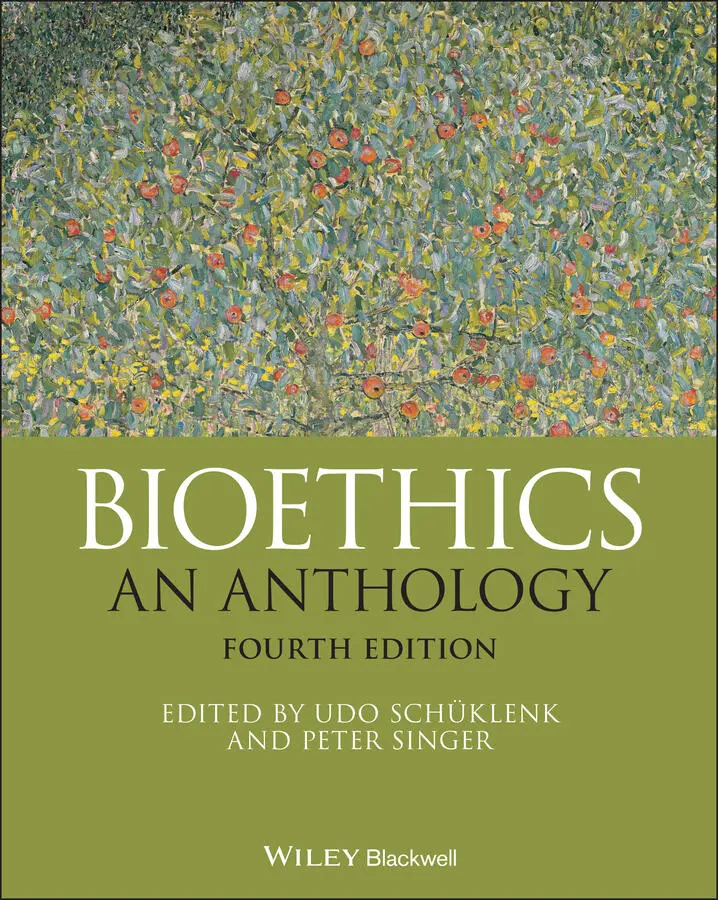
- Название:Bioethics
- Автор:
- Жанр:
- Год:неизвестен
- ISBN:нет данных
- Рейтинг книги:4 / 5. Голосов: 1
-
Избранное:Добавить в избранное
- Отзывы:
-
Ваша оценка:
Bioethics: краткое содержание, описание и аннотация
Предлагаем к чтению аннотацию, описание, краткое содержание или предисловие (зависит от того, что написал сам автор книги «Bioethics»). Если вы не нашли необходимую информацию о книге — напишите в комментариях, мы постараемся отыскать её.
For more than two decades,
has been widely regarded as the definitive single-volume compendium of seminal readings on both traditional and cutting-edge ethical issues in biology and medicine. Acclaimed for its scope and depth of coverage, this landmark work brings together compelling writings by internationally-renowned bioethicist to help readers develop a thorough understanding of the central ideas, critical issues, and current debate in the field.
Now fully revised and updated, the fourth edition contains a wealth of new content on ethical questions and controversies related to the COVID-19 pandemic, advances in CRISPR gene editing technology, physician-assisted death, public health and vaccinations, transgender children, medical aid in dying, the morality of ending the lives of newborns, and much more. Throughout the new edition, carefully selected essays explore a wide range of topics and offer diverse perspectives that underscore the interdisciplinary nature of bioethical study. Edited by two of the field’s most respected scholars, Covers an unparalleled range of thematically-organized topics in a single volume Discusses recent high-profile cases, debates, and ethical issues Features three brand-new sections: Conscientious Objection, Academic Freedom and Research, and Disability Contains new essays on topics such as brain death, life and death decisions for the critically ill, experiments on humans and animals, neuroethics, and the use of drugs to ease the pain of unrequited love Includes a detailed index that allows the reader to easily find terms and topics of interest
remains a must-have resource for all students, lecturers, and researchers studying the ethical implications of the health-related life sciences, and an invaluable reference for doctors, nurses, and other professionals working in health care and the biomedical sciences.
Bioethics — читать онлайн ознакомительный отрывок
Ниже представлен текст книги, разбитый по страницам. Система сохранения места последней прочитанной страницы, позволяет с удобством читать онлайн бесплатно книгу «Bioethics», без необходимости каждый раз заново искать на чём Вы остановились. Поставьте закладку, и сможете в любой момент перейти на страницу, на которой закончили чтение.
Интервал:
Закладка:
1.4 Neo‐Lockean persons and the right to life
Imagine there are times when you have perceptual experiences and bodily sensations unaccompanied by any thoughts . Concerned, you contact your doctor, who tells you of a new virus that temporarily prevents you having any thoughts. Asking about your prognosis, you learn that the temporal gaps between such occurrences will gradually become less and less, until, finally, your ability to have thoughts no longer exists. You ask whether there is any treatment, and are told that there is a drug that, if successful, will completely cure you, but otherwise will kill you.
Consider, now, what it would be like to have sensory experiences and bodily sensations, but to have no thoughts at all at any time – no thoughts about your present experiences, no thoughts about what you did in the past, no thoughts when someone speaks to you, no thoughts about anything. What value would you assign to such a life?
Suppose p is the probability that the drug will cure you, and thus (1 – p ) the probability that it will kill you. How high does p have to be for you to decide to take the drug at some point before you permanently lose the capacity for thought? The answer to that question will fix the value that a life lacking forever the capacity for thought has for you.
Many people I have talked to about this have said that they would ultimately opt for the drug regardless of how close to zero the value of p was . That, however, would imply that the extent to which one values the continued existence of a life with experiences and sensations, but with no capacity for thought, is essentially zero.
The idea is then that it seems plausible to think that there should be a connection between the extent to which people would value such a life and the intrinsic wrongness of killing a person with such a life. If so, the conclusion would be that the wrongness of killing a conscious being permanently lacking the capacity for thought is essentially zero, in which case it would be plausible to conclude that conscious beings permanently lacking a capacity for thought, and thus who are not neo‐Lockean persons, lack a right to continued existence.
Notice that the conclusion here is that being a neo‐Lockean person is a necessary condition for having a right to continued existence, and not that it is also a sufficient condition, since one might hold, as many philosophers do, that one must also have desires, preferences, or interests in order to have a right to continued existence, and neither Locke’s account of a person, nor mine, refers to such mental states. Whether such states are necessary for moral status is a deep and difficult issue in normative ethics, and happily, not one we need not explore here.
2 Cloning to Produce Human Organisms that Will Never Become Persons
2.1 Cloning for medical purposes or scientific research
Embryonic stem cells have proven important for drug discovery and in testing for toxicity, and they also show promise for the treatment of presently incurable diseases, since they can be used to produce different types of cells that can serve to repair damaged tissue (Cerva and Stojkovic, 2007.). To avoid rejection, however, the stems cells should be derived not just from any embryo, but from a clone of the patient.
2.2 Cloning to produce a human organ bank
Here the idea is to clone a human being to produce another human with the same genetic makeup as the original individual, where the human clone will serve as an organ bank, so that if the original individual loses an arm in an accident, or winds up with liver cancer, appropriate spare parts will be available, and no problem of rejection will arise.
If the resulting cloned human being were a person, it would, of course, be wrong to take parts from him or her to repair the damage to the original individual. The idea, however, is that something will be done to the brain of the human that is produced so that the human organism in question never has a conscious thought, and thus is not a neo‐Lockean person.
2.3 Arguments Against Such Cloning
The objection to cloning that involves the destruction of human embryos is that such entities have a right to life. What support can be offered for the latter claim? There are three important arguments, appealing, respectively, to an immaterial mind or soul, to potentialities, or to a future like ours.
2.3.1 Appeals to immaterial minds or souls
Do humans have immaterial minds or souls that are the basis of all their mental states and capacities? The answer is that this is a deeply implausible view, since there are facts about human beings, and other animals, that provide strong evidence for the hypothesis that the categorical basis for all mental states and capacities lies in the brain. First of all, there are extensive correlations between the behavioral capacities of different animals and the neural structures present in their brains. Secondly, the gradual maturation of the brain of a human being is accompanied by a corresponding increase in his or her intellectual capabilities. Thirdly, damage to the brain, due either to external trauma, or to stroke, results in impairment of one's cognitive capacities, and the nature of the impairment is correlated with the part of the brain that was damaged. As I have argued elsewhere (Tooley et al. 2009, 15–19), these facts, and many others, receive a very straightforward explanation given the hypothesis that mental capacities have as their basis appropriate neural circuitry, whereas, on the other hand, they would be both unexplained, and deeply puzzling, if mental capacities had their basis not in the brain, but in some immaterial substance.
2.3.2 Appeals to potentialities
Consider fully active potentialities, understood as states of affairs inevitably leading to a certain result in the absence of outside interference, and consider the thesis that the destruction of a fully active potentiality for the emergence of a neo‐Lockean person is seriously wrong. Elsewhere I have offered several arguments against this principle (2009, 42–51). Here is one of the simpler arguments.
Suppose artificial wombs have been perfected, and there is a device containing an unfertilized human egg cell and a human spermatozoon, where if the device is not interfered with, fertilization will result, and the fertilized human egg cell will be transferred to an artificial womb, from which will emerge, in nine months' time, a healthy newborn human. Such a situation involves not merely an “almost active” potentiality for personhood – as in the case of a fertilized human egg cell on its own – but, rather, a fully active potentiality for personhood. To turn off this device, then, thereby allowing the unfertilized egg cell to die, would involve the destruction of an active potentiality for personhood. Consequently, that action would be seriously wrong if the above, fully active potentiality principle were correct. The action of turning off the device, however, is not morally wrong. Therefore it is not wrong to destroy an active potentiality for personhood.
2.3.3 The appeal to a future like ours
One of the most discussed and reprinted papers on abortion is Don Marquis’s “Why Abortion is Immoral.” In that article, Marquis contends that what makes it wrong to kill something is that thing’s having a future like ours.
One objection to this view is that whether something has a future like ours is a matter of that thing’s potentialities, so Marquis’s view is open to all of the objections that tell against any view that appeals to potentialities.
Читать дальшеИнтервал:
Закладка:
Похожие книги на «Bioethics»
Представляем Вашему вниманию похожие книги на «Bioethics» списком для выбора. Мы отобрали схожую по названию и смыслу литературу в надежде предоставить читателям больше вариантов отыскать новые, интересные, ещё непрочитанные произведения.

Обсуждение, отзывы о книге «Bioethics» и просто собственные мнения читателей. Оставьте ваши комментарии, напишите, что Вы думаете о произведении, его смысле или главных героях. Укажите что конкретно понравилось, а что нет, и почему Вы так считаете.