Bioethics
Здесь есть возможность читать онлайн «Bioethics» — ознакомительный отрывок электронной книги совершенно бесплатно, а после прочтения отрывка купить полную версию. В некоторых случаях можно слушать аудио, скачать через торрент в формате fb2 и присутствует краткое содержание. Жанр: unrecognised, на английском языке. Описание произведения, (предисловие) а так же отзывы посетителей доступны на портале библиотеки ЛибКат.
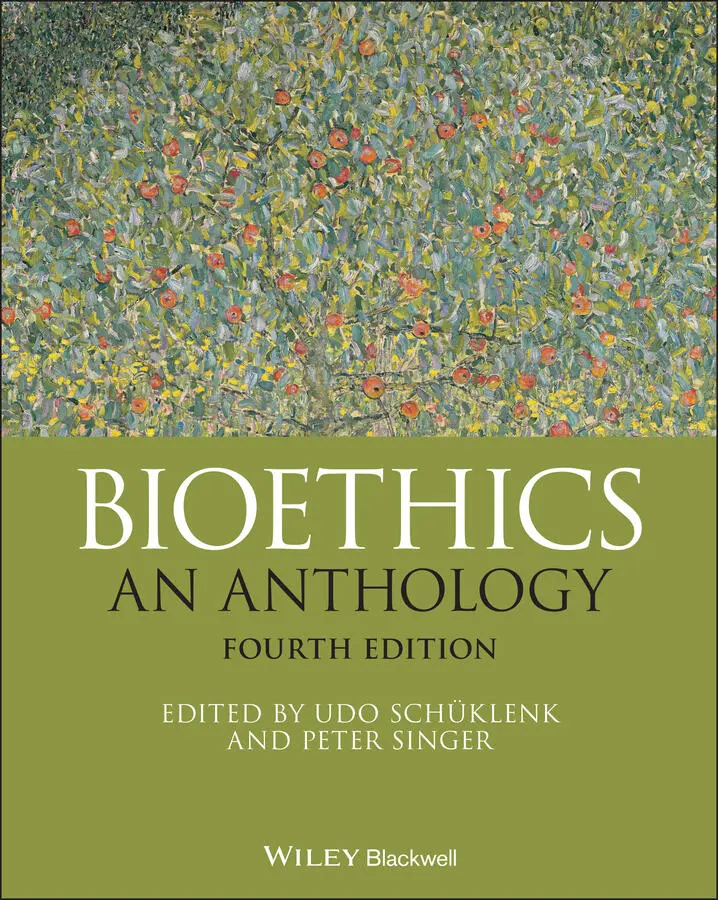
- Название:Bioethics
- Автор:
- Жанр:
- Год:неизвестен
- ISBN:нет данных
- Рейтинг книги:4 / 5. Голосов: 1
-
Избранное:Добавить в избранное
- Отзывы:
-
Ваша оценка:
Bioethics: краткое содержание, описание и аннотация
Предлагаем к чтению аннотацию, описание, краткое содержание или предисловие (зависит от того, что написал сам автор книги «Bioethics»). Если вы не нашли необходимую информацию о книге — напишите в комментариях, мы постараемся отыскать её.
For more than two decades,
has been widely regarded as the definitive single-volume compendium of seminal readings on both traditional and cutting-edge ethical issues in biology and medicine. Acclaimed for its scope and depth of coverage, this landmark work brings together compelling writings by internationally-renowned bioethicist to help readers develop a thorough understanding of the central ideas, critical issues, and current debate in the field.
Now fully revised and updated, the fourth edition contains a wealth of new content on ethical questions and controversies related to the COVID-19 pandemic, advances in CRISPR gene editing technology, physician-assisted death, public health and vaccinations, transgender children, medical aid in dying, the morality of ending the lives of newborns, and much more. Throughout the new edition, carefully selected essays explore a wide range of topics and offer diverse perspectives that underscore the interdisciplinary nature of bioethical study. Edited by two of the field’s most respected scholars, Covers an unparalleled range of thematically-organized topics in a single volume Discusses recent high-profile cases, debates, and ethical issues Features three brand-new sections: Conscientious Objection, Academic Freedom and Research, and Disability Contains new essays on topics such as brain death, life and death decisions for the critically ill, experiments on humans and animals, neuroethics, and the use of drugs to ease the pain of unrequited love Includes a detailed index that allows the reader to easily find terms and topics of interest
remains a must-have resource for all students, lecturers, and researchers studying the ethical implications of the health-related life sciences, and an invaluable reference for doctors, nurses, and other professionals working in health care and the biomedical sciences.
Bioethics — читать онлайн ознакомительный отрывок
Ниже представлен текст книги, разбитый по страницам. Система сохранения места последней прочитанной страницы, позволяет с удобством читать онлайн бесплатно книгу «Bioethics», без необходимости каждый раз заново искать на чём Вы остановились. Поставьте закладку, и сможете в любой момент перейти на страницу, на которой закончили чтение.
Интервал:
Закладка:
Thus, when the Committee concludes that preimplantation genetic diagnosis for sex selection poses a ‘risk of unwarranted gender bias, social harm, the diversion of medical resources from genuine medical need and should therefore be discouraged’, it seems that the boldness of its statement is in conspicuous contrast to the weakness of its arguments.
References
1 Benagiano, G. and Bianchi, P. (1999). Sex preselection: an aid to couples or a threat to humanity? Hum. Reprod., 14: 868–70.
2 ESHRE PGD Consortium Steering Committee (1999). ESHRE Preimplantation Genetic Diagnosis (PGD) Consortium: preliminary assessment of data from January 1997 to September 1998. Hum. Reprod., 14: 3138–48.
3 Ethics Committee of the American Society of Reproductive Medicine (1999). Sex selection and preimplantation genetic diagnosis. Fertil. Steril., 72: 595–8.
4 Fugger, E. F., Black, S. H., Keyvanfar, K. et al. (1998). Births of normal daughters after Microsort sperm separation and intrauterine insemination, in‐vitro fertilization, or intracytoplasmic sperm injection. Hum. Reprod., 13: 2367–70.
5 Khatamee, M. A., Leinberger‐Sica, A., Matos, P. et al. (1989). Sex preselection in New York City: who chooses which sex and why. Int. J. Fertil., 34: 353–4.
6 Liu, P. and Rose, A. (1995). Social aspects of >800 couples coming forward for gender selection of their children. Hum. Reprod., 10: 968–971.
7 Savulescu, J. (1999). Sex selection – the case for. Med. J. Australia, 171: 373–5.
8 Simpson, J. L. and Carson, S.A. (1999). The reproductive option of sex selection. Hum. Reprod., 14: 870–2.
9 Statham, H., Green, J., Snowdon, C. and France‐Dawson, M. (1993). Choice of baby’s sex. Lancet, 341: 564–5.
10 Sureau, G. (1999). Gender selection: a crime against humanity or the exercise of a fundamental right? Hum. Reprod., 14: 867–8.
11 Why We Should Not Permit Embryos to Be Selected as Tissue Donors
David King
The announcement of the birth of a son to the Whitaker family, who was selected as an embryo to be a tissue‐matched donor for his sick brother, has sparked the usual massive media interest. It seems that the Whitaker family have great public sympathy and support for their use of the technique. As usual, the main voices opposing the use of this technique have been those of the pro‐lifers. The predominant view, summarised as: ‘What can be wrong with saving the life of a sick child?’ demands a proper response, which is not grounded in the belief that embryos possess a right to life.
Children as Things
The main objection to the use of pre‐implantation genetic diagnosis (PGD) for this purpose is that it objectifies the child by turning it into a mere tool, and so contradicts the basic ethical principle that we should never use human beings merely as a means to an end (however good that end may be), because they should also be treated as ends in themselves. That is the basic ethical objection to slavery, for example. In response to this, it is often said that the new child will be loved for himself, and will not be treated by his parents as a mere tool, and this is no doubt true. However, the Whitakers have made it very clear that their primary purpose for conceiving Jamie was to save their other son: this will nearly always be the case for couples in their position. The case against this use of PGD does not depend on fine analysis of each couple’s motivations and emotional states, or on how much they succeed in loving their new child despite the reasons for his/her conception, but on the consequences of breaking the ethical rule.
While most people would agree with the ethical principle, many seem to feel that it is a case of abstract principles versus real individual suffering; and because, as is typical in our public discourse, the case is discussed without considering the context, ie. the overall trends promoted by reproductive and biomedical technology, the reasons for concern about objectification seem remote and theoretical. However, I would argue that these cases, far from being special examples, in which we should allow exceptions to our principles, are in fact typical examples of the way that reproductive and biomedical technologies objectify human beings. That is why it is so important that we resist the selection of embryos as tissue donors: because these cases significantly advance the objectifying trend, and the consequences of doing so are, in the not‐so‐long term, disastrous.
Selection of embryos as tissue donors falls squarely into the objectifying trend in two senses: the literal and the ethical. What makes many people very uncomfortable about biomedical technology in general is the way that the relentless march of reductionist science continually turns human beings, at various stages of development, into human organisms, useful sources of biological raw material for spare parts. As science discovers more and more about the workings of the human body, our bodies are seen as no more than machines, with no special moral meaning or dignity, and the pressure to extract various components in order to benefit others becomes ever greater. The problem is the way that this pressure leads to rewriting of ethical rules. Whether it is at the beginning of the lifecycle, with the envisioned creation of cloned embryos purely as sources of stem cells and the proposed extraction of eggs from aborted fetuses for use in IVF, or at the end, with the constant shifting of definitions of death to facilitate ‘harvesting’ of organs for transplantation, the integrity of human organisms and the ethical rules protecting them seem everywhere under siege from the enthusiasm of biomedical technicians. Only able‐bodied post‐natal humans seem, for the moment, to be safe.
The creation of babies as sources of tissue, and, as shocking, the co‐option of reproduction for reasons other than procreation, push instrumentalisation of human life one step further, and dispose of one more ethical principle. They also set the stage for further steps: how long before we will be told that saving a child this way is the best reason for cloning? And if we can create embryos and children as sources of cells, if it proves necessary, (perhaps because it proves impossible to create the required organs from embryonic stem cells), why not allow the embryos to grow into fetuses and ‘harvest’ tissues at that stage?
Leaving aside these next steps, many people could benefit medically from matched tissue donation – there is nothing unique about Charlie Whitaker’s disease. How will we feel when the tissue recipient is not another child, but an adult, maybe a parent or a more remote family member?
In the reproductive context, objectification has a particular ethical meaning, often summed up in the term ‘designer babies’. The increasing technologisation of reproduction, and the use of technology to choose our children’s characteristics, tend to make reproduction just another process for producing consumer goods. Although the outputs of this process are undeniably human beings, by choosing their characteristics we turn them into things, just human‐designed objects. Conversely, by taking this new power of selection/design over a key part of what constitutes those individuals, we elevate ourselves above them. This is part of what people mean when they talk about playing God. The parent–child relationship becomes a designer–object relationship, rather than one between two fundamentally equal human subjects.
The selection of children as tissue donors is an example of the objectifying trend in techno‐reproduction, albeit not a typical one. Here, the child is not selected for characteristics that will ‘improve’ it, but to benefit another child. In one sense this is more acceptable, since the aim of the procedure is undoubtedly good, and is not motivated by consumerist desires for ‘enhancement’. But in another sense it is a more extreme example of objectification, because the primary reason for the child’s being is not even to be a child as such, but to be a source of spare parts for another.
Читать дальшеИнтервал:
Закладка:
Похожие книги на «Bioethics»
Представляем Вашему вниманию похожие книги на «Bioethics» списком для выбора. Мы отобрали схожую по названию и смыслу литературу в надежде предоставить читателям больше вариантов отыскать новые, интересные, ещё непрочитанные произведения.

Обсуждение, отзывы о книге «Bioethics» и просто собственные мнения читателей. Оставьте ваши комментарии, напишите, что Вы думаете о произведении, его смысле или главных героях. Укажите что конкретно понравилось, а что нет, и почему Вы так считаете.