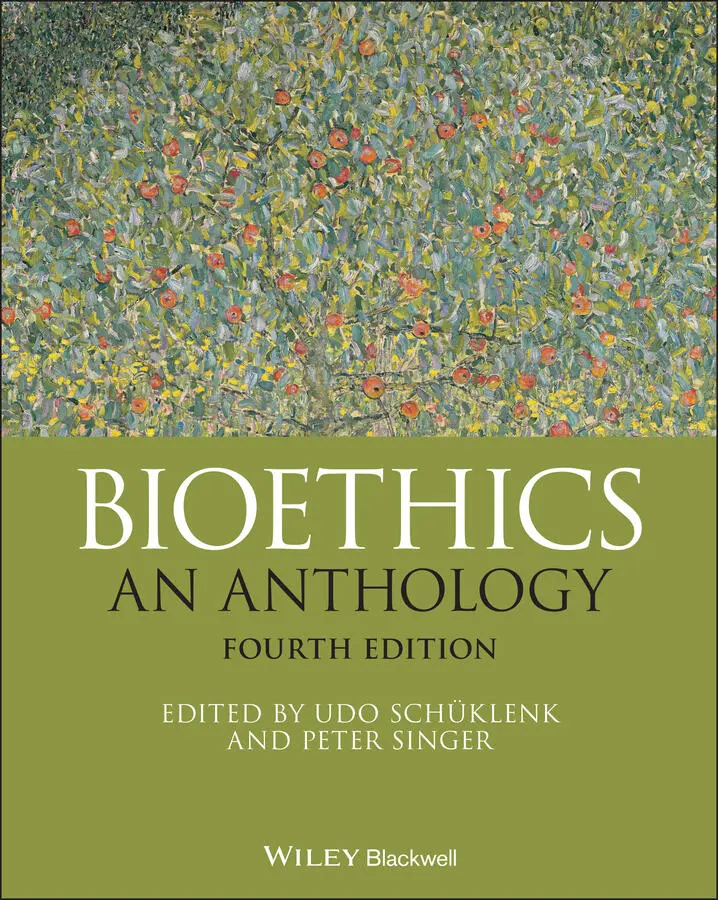
Bioethics
Здесь есть возможность читать онлайн «Bioethics» — ознакомительный отрывок электронной книги совершенно бесплатно, а после прочтения отрывка купить полную версию. В некоторых случаях можно слушать аудио, скачать через торрент в формате fb2 и присутствует краткое содержание. Жанр: unrecognised, на английском языке. Описание произведения, (предисловие) а так же отзывы посетителей доступны на портале библиотеки ЛибКат.
- Название:Bioethics
- Автор:
- Жанр:
- Год:неизвестен
- ISBN:нет данных
- Рейтинг книги:4 / 5. Голосов: 1
-
Избранное:Добавить в избранное
- Отзывы:
-
Ваша оценка:
Bioethics: краткое содержание, описание и аннотация
Предлагаем к чтению аннотацию, описание, краткое содержание или предисловие (зависит от того, что написал сам автор книги «Bioethics»). Если вы не нашли необходимую информацию о книге — напишите в комментариях, мы постараемся отыскать её.
For more than two decades,
has been widely regarded as the definitive single-volume compendium of seminal readings on both traditional and cutting-edge ethical issues in biology and medicine. Acclaimed for its scope and depth of coverage, this landmark work brings together compelling writings by internationally-renowned bioethicist to help readers develop a thorough understanding of the central ideas, critical issues, and current debate in the field.
Now fully revised and updated, the fourth edition contains a wealth of new content on ethical questions and controversies related to the COVID-19 pandemic, advances in CRISPR gene editing technology, physician-assisted death, public health and vaccinations, transgender children, medical aid in dying, the morality of ending the lives of newborns, and much more. Throughout the new edition, carefully selected essays explore a wide range of topics and offer diverse perspectives that underscore the interdisciplinary nature of bioethical study. Edited by two of the field’s most respected scholars, Covers an unparalleled range of thematically-organized topics in a single volume Discusses recent high-profile cases, debates, and ethical issues Features three brand-new sections: Conscientious Objection, Academic Freedom and Research, and Disability Contains new essays on topics such as brain death, life and death decisions for the critically ill, experiments on humans and animals, neuroethics, and the use of drugs to ease the pain of unrequited love Includes a detailed index that allows the reader to easily find terms and topics of interest
remains a must-have resource for all students, lecturers, and researchers studying the ethical implications of the health-related life sciences, and an invaluable reference for doctors, nurses, and other professionals working in health care and the biomedical sciences.
Bioethics — читать онлайн ознакомительный отрывок
Ниже представлен текст книги, разбитый по страницам. Система сохранения места последней прочитанной страницы, позволяет с удобством читать онлайн бесплатно книгу «Bioethics», без необходимости каждый раз заново искать на чём Вы остановились. Поставьте закладку, и сможете в любой момент перейти на страницу, на которой закончили чтение.
Интервал:
Закладка:
This document’s focus on PGD for sex selection is prompted by the increasing attractiveness of prepregnancy sex selection over prenatal diagnosis and sex‐selective abortion, and by the current limited availability of methods of prefertilization sex selection techniques that are both reliable and safe. Although the actual use of PGD for sex selection is still infrequent, its potential use continues to raise important ethical questions.
Central to the controversies over the use of PGD for sex selection, particularly for nonmedical reasons, are issues of gender discrimination, the appropriateness of expanding control over nonessential characteristics of offspring, and the relative importance of sex selection when weighed against medical and financial burdens to parents and against multiple demands for limited medical resources. In western societies, these concerns inevitably encounter what has become a strong presumption in favor of reproductive choice.
The General Ethical Debate
Arguments for PGD and sex selection make two primary appeals. The first is to the right to reproductive choice on the part of the person or persons who seek to bear a child. Sex selection, it is argued, is a logical extension of this right. The second is an appeal to the important goods to be achieved through this technique and the choices it allows – above all, the medical good of preventing the transmission of sex‐linked genetic disorders such as hemophilia A and B, Lesch‐Nyhan syndrome, Duchenne‐Becker muscular dystrophy, and Hunter syndrome. There also are perceived individual and social goods such as gender balance or distribution in a family with more than one child, parental companionship with a child of one’s own gender, and a preferred gender order among one’s children. More remotely, it sometimes is argued that PGD and sex selection of embryos for transfer is a lesser evil (medically and ethically) than the alternative of prenatal diagnosis and sex‐selected abortion, and even that PGD and sex selection can contribute indirectly to population limitation (i.e., with this technique, parents no longer are compelled to continue to reproduce until they achieve a child of the preferred gender).
Arguments against PGD used for sex selection appeal either to what is considered inherently wrong with sex selection or to the bad consequences that are likely to outweigh the good consequences of its use. Suspicion of sex selection as wrong is lodged in the concerns identified earlier: the potential for inherent gender discrimination, inappropriate control over nonessential characteristics of children, unnecessary medical burdens and costs for parents, and inappropriate and potentially unfair use of limited medical resources for sex selection rather than for more genuine and urgent medical needs. These concerns are closely connected with predictions of negative consequences, such as risk of psychological harm to sex‐selected offspring (i.e., by placing on them too high expectations), increased marital conflict over sex‐selective decisions, and reinforcement of gender bias in society as a whole. Sometimes the predictions reach to dire consequences such as an overall change in the human sex ratio detrimental to the future of a particular society.
Preimplantation Genetic Diagnosis and Sex Selection: Joining the Particular Issues
The right to reproductive freedom has never been considered an absolute right, certainly not if it is extended to include every sort of decision about reproduction or every demand for positive support in individuals’ reproductive decisions. Still, serious reasons (e.g., the likelihood of seriously harmful consequences or the presence of a competing stronger right) must be provided if a limitation on reproductive freedom is to be justified. Hence, the weighing of opposing positions regarding PGD and sex selection depends on an assessment of the strength of the reasons given for and against it.
Preimplantation genetic diagnosis has the potential for serving sex selection in varying categories of cases, each of which raises different medical and ethical questions. Preimplantation genetic diagnosis may be done for disease prevention, or it may be done for any of the other motivations individuals have for determining the sex of their offspring. Moreover, information about the sex of an embryo may be obtained (a) as an essential part of or by‐product of PGD performed for other (medical) reasons or (b) through a test for sex identification that is added to PGD performed for medical reasons. Further, (c) a patient who is undergoing IVF procedures as part of fertility treatment (but whose treatment does not require PGD for medical reasons) may request PGD solely for the purpose of sex selection, and (d) a patient who is fertile (hence, not undergoing IVF as part of treatment) may request IVF and PGD, both solely for the purpose of sex selection. Each of these situations calls for a distinct medical and ethical assessment ( Table 9.1).
There presently is little debate over the ethical validity of PGD for sex selection when its aim is to prevent the transmission of sex‐linked genetic disease. In this case, sex selection does not prefer one sex over the other for its own supposed value; it does not, therefore, have the potential to contribute as such to gender bias. And when the genetic disorder is severe, efforts to prevent it can hardly be placed in a category of trivializing or instrumentalizing human reproduction. Moreover, prepregnancy sex‐selective techniques used for this purpose appear to have a clear claim on limited resources along with other medical procedures that are performed with the goal of eliminating disease and suffering.
It is less easy to eliminate concerns regarding PGD and sex selection when it is aimed at serving social and psychological goals not related to the prevention of disease. It must be recognized, of course, that individuals and couples have wide discretion and liberty in making reproductive choices, even if others object. Yet ethical arguments against sex selection appear to gain strength as the categories of potential cases descend from (a) to (d). For example, desires for family gender balance or birth order, companionship, family economic welfare, and the ready acceptance of offspring who are more “wanted” because their gender is selected may not in every case deserve the charge of unjustified gender bias, but they are vulnerable to it.
Whatever they may mean for an individual or family choice, they also, if fulfilled on a large scale through PGD for sex selection, may contribute to a society’s gender stereotyping and overall gender discrimination. On the other hand, if they are expressed and fulfilled only on a small scale and sporadically (as is presently the case), their social implications will be correspondingly limited. Still, they remain vulnerable to the judgment that no matter what their basis, they identify gender as a reason to value one person over another, and they support socially constructed stereotypes of what gender means. In doing so, they not only reinforce possibilities of unfair discrimination, but they may trivialize human reproduction by making it depend on the selection of nonessential features of offspring.
Desired potential social benefits of sex selection also may appear insufficiently significant when weighed against unnecessary bodily burdens and risks for women, and when contrasted with other needs for and claims on medical resources. In particular, many would judge it unreasonable for individuals who do not otherwise need IVF (for the treatment of infertility or prevention of genetic disease) to undertake its burdens and expense solely to select the gender of their offspring. Although individuals may be free to accept such burdens, and although costs may be borne in a way that does not directly violate the rights of others, to encourage PGD for sex selection when it is not medically indicated presents ethical problems.
Читать дальшеИнтервал:
Закладка:
Похожие книги на «Bioethics»
Представляем Вашему вниманию похожие книги на «Bioethics» списком для выбора. Мы отобрали схожую по названию и смыслу литературу в надежде предоставить читателям больше вариантов отыскать новые, интересные, ещё непрочитанные произведения.

Обсуждение, отзывы о книге «Bioethics» и просто собственные мнения читателей. Оставьте ваши комментарии, напишите, что Вы думаете о произведении, его смысле или главных героях. Укажите что конкретно понравилось, а что нет, и почему Вы так считаете.