Bioethics
Здесь есть возможность читать онлайн «Bioethics» — ознакомительный отрывок электронной книги совершенно бесплатно, а после прочтения отрывка купить полную версию. В некоторых случаях можно слушать аудио, скачать через торрент в формате fb2 и присутствует краткое содержание. Жанр: unrecognised, на английском языке. Описание произведения, (предисловие) а так же отзывы посетителей доступны на портале библиотеки ЛибКат.
- Название:Bioethics
- Автор:
- Жанр:
- Год:неизвестен
- ISBN:нет данных
- Рейтинг книги:4 / 5. Голосов: 1
-
Избранное:Добавить в избранное
- Отзывы:
-
Ваша оценка:
Bioethics: краткое содержание, описание и аннотация
Предлагаем к чтению аннотацию, описание, краткое содержание или предисловие (зависит от того, что написал сам автор книги «Bioethics»). Если вы не нашли необходимую информацию о книге — напишите в комментариях, мы постараемся отыскать её.
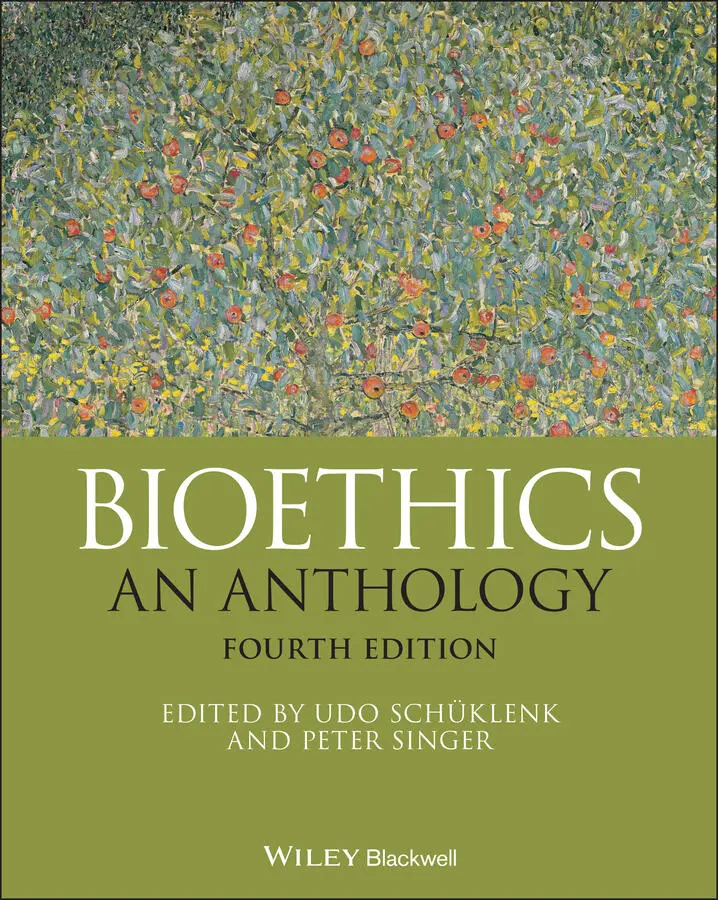
For more than two decades,
has been widely regarded as the definitive single-volume compendium of seminal readings on both traditional and cutting-edge ethical issues in biology and medicine. Acclaimed for its scope and depth of coverage, this landmark work brings together compelling writings by internationally-renowned bioethicist to help readers develop a thorough understanding of the central ideas, critical issues, and current debate in the field.
Now fully revised and updated, the fourth edition contains a wealth of new content on ethical questions and controversies related to the COVID-19 pandemic, advances in CRISPR gene editing technology, physician-assisted death, public health and vaccinations, transgender children, medical aid in dying, the morality of ending the lives of newborns, and much more. Throughout the new edition, carefully selected essays explore a wide range of topics and offer diverse perspectives that underscore the interdisciplinary nature of bioethical study. Edited by two of the field’s most respected scholars, Covers an unparalleled range of thematically-organized topics in a single volume Discusses recent high-profile cases, debates, and ethical issues Features three brand-new sections: Conscientious Objection, Academic Freedom and Research, and Disability Contains new essays on topics such as brain death, life and death decisions for the critically ill, experiments on humans and animals, neuroethics, and the use of drugs to ease the pain of unrequited love Includes a detailed index that allows the reader to easily find terms and topics of interest
remains a must-have resource for all students, lecturers, and researchers studying the ethical implications of the health-related life sciences, and an invaluable reference for doctors, nurses, and other professionals working in health care and the biomedical sciences.
Bioethics — читать онлайн ознакомительный отрывок
Ниже представлен текст книги, разбитый по страницам. Система сохранения места последней прочитанной страницы, позволяет с удобством читать онлайн бесплатно книгу «Bioethics», без необходимости каждый раз заново искать на чём Вы остановились. Поставьте закладку, и сможете в любой момент перейти на страницу, на которой закончили чтение.
Интервал:
Закладка:
Expecting people to forgo having genetically related children might seem to demand too great a sacrifice of them. But before reaching that conclusion we need to ask what is really at stake. One reason for wanting children is to experience family life, including love, companionship, watching kids grow, sharing their pains and triumphs, and helping to form members of the next generation. Other reasons emphasize the validation of parents as individuals within a continuous family line, children as a source of immortality, or perhaps even the gratification of producing partial replicas of oneself. Children may also be desired in an effort to prove that one is an adult, to try to cement a marriage, or to benefit parents economically.
Are there alternative ways of satisfying these desires? Adoption or new reproductive technologies can fulfill many of them without passing on known genetic defects. Sperm replacement has been available for many years via artificial insemination by donor. More recently, egg donation, sometimes in combination with contract pregnancy, 18 has been used to provide eggs for women who prefer not to use their own. Eventually it may be possible to clone individual humans, although that now seems a long way off. All of these approaches to avoiding the use of particular genetic material are controversial and have generated much debate. I believe that tenable moral versions of each do exist. 19
None of these methods permits people to extend both genetic lines or realize the desire for immortality or for children who resemble both parents; nor is it clear that such alternatives will necessarily succeed in proving that one is an adult, cementing a marriage, or providing economic benefits. Yet, many people feel these desires strongly. Now, I am sympathetic to William James’s dictum regarding desires: “Take any demand, however slight, which any creature, however weak, may make. Ought it not, for its own sole sake be satisfied? If not, prove why not.” 20 Thus a world where more desires are satisfied is generally better than one where fewer are. However, not all desires can be legitimately satisfied, because as James suggests, there may be good reasons, such as the conflict of duty and desire, why some should be overruled.
Fortunately, further scrutiny of the situation reveals that there are good reasons why people should attempt with appropriate social support to talk themselves out of the desires in question or to consider novel ways of fulfilling them. Wanting to see the genetic line continued is not particularly rational when it brings a sinister legacy of illness and death. The desire for immortality cannot really be satisfied anyway, and people need to face the fact that what really matters is how they behave in their own lifetimes. And finally, the desire for children who physically resemble one is understandable, but basically narcissistic, and its fulfillment cannot be guaranteed even by normal reproduction. There are other ways of proving one is an adult, and other ways of cementing marriages – and children don’t necessarily do either. Children, especially prematurely ill children, may not provide the expected economic benefits anyway. Nongenetically related children may also provide benefits similar to those that would have been provided by genetically related ones, and expected economic benefit is, in many cases, a morally questionable reason for having children.
Before the advent of reliable genetic testing, the options of people in Huntington’s families were cruelly limited. On the one hand, they could have children, but at the risk of eventual crippling illness and death for them. On the other, they could refrain from child‐bearing, sparing their possible children from significant risk of inheriting this disease, perhaps frustrating intense desires to procreate – only to discover, in some cases, that their sacrifice was unnecessary because they did not develop the disease. Or they could attempt to adopt or try new reproductive approaches.
Reliable genetic testing has opened up new possibilities. Those at risk who wish to have children can get tested. If they test positive, they know their possible children are at risk. Those who are opposed to abortion must be especially careful to avoid conception if they are to behave responsibly. Those not opposed to abortion can responsibly conceive children, but only if they are willing to test each fetus and abort those who carry the gene. If individuals at risk test negative, they are home free.
What about those who cannot face the test for themselves? They can do prenatal testing and abort fetuses who carry the defective gene. A clearly positive test also implies that the parent is affected, although negative tests do not rule out that possibility. Prenatal testing can thus bring knowledge that enables one to avoid passing the disease to others, but only, in some cases, at the cost of coming to know with certainty that one will indeed develop the disease. This situation raises with peculiar force the question of whether parental responsibility requires people to get tested.
Some people think that we should recognize a right “not to know.” It seems to me that such a right could be defended only where ignorance does not put others at serious risk. So if people are prepared to forgo genetically related children, they need not get tested. But if they want genetically related children, then they must do whatever is necessary to ensure that affected babies are not the result. There is, after all, something inconsistent about the claim that one has a right to be shielded from the truth, even if the price is to risk inflicting on one’s children the same dread disease one cannot even face in oneself.
In sum, until we can be assured that Huntington’s Disease does not prevent people from living a minimally satisfying life, individuals at risk for the disease have a moral duty to try not to bring affected babies into this world. There are now enough options available so that this duty needn’t frustrate their reasonable desires. Society has a corresponding duty to facilitate moral behavior on the part of individuals. Such support ranges from the narrow and concrete (such as making sure that medical testing and counseling is available to all) to the more general social environment that guarantees that all pregnancies are voluntary, that pronatalism is eradicated, and that women are treated with respect regardless of the reproductive options they choose.
Notes
1 1I focus on genetic considerations, although with the advent of AIDS the scope of the general question here could be expanded. There are two reasons for sticking to this relatively narrow formulation. One is that dealing with a smaller chunk of the problem may help us to think more clearly, while realizing that some conclusions may nonetheless be relevant to the larger problem. The other is the peculiar capacity of some genetic problems to affect ever more individuals in the future.
2 2For example, see Leon Kass, “Implications of Prenatal Diagnosis for the Human Right to Life,” in Ethical Issues in Human Genetics, ed. Bruce Hilton et al. (New York: Plenum, 1973).
3 3This is, of course, a very broad thesis. I defend an even broader version in ch. 2 of Reproducing Persons, “Loving Future People.”
4 4Why would we want to resist legal enforcement of every moral conclusion? First, legal action has many costs, costs not necessarily worth paying in particular cases. Second, legal enforcement tends to take the matter out of the realm of debate and treat it as settled. But in many cases, especially where mores or technology are rapidly evolving, we don’t want that to happen. Third, legal enforcement would undermine individual freedom and decision‐making capacity. In some cases, the ends envisioned are important enough to warrant putting up with these disadvantages.
Читать дальшеИнтервал:
Закладка:
Похожие книги на «Bioethics»
Представляем Вашему вниманию похожие книги на «Bioethics» списком для выбора. Мы отобрали схожую по названию и смыслу литературу в надежде предоставить читателям больше вариантов отыскать новые, интересные, ещё непрочитанные произведения.

Обсуждение, отзывы о книге «Bioethics» и просто собственные мнения читателей. Оставьте ваши комментарии, напишите, что Вы думаете о произведении, его смысле или главных героях. Укажите что конкретно понравилось, а что нет, и почему Вы так считаете.