Bioethics
Здесь есть возможность читать онлайн «Bioethics» — ознакомительный отрывок электронной книги совершенно бесплатно, а после прочтения отрывка купить полную версию. В некоторых случаях можно слушать аудио, скачать через торрент в формате fb2 и присутствует краткое содержание. Жанр: unrecognised, на английском языке. Описание произведения, (предисловие) а так же отзывы посетителей доступны на портале библиотеки ЛибКат.
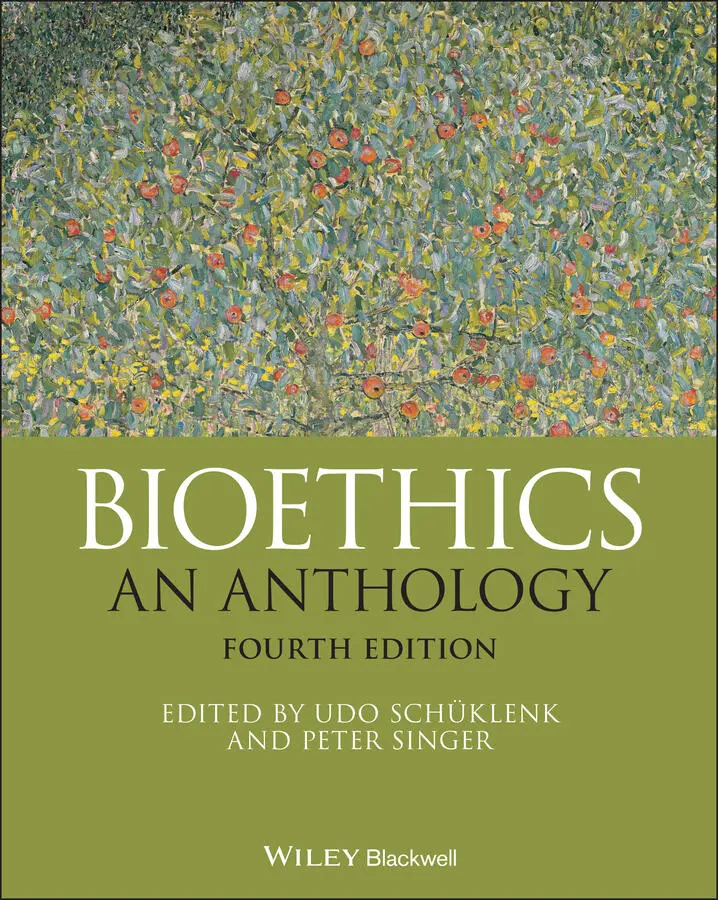
- Название:Bioethics
- Автор:
- Жанр:
- Год:неизвестен
- ISBN:нет данных
- Рейтинг книги:4 / 5. Голосов: 1
-
Избранное:Добавить в избранное
- Отзывы:
-
Ваша оценка:
Bioethics: краткое содержание, описание и аннотация
Предлагаем к чтению аннотацию, описание, краткое содержание или предисловие (зависит от того, что написал сам автор книги «Bioethics»). Если вы не нашли необходимую информацию о книге — напишите в комментариях, мы постараемся отыскать её.
For more than two decades,
has been widely regarded as the definitive single-volume compendium of seminal readings on both traditional and cutting-edge ethical issues in biology and medicine. Acclaimed for its scope and depth of coverage, this landmark work brings together compelling writings by internationally-renowned bioethicist to help readers develop a thorough understanding of the central ideas, critical issues, and current debate in the field.
Now fully revised and updated, the fourth edition contains a wealth of new content on ethical questions and controversies related to the COVID-19 pandemic, advances in CRISPR gene editing technology, physician-assisted death, public health and vaccinations, transgender children, medical aid in dying, the morality of ending the lives of newborns, and much more. Throughout the new edition, carefully selected essays explore a wide range of topics and offer diverse perspectives that underscore the interdisciplinary nature of bioethical study. Edited by two of the field’s most respected scholars, Covers an unparalleled range of thematically-organized topics in a single volume Discusses recent high-profile cases, debates, and ethical issues Features three brand-new sections: Conscientious Objection, Academic Freedom and Research, and Disability Contains new essays on topics such as brain death, life and death decisions for the critically ill, experiments on humans and animals, neuroethics, and the use of drugs to ease the pain of unrequited love Includes a detailed index that allows the reader to easily find terms and topics of interest
remains a must-have resource for all students, lecturers, and researchers studying the ethical implications of the health-related life sciences, and an invaluable reference for doctors, nurses, and other professionals working in health care and the biomedical sciences.
Bioethics — читать онлайн ознакомительный отрывок
Ниже представлен текст книги, разбитый по страницам. Система сохранения места последней прочитанной страницы, позволяет с удобством читать онлайн бесплатно книгу «Bioethics», без необходимости каждый раз заново искать на чём Вы остановились. Поставьте закладку, и сможете в любой момент перейти на страницу, на которой закончили чтение.
Интервал:
Закладка:
How serious are the risks involved in Huntington’s Disease? Geneticists often think a 10 percent risk is high. 11 But risk assessment also depends on what is at stake: the worse the possible outcome, the more undesirable an otherwise small risk seems. In medicine, as elsewhere, people may regard the same result quite differently. But for devastating diseases such as Huntington’s this part of the judgment should be unproblematic: no one wants a loved one to suffer in this way. 12
There may still be considerable disagreement about the acceptability of a given risk. So it would be difficult in many circumstances to say how we should respond to a particular risk. Nevertheless, there are good grounds for a conservative approach, for it is reasonable to take special precautions to avoid very bad consequences, even if the risk is small. But the possible consequences here are very bad: a child who may inherit Huntington’s Disease has a much greater than average chance of being subjected to severe and prolonged suffering. And it is one thing to risk one’s own welfare, but quite another to do so for others and without their consent.
Is this judgment about Huntington’s Disease really defensible? People appear to have quite different opinions. Optimists argue that a child born into a family afflicted with Huntington’s Disease has a reasonable chance of living a satisfactory life. After all, even children born of an afflicted parent still have a 50 percent chance of escaping the disease. And even if afflicted themselves, such people will probably enjoy some thirty years of healthy life before symptoms appear. It is also possible, although not at all likely, that some might not mind the symptoms caused by the disease. Optimists can point to diseased persons who have lived fruitful lives, as well as those who seem genuinely glad to be alive. One is Rick Donohue, a sufferer from the Joseph family disease: “You know, if my mom hadn’t had me, I wouldn’t be here for the life I have had. So there is a good possibility I will have children.” 13 Optimists therefore conclude that it would be a shame if these persons had not lived.
Pessimists concede some of these facts but take a less sanguine view of them. They think a 50 percent risk of serious disease such as Huntington’s is appallingly high. They suspect that many children born into afflicted families are liable to spend their youth in dreadful anticipation and fear of the disease. They expect that the disease, if it appears, will be perceived as a tragic and painful end to a blighted life. They point out that Rick Donohue is still young and has not experienced the full horror of his sickness. It is also well‐known that some young persons have such a dilated sense of time that they can hardly envision themselves at 30 or 40, so the prospect of pain at that age is unreal to them. 14
More empirical research on the psychology and life history of suffers and potential sufferers is clearly needed to decide whether optimists or pessimists have a more accurate picture of the experiences of individuals at risk. But given that some will surely realize pessimists’ worst fears, it seems unfair to conclude that the pleasures of those who deal best with the situation simply cancel out the suffering of those others when that suffering could be avoided altogether.
I think that these points indicate that the morality of procreation in such situations demands further investigation. I propose to do this by looking first at the position of the possible child, then at that of the potential parent.
Possible Children and Potential Parents
The first task in treating the problem from the child’s point of view is to find a way of referring to possible future offspring without seeming to confer some sort of morally significant existence on them. I follow the convention of calling children who might be born in the future but who are not now conceived “possible” children, offspring, individuals, or persons.
Now, what claims about children or possible children are relevant to the morality of child‐bearing in the circumstances being considered? Of primary importance is the judgment that we ought to try to provide every child with something like a minimally satisfying life. I am not altogether sure how best to formulate this standard, but I want clearly to reject the view that it is morally permissible to conceive individuals so long as we do not expect them to be so miserable that they wish they were dead. 15 I believe that this kind of moral minimalism is thoroughly unsatisfactory and that not many people would really want to live in a world where it was the prevailing standard. Its lure is that it puts few demands on us, but its price is the scant attention it pays to human well‐being.
How might the judgment that we have a duty to try to provide a minimally satisfying life for our children be justified? It could, I think, be derived fairly straightforwardly from either utilitarian or contractarian theories of justice, although there is no space here for discussion of the details. The net result of such analysis would be to conclude that neglecting this duty would create unnecessary unhappiness or unfair disadvantage for some persons.
Of course, this line of reasoning confronts us with the need to spell out what is meant by “minimally satisfying” and what a standard based on this concept would require of us. Conceptions of a minimally satisfying life vary tremendously among societies and also within them. De rigueur in some circles are private music lessons and trips to Europe, whereas in others providing eight years of schooling is a major accomplishment. But there is no need to consider this complication at length here because we are concerned only with health as a prerequisite for a minimally satisfying life. Thus, as we draw out what such a standard might require of us, it seems reasonable to retreat to the more limited claim that parents should try to ensure something like normal health for their children. It might be thought that even this moderate claim is unsatisfactory as in some places debilitating conditions are the norm, but one could circumvent this objection by saying that parents ought to try to provide for their children health normal for that culture, even though it may be inadequate if measured by some outside standard. 16 This conservative position would still justify efforts to avoid the birth of children at risk for Huntington’s Disease and other serious genetic diseases in virtually all societies. 17
This view is reinforced by the following considerations. Given that possible children do not presently exist as actual individuals, they do not have a right to be brought into existence, and hence no one is maltreated by measures to avoid the conception of a possible person. Therefore, the conservative course that avoids the conception of those who would not be expected to enjoy a minimally satisfying life is at present the only fair course of action. The alternative is a laissez‐faire approach that brings into existence the lucky, but only at the expense of the unlucky. Notice that attempting to avoid the creation of the unlucky does not necessarily lead to fewer people being brought into being; the question boils down to taking steps to bring those with better prospects into existence, instead of those with worse ones.
I have so far argued that if people with Huntington’s Disease are unlikely to live minimally satisfying lives, then those who might pass it on should not have genetically related children. This is consonant with the principle that the greater the danger of serious problems, the stronger the duty to avoid them. But this principle is in conflict with what people think of as the right to reproduce. How might one decide which should take precedence?
Читать дальшеИнтервал:
Закладка:
Похожие книги на «Bioethics»
Представляем Вашему вниманию похожие книги на «Bioethics» списком для выбора. Мы отобрали схожую по названию и смыслу литературу в надежде предоставить читателям больше вариантов отыскать новые, интересные, ещё непрочитанные произведения.

Обсуждение, отзывы о книге «Bioethics» и просто собственные мнения читателей. Оставьте ваши комментарии, напишите, что Вы думаете о произведении, его смысле или главных героях. Укажите что конкретно понравилось, а что нет, и почему Вы так считаете.